


Indian homes are beginning to double as energy partners, not just energy consumers
A Summer Evening in Bengaluru
One scorching May evening in Bengaluru, the mercury touched 39°C. By 6 pm, air conditioners, coolers, and fans roared to life across apartment blocks. The local discom sent out an alert: load was spiking dangerously close to the tipping point.
But in one gated community in Whitefield, families barely noticed. Their smart meters and home energy management systems had already pre-cooled rooms earlier in the day. As demand peaked, AC thermostats adjusted slightly, geysers and washing machines delayed their cycles, and a few residents even charged their EVs overnight instead of during evening hours.
The result? While surrounding feeders faced load shedding for an hour, this community carried on with uninterrupted supply. Residents didn’t feel deprived; in fact, many didn’t even realize they were part of a coordinated demand response event.
That’s the promise of IoT-enabled Demand Side Management (DSM) in India - ensuring comfort for households while giving discoms breathing space during stress events.
India’s Energy Challenge
Unlike the U.S. grid, India’s challenge is unique:
- Rising household bills. Average monthly urban electricity bills for middle-class families now range ₹1,200–₹2,500, and much higher in summer.
- Discom stress. Most discoms face high aggregate technical & commercial (AT&C) losses, and costly short-term power procurement during demand surges.
- Infrastructure gaps. While the Smart Meter National Programme is rolling out millions of smart meters, much of the system still relies on manual load management and outdated distribution assets.
- Seasonal extremes. Peak summer demand in Delhi and Uttar Pradesh hit record highs this year, forcing scheduled cuts in some areas.
India’s grid is no stranger to crisis: load shedding and diesel gensets have been the default response. But with IoT-enabled DSM, we can move from reactive firefighting to proactive balancing.
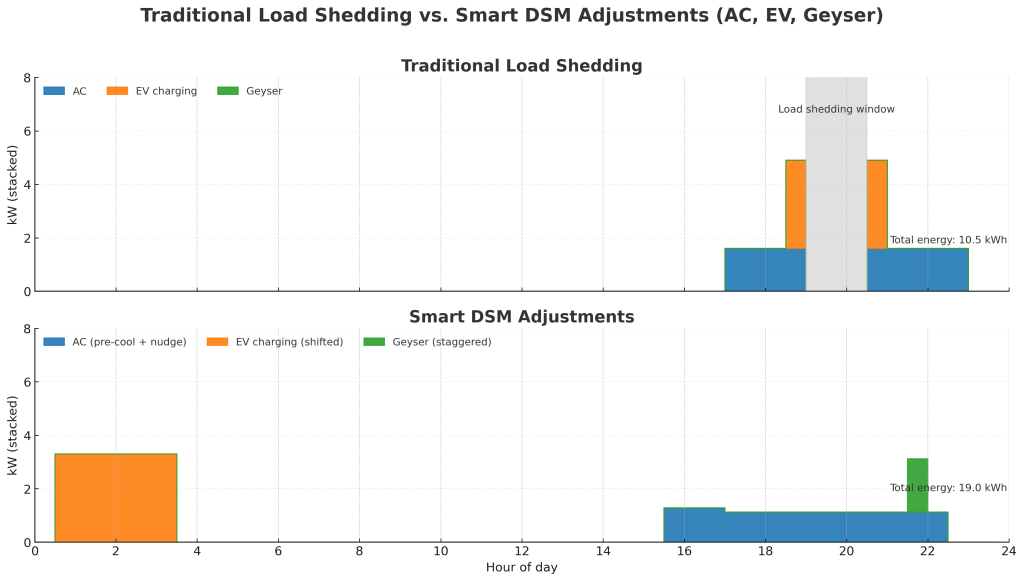
DSM helps discoms avoid cuts by shaving load peaks intelligently
A Practitioner’s Toolkit for Indian Homes
From a field engineer’s view, DSM in India is taking shape through three key building blocks:
- Smart Meters: The foundation. These provide granular consumption data, enabling time-of-day tariffs and remote connect/disconnect. Discoms in states like Uttar Pradesh and Bihar already use them to identify peak usage clusters.
- Home Energy Management Systems (HEMS): Still nascent in India, but emerging in urban gated communities. These act as the “brain” for coordinating appliances.
- Controllable Loads: ACs, geysers, refrigerators, EV chargers, and rooftop solar-battery hybrids are the big levers. Even small shifts - like delaying a geyser or EV charging - can ease stress on the system.
The approach is simple:
- Price-based DSM: Time-of-Day tariffs nudge consumers to shift usage (for example, cheaper tariffs at night).
- Incentive-based DSM: Communities or households allow utilities to control certain loads in exchange for rebates.
The challenge in India? Making this trustworthy and simple so consumers see real value and don’t feel “controlled” by the discom.
Results Emerging on the Ground
The numbers from early pilots are promising:
- Household bills: Smart thermostat and load-shifting pilots in Delhi NCR communities showed 10–15% reductions in monthly bills.
- Discom savings: Peak demand reductions of 8–12% during evening hours, helping avoid costly spot-market purchases.
- Reliability: Communities with DSM pilots reported fewer outages compared to neighboring feeders.
- Integration with renewables: Rooftop solar coupled with battery + DSM is reducing diesel genset reliance in high-end apartments.
For Indian discoms struggling with financial stress, these savings can be the difference between debt and stability.
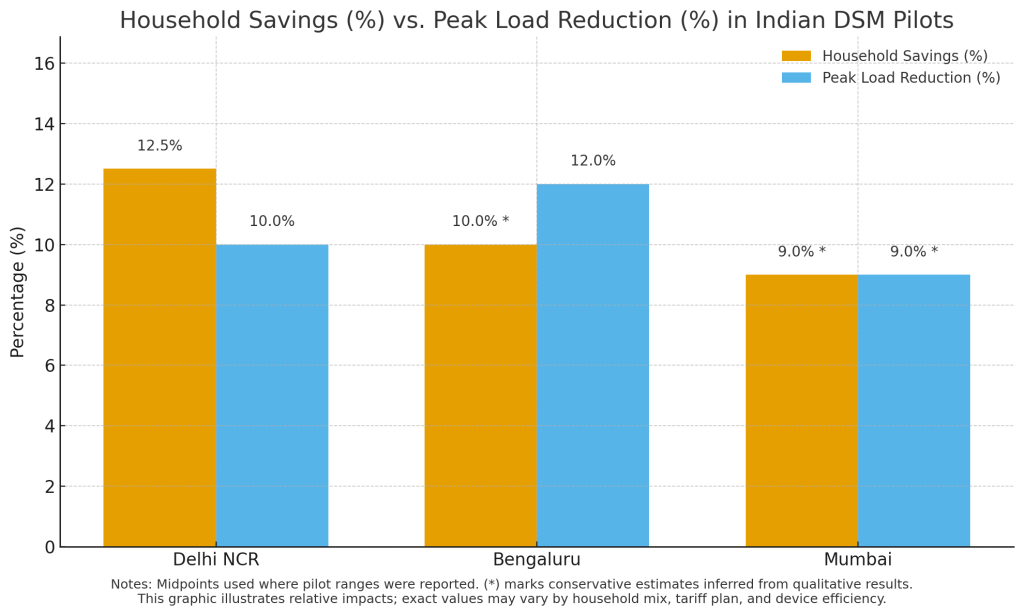
Pilot projects show DSM can deliver both consumer relief and discom resilience
Lessons from the Trenches
As practitioners, a few lessons are clear:
- Trust is everything. Many Indian consumers fear “remote control” of their appliances. Transparency, easy opt-outs, and visible savings are key.
- Interoperability matters. In India, devices come from multiple vendors. If HEMS and appliances don’t talk seamlessly, adoption stalls.
- Affordability drives adoption. Middle-class households won’t buy expensive smart devices unless discoms or state programs subsidize them. Programs like RDSS and the SMNP rollouts are critical enablers.
- Reliability is non-negotiable. A smart meter or HEMS that fails even once can make users distrust the entire program. Stability must come first.
Looking Ahead
DSM in India is no longer just a pilot experiment - it’s entering mainstream conversations. Time-of-Day tariffs have already been notified in several states, and smart meter rollouts are accelerating.
But scaling DSM will depend on three things:
- Awareness: Households need to understand not just the “what” but the “why” of DSM.
- Incentives: Unless customers feel tangible savings, enthusiasm will fade.
- Integration: Rooftop solar, EV chargers, and batteries must be tied seamlessly into discom operations.
The grid of the future in India won’t be built by utilities alone. It will be co-created - one household, one RWA, one community at a time - with DSM as the glue between consumer comfort and grid resilience.
“DSM in India is not just about saving rupees - it’s about keeping the lights on when it matters most.”
Excellent breakdown of scope 1, 2, and 3 emissions
Extremely appreciated Nikhil! 📖
Excellent information on emission intensity!
Appreciate you taking the time! Super insightful
This makes net zero planning clearer. ✅
Appreciate it Rajesh! 🔄
Excellent information on renewable targets! This will help with our climate goals 🌞
Fantastic perspective on carbon reduction!
Thank you! That means a lot
Thanks for the clear sustainability metrics. 🔋
Thanks Neeraj for highlighting sustainability pathways
Thank you Sumit!
Love this Neeraj, seeing this focus on environmental impact. 🌍
Excellent analysis of energy metrics Neeraj! 📊
Thanks Ritika!
Thanks Neeraj for breaking down the energy metrics! This will help with our climate goals 🔋
This makes sustainability goals more achievable. 💪
Thank you for reading!
Really appreciate the renewable energy insights
Thank you Aarti!
Appreciate the focus on decarbonization strategies
Thanks Ashwin! 💫
Love this Neeraj, seeing this focus on environmental impact. 🌍
Glad it helped Sanjay!