
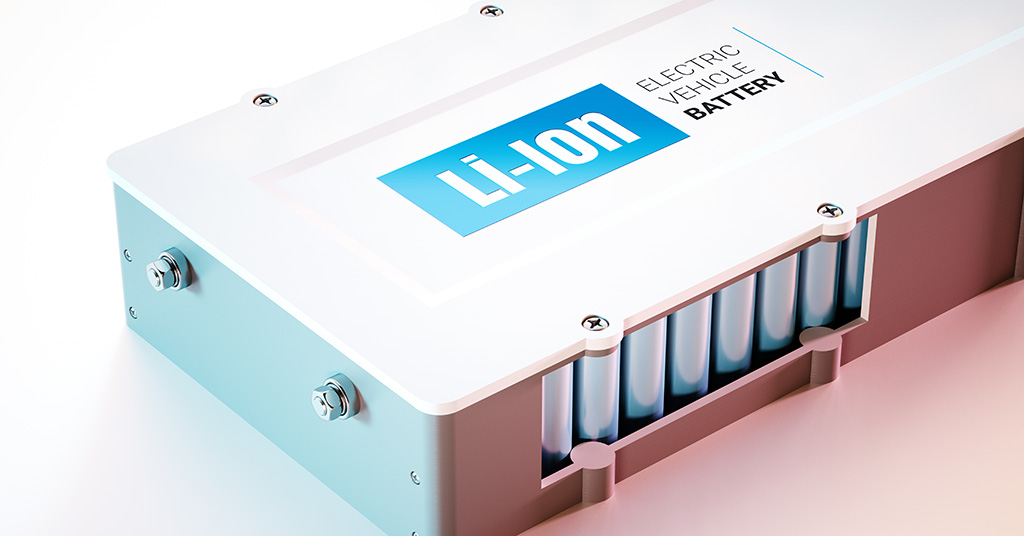

This section continues from “LiFePO₄ Batteries: Securing India’s Energy Future with a Safer, Smarter Charge,” picking up where chemistry and project execution meet end-of-life strategy.
Context at a Glance
If LiFePO₄ is the chemistry that makes storage safer and longer-lived, second-life batteries are the operating model that makes the whole system smarter. India’s EV push will leave us with a steady stream of packs retiring from vehicles over the next few years. We can scrap them or give them a second career stabilising the grid, shaving peaks, and backing up communities. When capex is scarce and demand is jumpy, reusing assets we already own is simply good engineering and even better economics.
Understanding the Second-Life Opportunity
EV Batteries: More than First-Life Power
By the time an EV pack is pulled from a vehicle, it usually retains ~70–80% of its original capacity. That’s not ideal for fast acceleration, but it’s excellent for stationary duty cycles—charge at midday, discharge in the evening, repeat. The upshot: second-life batteries (SLBs) turn what looks like a waste stream into a dependable storage fleet.
Second-life sits squarely in the circular playbook—reduce, reuse, recycle—without skipping steps. We sweat the asset twice, then recover materials. Fewer imports, less e-waste, more delivered kilowatt-hours per tonne of minerals.
Policy Backbone
India’s Battery Waste Management Rules (2023) with Extended Producer Responsibility (EPR) shift end-of-life from an afterthought to a design constraint. For SLBs, that’s ideal: clearer custody, proper diagnostics, traceability, warranties that mean something. Link this with LiFePO₄ strategy and got chemistry + compliance working in tandem.
Global Trends, Local Timing
EV numbers have rocketed globally, so a wave of end-of-vehicle-life packs is inevitable. For India, the timing is useful: our dual-peak demand (sunny afternoons and post-solar evenings) cries out for mid-duration storage. Second-life can slot into precisely those hours, especially when paired with LiFePO₄’s safety and cycle life.
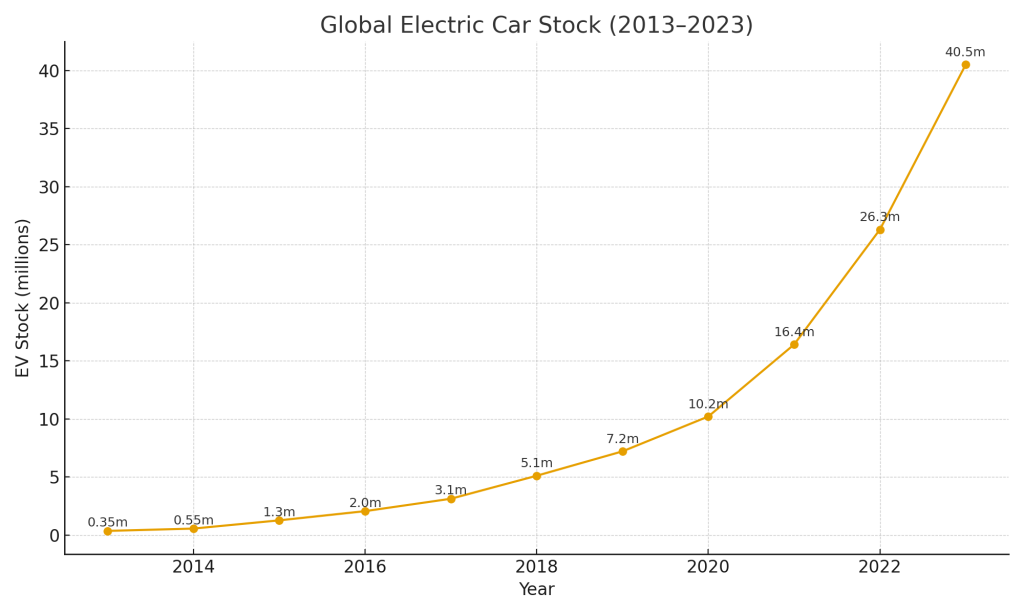
Global EV growth today = second-life storage supply tomorrow
Stakeholder Impacts
DISCOMs: From Headwinds to Hedge
The LiFePO₄ primer showed why safer chemistries matter. SLBs add the cost angle. Together, they help DISCOMs:
- Shift energy from solar-heavy afternoons to evening peaks;
- Smooth renewables and cut curtailment;
- Provide fast response for frequency nudges and contingencies.
With 500 GW renewables targeted by 2030, SLBs are not “nice to have”. They’re the shock absorbers for a more weather-shaped grid.
Industry Players: Two Lives, More Revenue
For automakers and cell makers, second-life means selling storage twice. Retired packs become BESS for grid, C&I, and community microgrids, especially compelling where safety (LiFePO₄) and predictable cycling matter more than energy density.
We have already see the direction of travel:
- MG Motor India × Lohum × Vision Mechatronics on second-life BESS;
- Tata Power pilots with AES and Mitsubishi;
- JSW × MG Motor replacing diesel gensets with battery UPS.
The business model is maturing: collect → grade → repurpose → warranty → operate.
Communities and Consumers: Access Without Diesel
Because SLBs can land 30–50% cheaper than new packs, rooftop solar + storage and rural microgrids become viable without defaulting to diesel. Small size shops and hospitals or health Clinics, schools, and other small offices get benefit first while households follow as tariffs and reliability improve.
Opportunities and Risks
Strategic Opportunities
- Lower delivered cost: Reuse slashes capex per usable kWh and improves LCOE.
- Resource security: Fewer critical-mineral imports per unit of service delivered.
- Cleaner backup: Displaces gensets, cuts local air and noise pollution.
- Market upside: A credible path to a $1 billion domestic second-life market by 2030, compounding with new-build BESS.
Key Challenges
- New-pack price declines: SLBs must compete on total value, not sticker price.
- Standards and safety: Grading (SoH), pack reconfiguration rules, and fire-safety protocols are non-negotiable.
- Data poverty: No state-of-health history, no bankability, hence the push for digital IDs.
- Informal handling: Untracked flows erode trust and environmental outcomes.
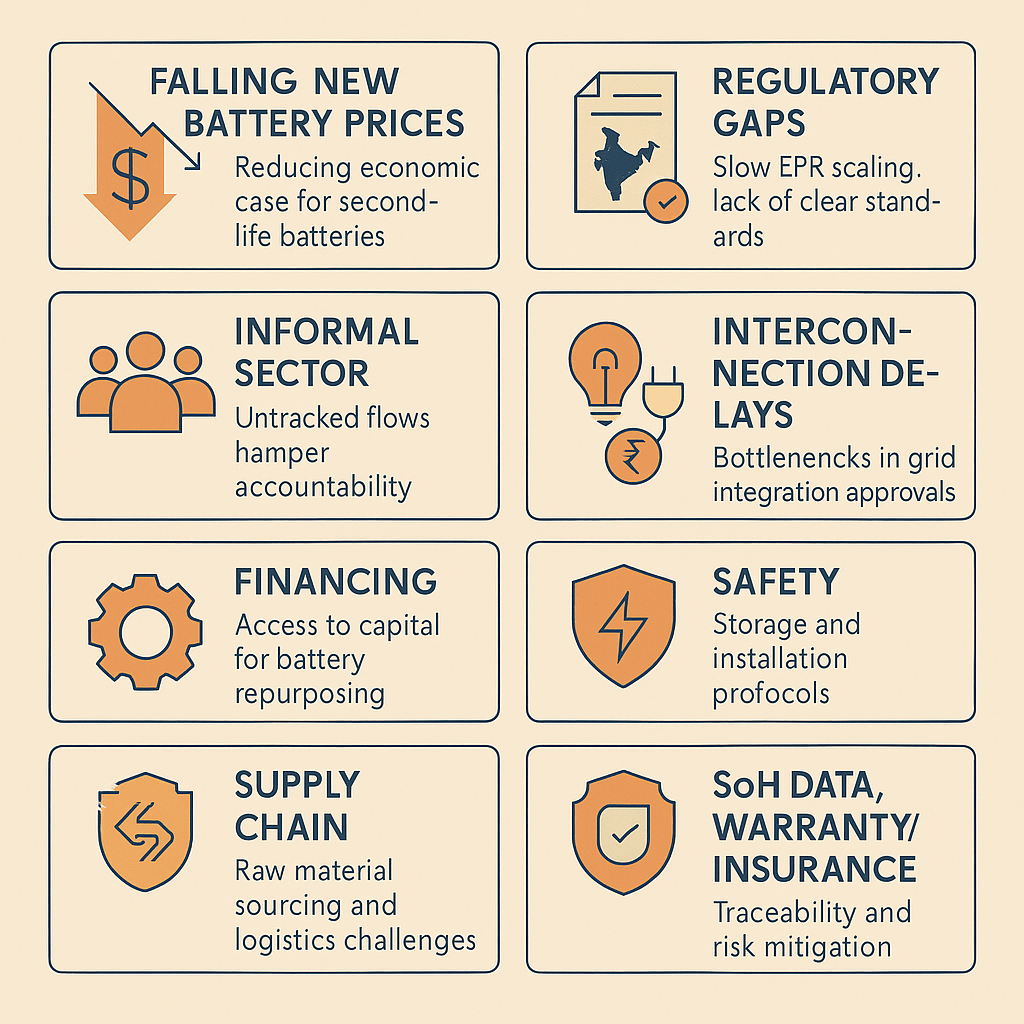
Risk factors infographic
Strategic Recommendations (Building on Your LiFePO₄ Playbook)
1) Make EPR Actionable, Not Aspirational
- Battery Aadhaar: Unique digital IDs capturing chemistry, usage, SoH, service history.
- Chain-of-custody APIs: Let OEMs, refurbishers, lenders, and utilities verify provenance in seconds.
- Early-action incentives: Credit multipliers or tax relief for formal collection and certified repurposing now, not only post-2027.
2) A National Diagnostics Network
- Accredited SoH centres: Common test protocols; uniform grading (A/B/C) mapped to duty cycles (grid/C&I/residential).
- Warranty architecture: Standard forms for second-life warranties tied to grades and operating envelopes (DoD, C-rates, temperature).
- Insurance enablement: Underwriters need data and standards; give them both.
3) Safety and Interconnection
- BIS SLB addendum: Adapt existing standards for repurposed packs and LiFePO₄ chemistries.
- Fire safety playbooks: Layouts, spacing, ventilation, detection, suppression—pre-approved templates cut project friction.
- Plug-and-play LV/MV skids: Standard interconnection kits accelerate substation and C&I deployments.
4) Financing and Business Models
- OPEX/ESCO contracts: Pay for availability and performance, not hardware.
- Arbitrage + services stacking: Day-ahead spread + primary/secondary response + T&D deferral.
- Concessionary capital: First-loss guarantees to crowd in private debt for early portfolios.
5) Pilot, Replicate, Scale
- Replicate what works: Extend utility pilots across feeders with the sharpest evening ramps.
- Community templates: Pre-baked designs for clinics/schools with LiFePO₄ SLBs.
- Open playbooks: Share wiring, EMS tuning, warranty terms, and O&M checklists.
Emerging Applications (Designed Around India’s Dual Peaks)
- Grid-Scale Storage
Frequency control, peak shaving, renewable smoothing.
Example: Tata Power pilot BESS with Mitsubishi. - Residential & Commercial Backup
Sensible backup for homes, offices, SMEs.
Example: MG Motor–Lohum pilot improving rural reliability. - Rural Microgrids
Solar + SLB for off-grid/weak-grid areas.
Example: Nunam Energy’s integrated rural centres. - Industrial & Telecom Backup
Swap diesel gensets for quieter, cleaner storage.
Example: ReLive batteries at a JSW facility in Pune. - EV Charging Infrastructure
Reduces costs for fast-charging stations in underserved area
Implementation Tips
- Right-size first, optimise later: Start with the evening 3–4-hour window; add capacity as spreads and services justify.
- Thermal discipline: Shade + airflow beat expensive cooling for most Indian sites with LiFePO₄.
- EMS rules you actually use: Simple dispatch: charge 10:00–15:00, hold reserve, discharge 18:00–22:00; layer frequency response only after you stabilise revenues.
- Spare modules on site: Second-life fleets shine when swaps are quick. Keep 5–10% module spares.
- Measure what matters: Track round-trip efficiency, EFCs (equivalent full cycles), cell delta-T, and degradation per MWh dispatched—not just nameplate.
The Horizon: Key Takeaways
- Chemistry sets the floor; strategy sets the ceiling. Your LiFePO₄ base gives safety and long life; second-life turns that into system-wide value.
- Data is bankability. Without a digital trail (SoH, provenance, usage), scale will stall.
- Templates beat one-offs. Standardised diagnostics, safety layouts, warranties, and interconnection kits cut soft costs—the real enemy of BESS.
- Move now, learn fast. Pilot on the feeders with the nastiest evening ramps, publish the playbooks, and iterate.
Do that, and India won’t just survive the dual-peak era, it will make it boring, predictable, and affordable. That’s the real test of a modern grid, and second-life batteries-paired with LiFePO₄ are how we pass it
Love this Neeraj the emphasis on renewable deployment. ⚡
Extremely valuable Shruti! 🧮
Really appreciate this focus on sustainability.
Really thoughtful Akash!
Really appreciate the focus on renewable energy. ♻️
This helps us understand our carbon journey. 🌱
Thanks Simran! 🎨
Thanks Neeraj for breaking down the energy metrics! This will help with our climate goals 🔋
Thanks Neeraj for the clear decarbonization pathways
Very insightful! Very thoughtful
Appreciate the focus on energy efficiency gains
Thank you Sumit!
Fantastic insights on emission management!
Glad it was useful!