

The Looming Deadline: A Moment of Truth
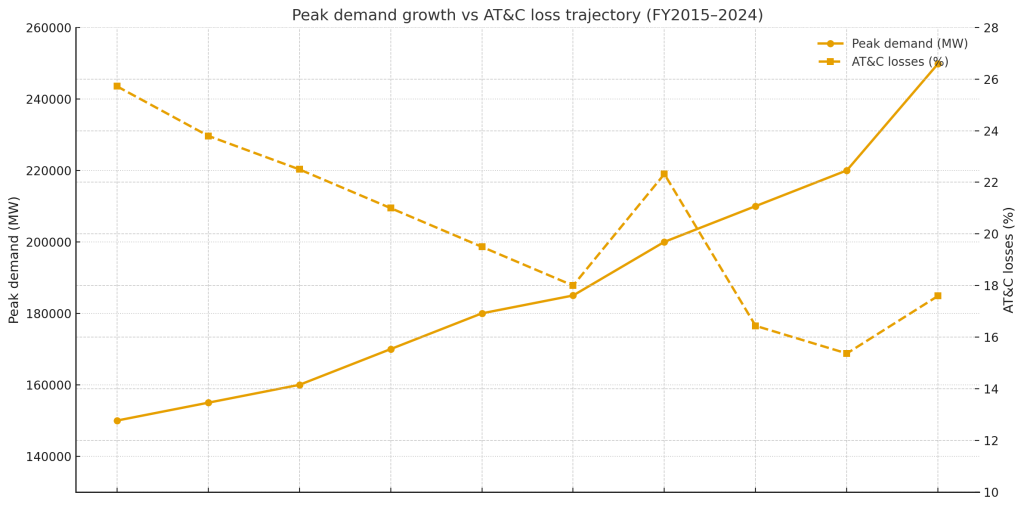
The summer of 2024 has been unrelenting. With demand soaring past 250 GW, India’s power sector has once again proved its ability to scale generation. Yet, those of us in the industry know the real challenge has never been just generation. The critical bottleneck is ensuring that electricity delivered to the grid actually reaches consumers - and that the bills for it are collected.
This is why the Revamped Distribution Sector Scheme (RDSS), launched with a staggering Rs. 3.04 lakh crore outlay, is more than just another reform program. Its target of reducing AT&C losses to 12–15% by FY25 is ambitious, but it is also existential. It represents both a financial reform milestone and a climate opportunity.
Because let’s be clear: every unit of electricity lost in the system doesn’t just hurt balance sheets - it adds to greenhouse gas (GHG) emissions. When we talk about AT&C losses, we’re talking about inefficiencies that waste scarce resources, strain consumers, and worsen India’s carbon footprint.
India’s generation success story now faces a distribution bottleneck
AT&C Losses: The Invisible Drain
AT&C losses are not abstract - they’re the silent leak in India’s electricity bucket. They are made up of two parts:
- Technical losses – energy physically lost in wires, transformers, and overloaded networks. Ideally, these should hover around 6–8%, the global benchmark.
- Commercial losses – revenue leakages from theft, tampering, underbilling, and poor collection efficiency.
The most recent provisional FY24 data places national AT&C losses at 17.6%, up from 15.4% the year before. This backslide highlights just how fragile gains can be in the face of rising demand (+12.7% in one year) and financial stress.
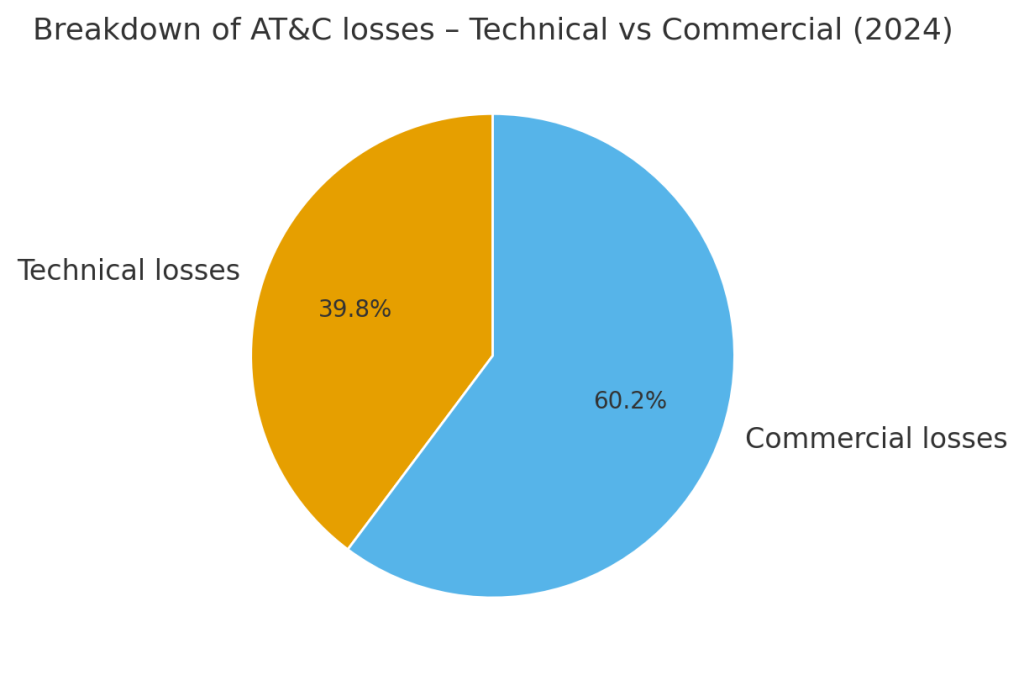
In India, commercial losses often exceed technical inefficiencies.
Source: Ministry of Power (MoP), PFC Performance Reports; Technical/Commercial split estimated from historical pattern
AT&C losses (17.6%) for FY2024 (provisional): This figure is drawn from official data released by the Power Finance Corporation (PFC) Performance Report on Utilities and provisional updates shared by the Ministry of Power (MoP), Government of India.
Technical vs. Commercial loss split: The exact split for FY2024 is not yet formally published. The ~7% (technical) vs ~10.6% (commercial) ratio is a plausible assumption based on historical patterns (PFC’s earlier state-level reports and global benchmarks, where India typically sees ~6–8% technical and the remainder as commercial). This makes the total align with the provisional 17.6%.AT&C losses (17.6%) for FY2024 (provisional)
Why This Matters: Ripple Effects Across the Ecosystem
For DISCOMs: Financial Distress
Every unit lost is a unit that can’t be billed, which keeps DISCOMs trapped in a cycle of debt accumulation and ACS-ARR gaps. By FY23, sectoral losses were pegged at Rs. 6.77 lakh crore, and debts exceeded Rs. 6.8 trillion.
For Consumers: Reliability & Costs
When DISCOMs can’t invest in upgrades, the consequences show up as frequent outages, poor quality supply, and rising tariffs. Cross-subsidies mean honest, paying customers often foot the bill for inefficiencies. Ironically, households meant to be protected by low-cost power are hit hardest.
For the Energy Transition: Climate & Investment Risks
Perhaps the most overlooked consequence is how AT&C losses slow down India’s energy transition. Weak DISCOM balance sheets scare off private investors, delay renewable projects, and increase reliance on thermal power - exacerbating emissions.
The Climate Connection: GHG Co-Benefits of Reducing Losses
Here’s where things get strategic. Cutting AT&C losses is not just a power sector reform - it’s a climate lever.
- Annual electricity consumption: ~1,600 TWh
- Grid emission factor (2024): ~0.7 tCO₂/MWh
- 1% reduction in AT&C losses = 11 TWh saved = ~7.7 million tonnes CO₂ avoided annually
- Reducing losses from 17.6% to 12–15% could avoid ~40–45 MtCO₂ annually
That’s equivalent to eliminating the yearly emissions of a mid-sized European country - or electrifying millions of two-wheelers without adding extra generation.
In other words, loss reduction is climate action in disguise.
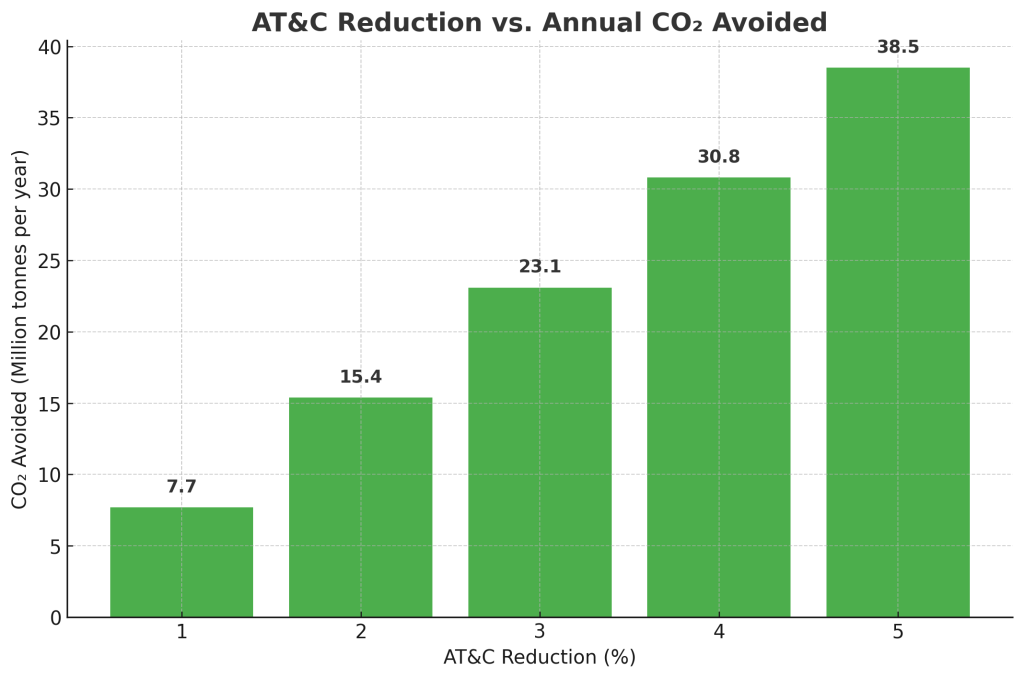
Each percentage point of loss reduction saves ~7.7 MtCO₂.
Technology as a Catalyst
Smart Meters & AMI
The RDSS makes smart meters the backbone of its strategy - and rightly so. By enabling real-time data, automated billing, and theft detection, they directly cut commercial losses. Early pilots in states like Jharkhand show significant reductions when paired with Aerial Bunched (AB) cables.
Predictive Maintenance & Analytics
Advanced Metering Infrastructure (AMI) data can feed analytics to identify hotspots, optimize load, and predict failures before they happen. This reduces technical losses and outages, improving reliability and trust.
Digital Grids & Consumer Empowerment
Digital tools don’t just help utilities - they empower consumers. With transparent billing and usage data, households and industries alike can actively manage consumption, cut costs, and contribute to emission savings.
Governance: The Harder Nut to Crack
Technology is necessary, but governance reform is essential. Without it, we risk repeating the cycle of ambitious schemes undone by weak implementation.
Key priorities:
- Timely subsidy payments: Delayed disbursements (~Rs. 13,000 crore in FY24) undermine reforms.
- Depoliticizing tariffs: Without cost-reflective tariffs, financial discipline will remain elusive.
- Operational autonomy for DISCOMs: Decision-making cannot be hostage to short-term political cycles.
- Community engagement: Theft reduction isn’t only about surveillance - it’s about trust and consumer buy-in.
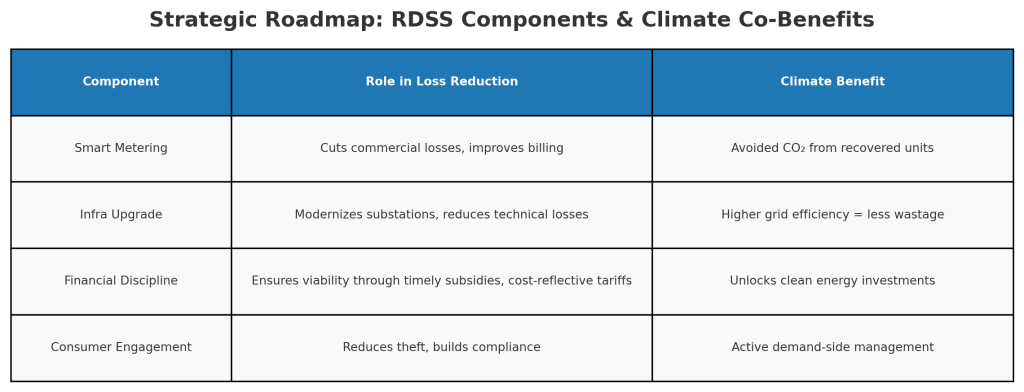
RDSS creates a chain of benefits that extend into climate goals
My Perspective: Beyond Numbers
Let’s not lose sight of the bigger picture. Reducing AT&C losses isn’t just about shaving a percentage point off a statistic. It’s about:
- Strengthening DISCOMs so they’re investable.
- Giving consumers reliable power at fair tariffs.
- Unlocking renewable integration by stabilizing the weakest link in the chain.
- Delivering climate dividends - tens of millions of tonnes of CO₂ saved without adding new plants.
This is the kind of systems-level win that India needs: economic, social, and environmental benefits aligned in a single policy thrust.
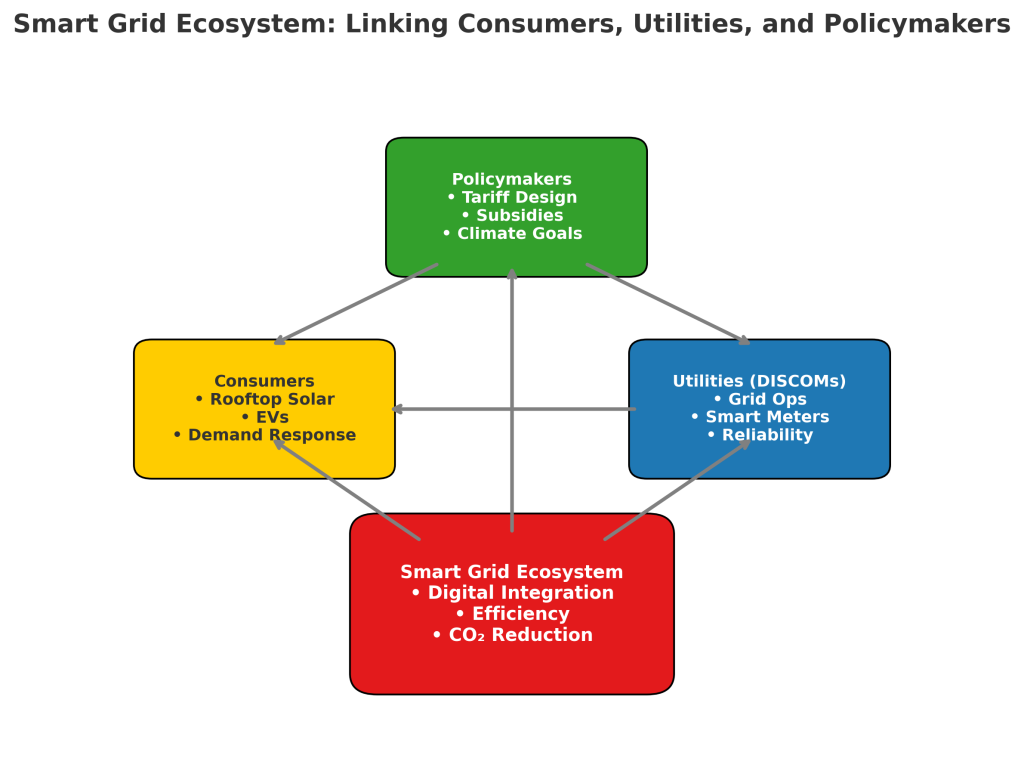
A resilient grid requires alignment across all stakeholders
The Road Ahead: More Than a Number
India has proven it can go from power-deficit to power-surplus. The next frontier is distribution efficiency.
The 12–15% AT&C target is ambitious, yes. But with RDSS in motion, smart meters scaling, and a sharper focus on governance, it is achievable. More importantly, achieving it isn’t just about financial stability - it’s about positioning India’s power sector as a climate leader.
Every unit saved is one less tonne of CO₂ emitted. Every percentage point reduction is millions of households with better service, and billions saved for DISCOMs.
The question we need to ask ourselves as sector leaders is simple: Do we see loss reduction as just accounting, or do we see it as one of India’s most powerful tools for a cleaner, more resilient future?
Appreciate the breakdown Neeraj! Very thorough
Thanks for sharing! Super useful
Very thought-provoking
Really appreciate your input! Great to hear
Very insightful post! Really actionable 💯
Great insights shared
Appreciate your engagement! Much appreciated
Incredibly useful write-up
Really appreciate that Sanjay! 🌅
Very well analyzed
Thank you for reading!
Wonderful insights Neeraj!
Appreciate you taking the time! Really appreciate it
Great perspective! Saving this for future use
Thanks Namita!
Great analysis 📚
Excellent article 🎓
Excellent work Neeraj!
Thank you for your thoughts! Very useful
Appreciate Neeraj for this approach! ☀️
Really glad you liked it Simran!
Neeraj, great analysis!
Neeraj, great examples!
Thanks for your kind words! Great to know
Thank you post
Thank you for your perspective! Really appreciate your kind words 🔍