

Tripura already has the bones of a modern power system , robust interstate and cross‑border links, a reform‑minded utility, and a roadmap that keeps affordability and reliability on equal footing. Below is a clear, walk‑through of where things stand today and the practical strategy to deliver the Vision on the ground.
Where we stand today
1) Economy and demand
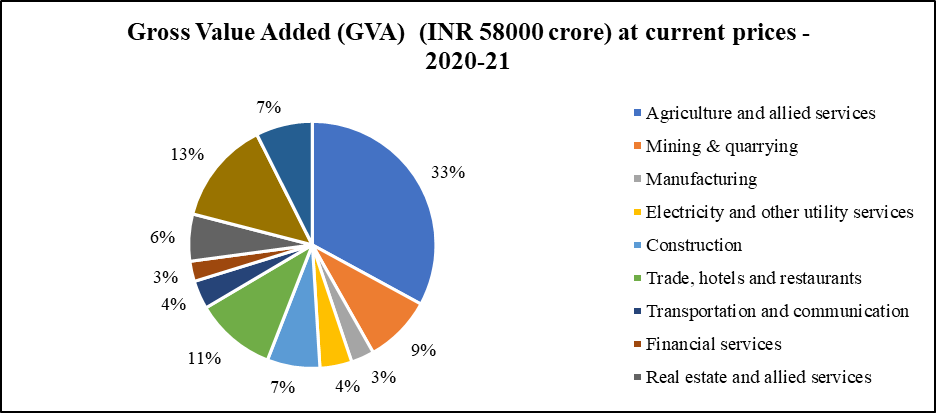
Tripura’s economy has been gathering pace, crossing the sixty‑thousand‑crore mark in FY22 with a strong year‑on‑year jump. Agriculture still leads the state economy, but policy is steadily nudging industry forward through measures like capital subsidies, concessional power for eligible units above twenty horsepower, and dedicated industrial areas and export parks. Electricity use has been climbing, though a bit slower than income, which signals headroom to grow access and reliability as new factories and services take off. Seasonal patterns matter too: demand typically softens in the high‑irrigation months and rises from spring into the monsoon, a curve that shapes how Tripura plans generation and trade.
2) Generation and supply mix
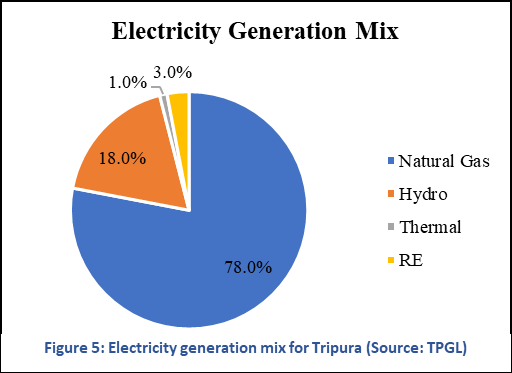
Tripura is still gas‑heavy. Natural gas provides the bulk of generation; hydropower contributes a meaningful share; renewables have started to register but from a small base. Many gas units run in open‑cycle mode—quick to build, but less efficient than combined‑cycle plants. Converting those machines to combined‑cycle operation delivers a step‑up in efficiency and lower emissions per unit of power. The pinch point is fuel: gas availability has constrained legacy plants and slowed new ones, which is why the roadmap couples gas‑fleet efficiency upgrades with a push for State‑owned solar (including floating solar) and other clean sources. Upstream and pipeline developments in the North‑East are important context for that shift.
3) What power costs today
Price signals already favour clean energy. Solar contracted through central agencies is cheaper than the average rate of long‑term purchases; floating solar is competitive; and State‑owned hydropower beats many external allocations. The more Tripura leans into low‑cost, State‑owned generation, the more room there is to moderate the average cost of supply and strengthen utility finances.
4) Transmission backbone
For a small state, Tripura’s grid punches above its weight. It operates dozens of substations with significant transformation capacity, enjoys strong connectivity across the North‑East, and has a working cross‑border interface. Modernisation is ongoing—replacing aging gear, upgrading protection with numerical relays, and planning ring‑main configurations for urban centres so single faults don’t black out entire neighbourhoods. A further round of new lines and substations, reconductoring, and OPGW on key corridors is in the pipeline to support load growth and the power trade that keeps tariffs in check.
5) Distribution and customers
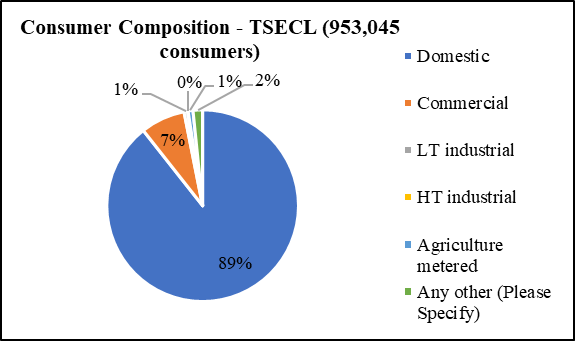
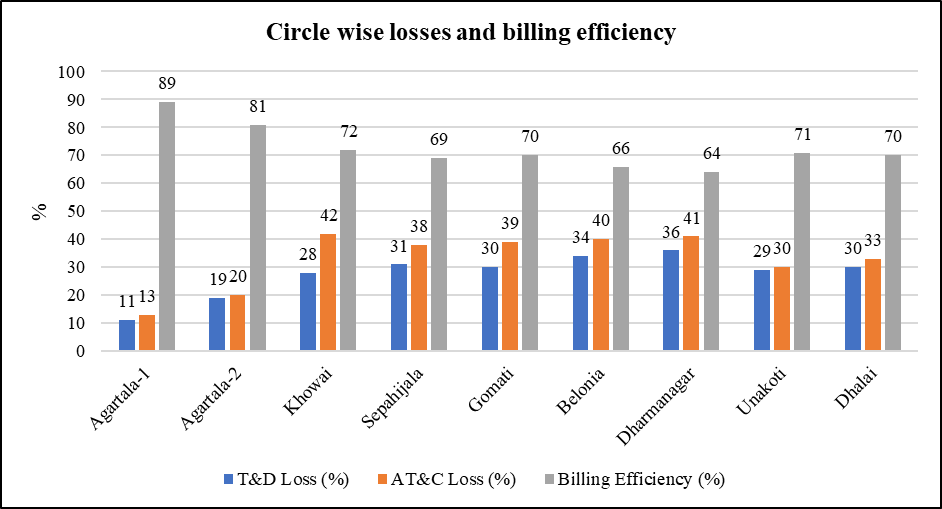
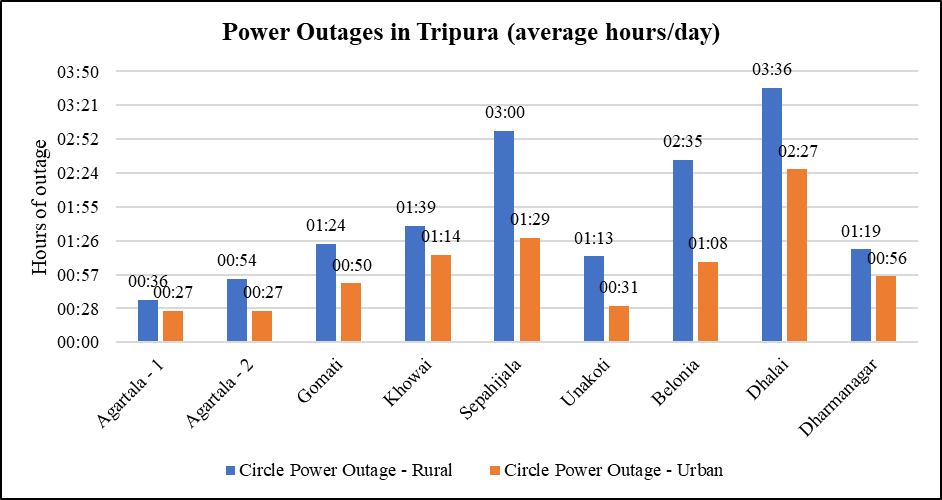
This is where citizens feel the sector. TSECL serves just under a million metered customers, and like most Indian DISCOMs the base is predominantly domestic. The network is wide, thousands of kilometres at 11 kV and low‑tension but the challenge is quality: AT&C losses sit around the thirty‑percent mark, with several circles recording both high technical losses and weak billing efficiency. Outages are longer in rural pockets than in cities. The upside: modernisation works. In Agartala, a smart‑grid pilot with advanced meters and improved billing processes delivered measurable gains—tens of millions of rupees from loss reduction and a similar figure from better billing over four years—proving that the right technology and process mix pays back.
6) Trade and tariffs
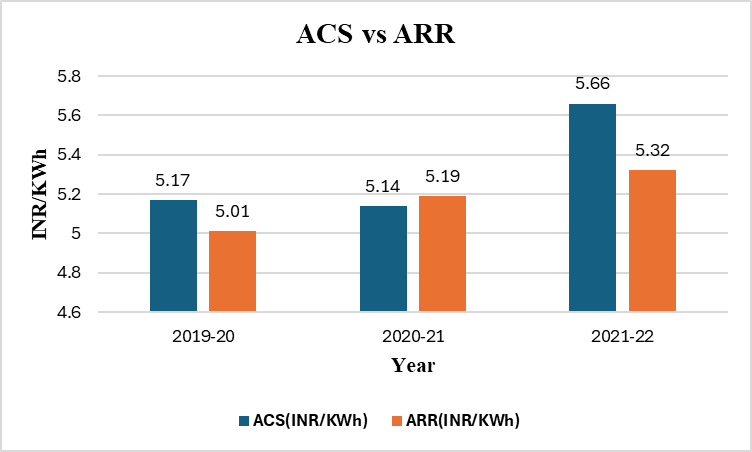
Trade is already a shock‑absorber for Tripura. Exports to Bangladesh on a round‑the‑clock basis generate steady revenue under a tariff with annual escalation. When interstate and cross‑border trade are counted, the ACS–ARR gap shrinks dramatically compared with intra‑state sales alone. Seasonality helps: Tripura faces peak shortfalls in the pre‑monsoon months, while Bhutan and Nepal tend to see winter deficits—banking power across borders smooths both sides of the ledger.
What success looks like by 2030
A supply stack that’s cleaner and cheaper, anchored by State‑owned renewables and more efficient gas. A sturdier transmission network that doubles as a trading highway. A distribution utility that has trimmed losses to the low‑teens and made outages rare, even in storm‑prone districts. And a digital layer—smart meters, geospatial mapping, grid automation, analytics—that keeps the system honest and nimble. That’s the Vision in practical terms.
How we’ll get there : the strategy pillars
To keep this practical, the steps below describe what to do and how to do it, not fixed megawatt counts or rupee figures. The only numbers shown reflect the current status you just read.
Pillar 1: Stop revenue leakage and improve power quality where it actually happens - the last mile
Losses in Tripura are a mix of network and process.
Network: weak conductors, long low‑tension spans, overloaded transformers, and unbalanced phases waste energy as heat.
Process: defective or bypassed meters, “door‑lock” and “zero‑consumption” billing that drifts for months, and arrears that harden into bad debt.
The solution starts with disciplined identification and then consistent execution. Pilot work in Khowai and neighbouring subdivisions offers a playbook:
Target high‑loss feeders and theft‑prone pockets. Replace bare conductor with AB‑cable where hooking and snapping are common, and rebalance phases and spans where voltage droops. Prioritise spots where technicians and meter readers flag persistent issues; field intelligence is often faster than dashboards.
Get the basics of billing right. “Door‑lock” and “zero‑consumption” cases should trigger standard field workflows—notice, photo‑verified self‑reading or supervised access, correction of billing status if the connection is temporarily disconnected or if the meter is defective, and a clear path to replacement and regularisation. Under‑billing flags deserve quick investigation for bypass, multiple connections at the same premises, or snapped service wires. Each situation has a distinct resolution code and a time‑bound path to close. This simple, repeatable discipline lifted assessed energy and collections in the pilot areas.
Treat collections with nuance, not just disconnections. Segment unpaid consumers by tenure and outstanding dues; run outreach and collection camps; offer realistic instalment plans once the first payment is made; and fix the utility‑side errors that often underlie non‑payment—wrong readings, defective meters left in place, or irregular billing. Create a separate track for government consumers, where the payment path and approvals differ from a retail shop or a household. The goal is to turn “never paid” into “paying again” without turning every case into a confrontation.
Make the network visible. Map feeders, distribution transformers and low‑tension spans in a GIS; capture the health of poles, conductors and joints; keep single‑line diagrams current; and show all of that on a live dashboard. Once the digital map exists, preventive maintenance can be scheduled, sagging spans after a storm can be spotted, and crews can be dispatched on data rather than guesswork. When smart meters scale up, AMI‑on‑GIS lets engineers see where losses spike and which assets or neighbourhoods are driving them.
Bring in simple but high‑leverage tech. Drones and infrared cameras catch hot spots before they become outages. Outage Management Systems (OMS) stitch together customer calls, crew dispatch and restoration. Distribution Management with Volt‑VAR keeps voltage steady as rooftop solar grows. Mobile workforce tools close the loop without paperwork. These measures are already in Tripura’s roadmap—the task now is disciplined rollout across districts, backed by standard checklists and monthly impact reviews.
Pillar 2: Build a home‑grown portfolio of low‑cost renewables—and make it grid‑ready
Clean power is not just greener; in Tripura, it’s cheaper than many alternatives. The State has ample solar potential, and its many lakes and reservoirs make floating solar a natural fit. Grid‑scale plants can lower the average cost of supply, while rooftops let homes, schools, hospitals and businesses shave daytime draw. The programme should do both, with:
- a single‑window process for rooftop approvals;
- clear interconnection standards so projects move quickly;
- early storage on feeders that serve hospitals, water works and emergency services; and
- a straightforward path for public bodies to host systems on public land and water.
Integrating this new supply is as important as building it. As rooftop and distributed solar grow, voltage on lightly loaded lines will swing more during the day. Volt‑VAR optimisation, feeder‑level capacitor control and smart inverters keep things stable. Over time, peer‑to‑peer pilots on select feeders can let neighbours trade surplus rooftop power under a regulatory sandbox. Consider virtual power plant aggregators to bundle many small systems and offer balancing services to the grid. None of this requires exotic technology—just steady standards, consumer‑friendly processes and a utility that can see what is happening on its network in near‑real time.
Pillar 3: Make gas plants cleaner, more efficient and ready for the long haul
Gas will remain part of Tripura’s mix for reliability and inertia. The efficiency win is straightforward: convert open‑cycle gas turbines to combined‑cycle wherever technically and commercially viable. In parallel, work with upstream companies on gas‑grid strengthening so plants are not starved of fuel, and commit to new capacity only after fuel certainty is locked in. Where waste‑heat recovery makes sense, capture it. The result is fewer emissions and a better heat rate, which shows up directly in the cost of supply.
Pillar 4: Strengthen the backbone—and use it as a trading highway
The transmission plan already recognises the need for new corridors, substation augmentation, reconductoring and fibre. Prioritise ring‑main supply for Agartala, build redundancy for remote districts, and keep protection modern with numerical relays and condition‑based maintenance. The same backbone underpins trade: flexible corridor capacity lets Tripura sell when prices are attractive and buy when that’s cheaper than running local plants.
Pillar 5: Trade smart so tariffs stay predictable
Trade is the quiet hero of Tripura’s recent turnaround. Exports to Bangladesh generate stable cash flows under a transparent formula, while domestic market sales and banking deals dramatically reduce the effective gap between cost and revenue. The next step is to systematise this: a standing desk that tracks market prices, hydrology in Bhutan and Nepal, seasonal demand in the North‑East, and maintenance calendars across plants. With that situational awareness, the utility can line up seasonal banking, optimise bids on power exchanges, and renew cross‑border contracts in ways that stabilise bills for consumers.
Pillar 6: Run the utility like a modern service business
Technology only works if the organisation does. Tripura’s process re‑engineering effort laid out the basics: clarify roles from meter reader to division manager; equip every subdivision with a daily pendency dashboard; standardise complaint capture; use official email and ERP consistently; and keep quality‑control formats for surveys, asset mapping and consumer indexing. Add a training plan tied to the roadmap—engineers on ADMS and OMS, revenue teams on analytics and collection strategy, linemen on AB‑cable practices and live‑line safety. These are not glamorous tasks; they are the routines that turn a plan into a reliable service.
What this means for people and businesses
Fewer blackouts, better voltage.
Storms and tree‑fall may be part of life in a forested state, but they shouldn’t mean hours in the dark. Undergrounding in vulnerable urban pockets, AB‑cable in theft‑prone stretches, and automatic reclosers on feeders can turn long interruptions into brief blinks. Volt‑VAR control keeps motors and household appliances happier, especially on long rural lines. Over time, the mix of better conductors, smarter switching and data‑driven maintenance makes “no power” a rare complaint.
More predictable bills.
When more electricity comes from low‑cost, State‑owned plants and when trading is used deliberately, the overall cost of supply is steadier. Add smart meters—no estimated bills, fewer disputes, easier payment—and the monthly bill becomes both more predictable and easier to manage. The Agartala pilot showed how better metering and billing can materially lift revenue without tariff shocks; scaling that lesson statewide benefits everyone.
A grid ready for investment.
Industrial estates and logistics hubs need power that doesn’t blink and voltage that holds its line. The strengthening underway, the focus on ring‑main supply for cities, and priority feeders for growth centres make that possible. When the grid is strong and the utility is digitally competent, it’s easier to anchor new industry—from food processing and rubber goods to future green‑hydrogen demand—because energy stops being the constraint.
Real benefits at the last mile.
For remote hamlets, a reliable microgrid means evening light for study, refrigeration for vaccines, and power for basic machines. For farmers, solarised pumps mean water on demand without diesel bills. For municipal bodies, solar plus storage on water‑works feeders keeps taps running through faults. These are day‑to‑day improvements in quality of life and local productivity.
A phased run plan (what happens when)
Near term: fix what bleeds and build the data spine. Replace defective and stuck meters. Regularise door‑lock and zero‑consumption cases using the standard field‑to‑billing playbook. Prioritise AB‑cabling and reconductoring in theft‑prone and weak pockets. Stand up GIS mapping for feeders and distribution transformers and link it to a live dashboard. Begin city‑scale smart metering and pilot drones and infrared inspections. Push a few shovel‑ready solar projects, including floating systems on suitable water bodies.
Middle stretch: scale what works. Expand smart meters to major districts and integrate meter data with billing and outage systems. Roll out Distribution Management with Volt‑VAR and an Outage Management System across high‑load circles. Grow rooftop and distributed solar with a single‑window portal and standardised interconnection. Add storage on critical feeders. Keep reconductoring and substation augmentation moving so the physical network strengthens in step with demand. Increase cross‑border and domestic trade activity with a dedicated analytics desk.
End of the decade: finish the transformation. With losses down and systems integrated, TSECL can operate more like a Distribution Network Operator: orchestrating distributed energy resources, enabling demand response for larger customers, and supporting more complex market participation as policy allows. New technologies Tripura is exploring—floating solar at scale, geothermal pilots where the geology permits, and green hydrogen for industry—move from feasibility to operation as the grid and the workforce mature.
Risks and how to de‑risk them
Fuel risk. Gas supply has been the Achilles’ heel. Don’t build new gas capacity until supply is firm, and prioritise efficiency upgrades on plants already running so they need less fuel for the same output. Keep a diversified portfolio with storage‑backed renewables so no single constraint can topple the plan.
Weather risk. Heavy rain and storms punish overhead lines. That’s why the program leans on undergrounding in cities, AB‑cable where spans are vulnerable, and faster fault isolation with reclosers and sectionalisers. Drone/IR inspections after major weather make restoration faster and safer.
Execution risk. Smart meters, GIS, ADMS, OMS—none is plug‑and‑play. The fix is governance: a clear program management office with weekly milestones; standard operating procedures for field teams; quality‑control formats for asset mapping and consumer indexing; and monthly impact assessments. The pilot work has already produced templates and checklists. Institutionalise them.
Financial risk. Capital is scarce and tariffs are sensitive. Sequence projects that save money early—meter replacement, AB‑cabling in high‑loss pockets, floating solar on public land—so savings can co‑fund the next tranche. Optimised cross‑border and domestic trading narrows the cost–revenue gap and reduces pressure for large tariff jumps.
People risk. Any transformation stands or falls on people. Job roles must be crystal‑clear, incentives aligned to the scorecard, and training continuous. Consumer communication matters too: when people know how to pay digitally, where to lodge a complaint, and what to expect during a meter change, resistance falls away.
The bottom line
Tripura’s Vision is neither vague nor utopian. The State knows its demand curve, understands where money leaks out of the system, and has already tested solutions that work from smart meters to AB‑cable, from cross‑border trading to rooftop solar. The path to success is a sequence, not a slogan: fix the last mile; scale clean, State‑owned generation; harden the backbone; trade smart; and run the utility with the discipline of a modern service business. Do that, and by the time the decade closes, the everyday experience of power in Tripura—at home, at work, and in the farthest hamlet—will match the promise of the Vision.
Really useful for sustainability metrics
This makes energy planning more strategic. 🔋
Much appreciated Akash!
Love seeing data on energy conservation. 💚
Great resource for clean energy transformation Neeraj!
Appreciate it Deepak!
Great perspective on clean energy transition! 🌱
Love! Really appreciate your thoughts
Fantastic breakdown of emission factors! 📉
Thanks! Really insightful
Great breakdown of energy transition pathways! 💡
Thanks for your insight! Really appreciate you
This is crucial for understanding our carbon footprint. 📊
Thank you Ashwin!
Excellent breakdown of renewable deployment! This aligns with our decarbonization plans ⚡
Very valuable! Glad you enjoyed it