

Why This Matters More Than You Think
Let’s be honest - the way we’ve priced power in India hasn’t really changed in decades.
We still treat electricity like it’s a flat commodity, sold at one rate, regardless of when you use it. Morning, night, summer peak, monsoon lull — same rate, same logic.
But here’s the catch: electricity isn’t the same at every hour. It’s dirt cheap when the sun is blazing and solar farms are spilling electrons onto the grid. And it’s painfully expensive and often polluting ,when everyone comes home at 8 p.m. and flips on the AC.
That’s where Time-of-Day (ToD) tariffs come in. They don’t just tweak your bill; they rewrite the entire story of how India uses energy.
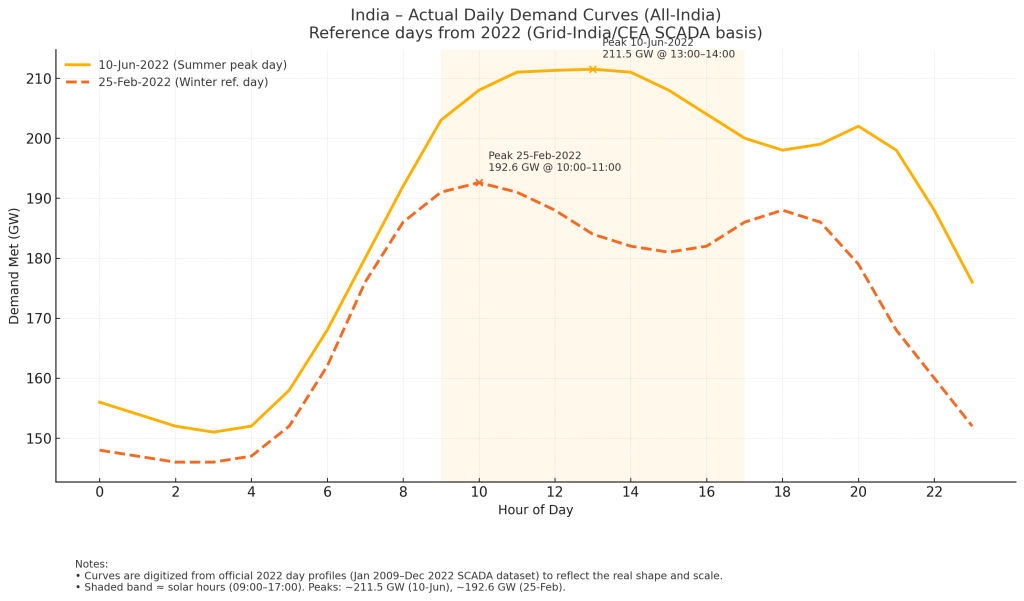
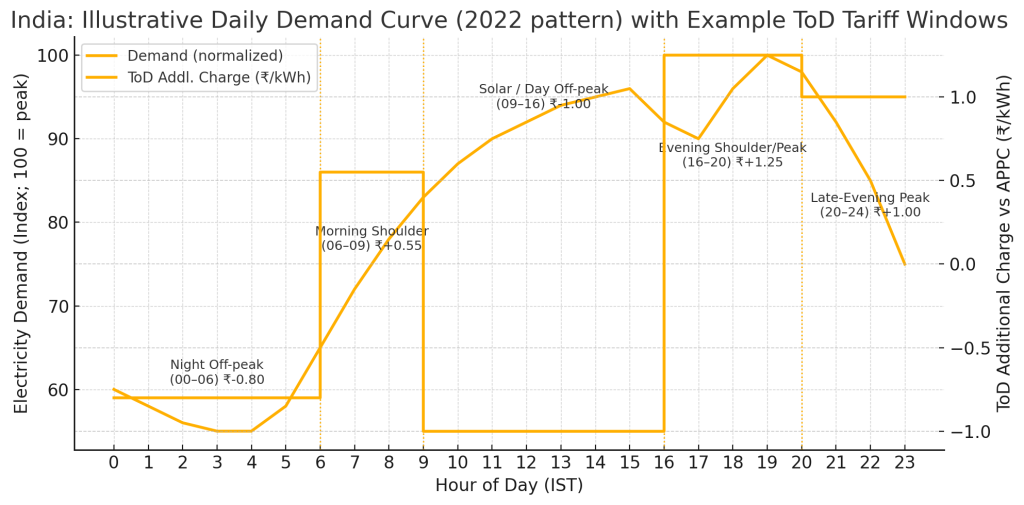
Note: This is an illustrative national demand shape with real (Dec‑2022) ToD windows from Maharashtra to show how price signals can line up against the grid’s daily rhythm.
The Context: Why Now?
India’s grid is groaning under the weight of its own success. Power demand has shot up. Renewables are everywhere. And DISCOMs ,the lifeline of India’s power sector are still juggling debts, technical losses, and political price pressures.
Historically, we’ve had what you could call a “polite fiction” of pricing. Consumers paid roughly the same rate all day. For now, utilities quietly struggled during peaks but specially evening peaks, buying short-term power at a very high prices or compel to firing old and inefficient plants for power generation.
It’s not viable, both economically and environmentally.
Now, think upon a system where electricity prices breathe with the sun. When solar power floods the grid at noon, tariffs drop. As evening descends, rates climb, signalling consumers to shift non-essential loads. It’s not a gimmick; it’s a market mechanism that reflects reality.
Countries from Japan to the U.K. have used ToD pricing to smooth out peaks. For India, the case is even stronger as India has the world’s fastest-growing solar capacity and one of the most stubborn evening peaks.
If we don’t manage demand intelligently now, the entire renewable transition risks slowing down.
What’s in It for Whom?
Let’s cut through the policy jargon and talk straight.
1. For DISCOMs — Finally, a Path to Sanity
For India’s distribution companies, ToD tariffs aren’t a luxury but they’re survival tools.
Every evening, DISCOMs face a brutal squeeze: buying expensive power to meet peak demand, only to sell it at regulated, lower tariffs. That’s not business; that’s charity with consequences.
ToD tariffs can change that game.
By stimulating demand to shift toward a cheaper, off-peak hours, DISCOMs can make their load curve flatten and can decrease the need of purchasing high cost power. That means fewer late-night panic procurements, better forecasting, and a fighting chance at financial stability.
But it won’t be easy. The tech backbone — smart meters, dynamic billing, real-time data — has to keep up. Otherwise, we’ll end up with policy ambition outpacing implementation (again).
2. For Industry — A Hidden Competitive Edge
If you run a factory, a data center, or even a large office complex, ToD tariffs are basically a mirror. They reflect how efficiently you operate.
Energy-intensive sectors like cement, textiles, metals can save a fortune simply by rescheduling non-critical processes to off-peak hours. Some forward-looking companies are already pairing automation with solar + storage setups to ride those lower midday tariffs.
Here’s the real opportunity: turning compliance into strategy.
Instead of groaning about new billing structures, industries can position themselves as pioneers in “flexible energy management.” Think ESG brownie points and bottom-line wins.
3. For Consumers — Small Shifts, Big Impact
Most households won’t see massive savings right away, but ToD tariffs do something subtler , they build awareness. They make people to change their consumption pattern.
Picture this: Running their washing machines and irons at 12:00 noon -2:00 p.m. instead of 6:0 0p.m. to 9:00pm.Charging EV during lunch hours when solar energy is available in plentiful amount. You charge your EV during lunch hours, when solar energy is abundant. Multiply that behaviour across a million homes, and suddenly, the grid starts breathing easier.
That’s the future we’re talking about a participatory grid where consumers aren’t passive ratepayers but active energy citizens.
The issue is-Consumers want clarity but not complexity.
The Balancing Act: Risks, Realities, and Roadblocks
Let’s not romanticize it — ToD tariffs sound elegant in theory, but the rollout will be messy.
The risks?
- Patchy metering infrastructure could derail implementation.
- Households may resist change if price signals aren’t communicated clearly.
- Lower-income families, with limited flexibility in usage patterns, might feel unfairly hit.
That’s the uncomfortable truth: every energy transition has growing pains. It’s rarely fair at the start — balance comes later, once systems catch up.
But there’s a silver lining. These very challenges can force better design. Tiered communication, pilot programs, and progressive tariff slabs can protect vulnerable users while still nudging behavior. The answer isn’t to abandon ToD — it’s to execute smartly.
Lessons from Abroad — and a Word of Caution
Globally, ToD tariffs have worked — when the groundwork was solid.
California’s “time-based pricing” saw peak demand drop by up to 8%. Japan’s consumers embraced late-night appliance use decades ago. Even South Africa uses flexible pricing to manage its fragile grid.
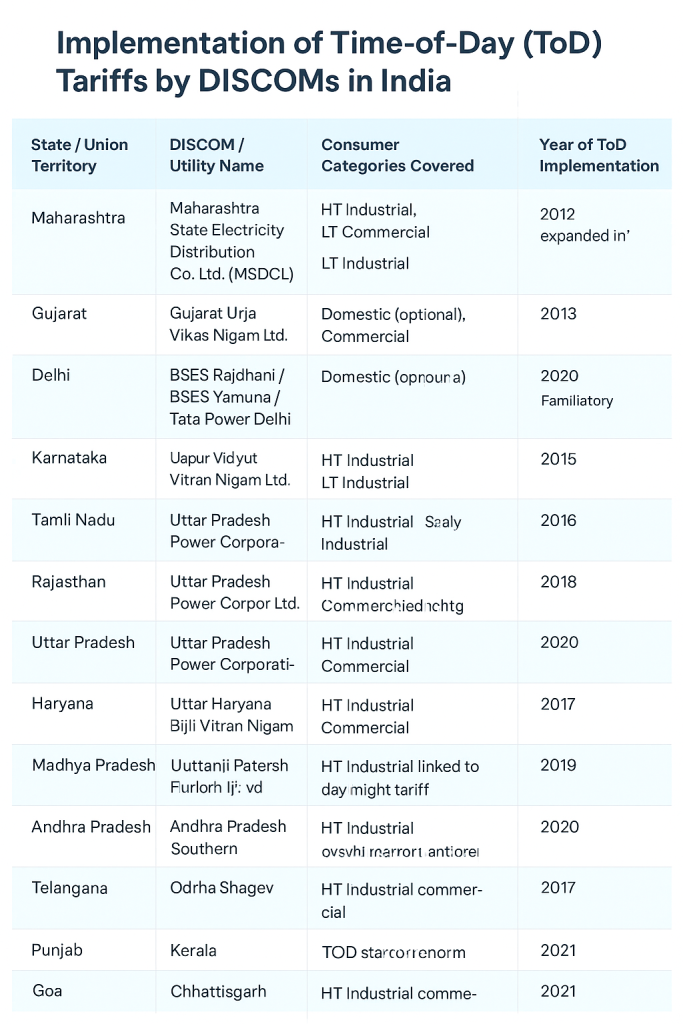
India’s far too complex for cookie-cutter solutions. Different states, different realities. If we try to force a uniform model, it’ll crack. The smarter path? Regional strategies shaped by local needs
We’ll need regional customization, not blanket mandates. Urban Gujarat’s consumption profile is nothing like rural Assam’s. The price signal must speak in local dialects — literally and metaphorically.
A Word to the Wise: For Leaders and Policymakers
Let’s be clear — ToD isn’t just a tariff tweak. It’s a strategic instrument for managing the energy transition.
Policy leaders should frame it not as “billing reform” but as energy orchestration — where every consumer, every business, and every grid operator becomes part of a synchronized system.
DISCOMs need confidence, not compliance fatigue. Businesses need to see ToD as a cost-saving lever, not an audit trap. And regulators? They need to lead the narrative — not chase it.
This is India’s moment to modernize consumption, not just generation.
Quick Takeaways for Strategic Audiences
- ToD tariffs turn consumers into active grid participants.
- Smart meters are non-negotiable.
- Industry can profit from flexibility.
- Communication is half the policy.
- ToD is not about bills — it’s about balance.
Strategic Insight: Why This Policy Deserves Real Urgency
Look, we can debate the details — metering, phasing, exceptions — all day. But step back for a second.
The global energy shocks of 2022 revealed how brittle centralized systems can be. Prices spiked, supply chains buckled, and the idea of “stable” electricity suddenly felt quaint.
India is not in the position to wait for perfection. Every delayed policy, every pilot project stuck in bureaucratic limbo, costs us flexibility — and resilience.
ToD tariffs won’t solve everything. But they’re a start. A real, tangible step toward a grid that responds, not just reacts.
Closing Thoughts: The Price of Inaction
If we don’t get this right now, we’ll be paying for it — quite literally — for years.
ToD tariffs are not about complicating your electricity bill. They’re about building intelligence into the system. A system where price signals guide behavior, efficiency replaces waste, and renewables finally fit neatly into the grid puzzle.
The energy transition isn’t just about how we produce power — it’s about how we value it.
Neeraj, really engaging!
Thanks! 🌟
Will definitely implement this
Thank you Nisha! 👍
Great write-up 🔄
Thanks for being here! Really appreciate your thoughts
Amazing post! Great examples
Thanks for reading and commenting!
Really helpful article Neeraj!
Extremely appreciated Sanjay!
Brilliant explanation Neeraj! 💡
Appreciate your engagement! Much appreciated
Excellent breakdown Neeraj!
Very insightful! Very thoughtful
Really enjoyed post! Very well researched
Thank you Rohan!
Great flow
Incredibly useful insights! Really easy to follow
Thanks Neeraj for this helpful post! Bookmarking for future reference
Appreciate your engagement Mohit!
Wonderful information! Great tips
Really thoughtful Vikram!
Great content
Thanks for being here! Super valuable