

A grid on the edge and an opportunity hiding in plain sight
Let’s be blunt: India’s grid is living on borrowed time. As the sun sets on every evening and millions of people switched on their lights, fans, coolers and ACs ,the grid's stability distributes . Solar has flooded our afternoons with abundance, but when twilight hits, that abundance vanishes. The system suddenly needs flexibility, not capacity.
We’ve built generation faster than we’ve built intelligence. Power plants we have; coordination we don’t. And here’s the truth the industry quietly knows that without flexibility, renewables are like an orchestra without a conductor. Everyone’s playing beautifully, but together? Chaos.
The flexibility dilemma -when the sun sets, the strain begins
India’s success in electrifying 99 per cent of households is a miracle, no doubt. Yet the new challenge isn’t connection, it’s control. Rooftop solar floods feeders at noon, then disappears by dusk. Wind behaves like a moody artist, brilliant one day, absent the next.
So, what happens? DISCOMs are already in big losses & debt but they are bound to purchase very costly power at absurd rates during the peak hours to fulfil the demand of their consumers through short term power purchase agreements. Consumers blame tariffs; policymakers blame subsidies. Meanwhile, the grid just wants a breather.
The answer isn’t more steel and concrete. It’s smarter coordination. That’s where Virtual Power Plants (VPPs) quietly step in.
What is a Virtual Power Plant?
Think of a VPP as the grid’s brain not another smokestack. It’s a digital network of scattered small distributed energy resources that is controlled by smart software and functions like a single power plant.
Imagine a network ,having thousands of small solar generation rooftops ,batteries ,EV chargers, chillers installed in plants and factories which are connected and communicate with each other through a smart software, certainly cloud based. A VPP communicates ,forecasts and guides them like a master. It supports in decision making like when to charge, discharge or pause any unit.
No new concrete. No giant turbine. Just orchestration.
Behind the scenes, it’s three layers deep:
- Aggregation : pooling hundreds of assets into one logical unit.
- Communication : using IoT, AMI, and secure data channels for two-way talk.
- Control & Dispatch : algorithms deciding when to charge, release, or curtail.
That combination can stabilise frequency, shave peaks, and even sell power back into markets without anyone building a single new plant.
Why Grid Flexibility Is Now Non-Negotiable
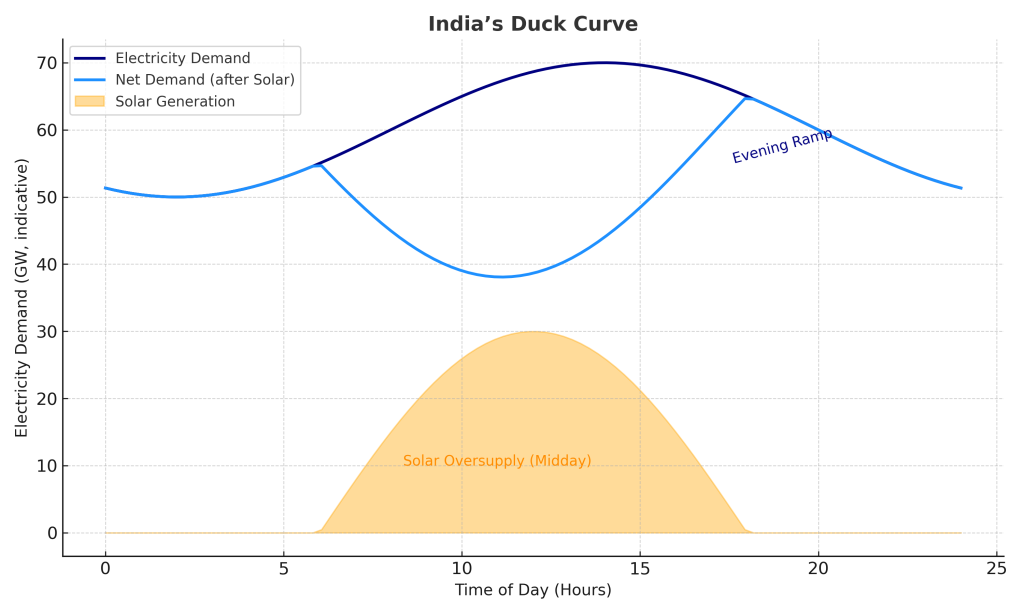
Think upon the “duck curve” everyone talks about. This is not a fancy theory but It’s a real problem. Solar generation is at its peak when demands is less while during the peak demand no solar generation becomes available. The gap that awkward belly of the duck has to be filled, fast.
Batteries can help, sure, but large-scale storage is still pricey. Gas peakers? Too dirty and politically touchy. VPPs, on the other hand, use what we already have. They make distributed chaos behave like disciplined power.
And let’s not forget the DISCOMs, India’s most overworked and underpaid public servants. With rooftop solar eating into their revenue base and reverse flows frying transformers, they need new tools, not just new reprimands. VPPs give them control, visibility, and whisper it a new revenue streams.
Lessons from abroad and what we shouldn’t copy blindly
Take South Australia. Thousands of homes with rooftop solar and Tesla batteries joined forces to form a single, dispatchable entity. When the grid faltered, these homes didn’t blink; they stabilised it. The result? Lower bills, cleaner supply, happier consumers.
Germany , where industrial plants, biogas units, and storage combine under VPPs to bid into energy markets. They treat flexibility like a product, not a favour. Even hydrogen plants have joined the act, turning downtime into market gold.
But let’s not romanticise imports. India’s market structures, tariffs, and regulatory mazes are… let’s say, uniquely Indian. We can’t just copy Europe’s rulebook. Our VPPs will have to survive messy metering data, inconsistent feeder upgrades, and a patchwork of state policies that often contradict each other by lunch.
Why India’s perfectly imperfect ecosystem is ideal for VPPs
Oddly enough, India is ready for this. We’ve already got millions of distributed assets , from the rooftop solar and EVs to captive industrial generators. Smart meters? Rolling out. Cloud infrastructure? Cheap. Start-ups hungry to disrupt the sector? Everywhere.
What’s missing isn’t technology, it’s choreography. A nudge from regulators. A willingness from DISCOMs to experiment. Some honesty about what data belongs to whom.
If you step back, the economics are actually elegant. A VPP can turn under-used assets into active contributors, help DISCOMs shave peaks, defer substation upgrades, and lower procurement costs. For consumers, it’s bill credits and bragging rights , who wouldn’t want to say, my rooftop solar helped stabilise the grid last night?
The Hurdles Nobody Wants to Talk About
The reality is hard to ignore. The challenges are real, and most officials would rather avoid last-minute shocks.
Regulatory fog: Nobody quite knows where VPPs fit. Are they generators? Aggregators? Service providers? Unless regulators carve out market access - letting them bid into ancillary and balancing markets , innovation will stay in pilot purgatory.
Data paranoia: Millions of connected devices mean oceans of data. Who owns it? Who secures it? One breach, and public trust evaporates faster than a summer pond.
Tech fragmentation: Too many proprietary systems, too few standards. Unless we adopt open APIs and device certification norms, every aggregator will speak a different digital dialect.
People factor: Why should a small factory or household participate? Incentives must be visible, reliable, and frankly, simple enough to explain over WhatsApp.
None of these are showstoppers but together, they can stall a revolution.
A realistic playbook - how to make this real, not rhetorical
Here’s the pragmatic way forward not a dream sequence, but a do able script.
Phase 1 – Pilot and validate: Launch sandboxes pairing municipal rooftops, office complexes, and EV fleets. Keep it small, transparent, and measurable. Let aggregators prove value in controlled settings.
Phase 2 – Write the rules: Create interoperability standards. Define who a “VPP operator” legally is. Allow market participation through time-of-day pricing or capacity products that actually reward flexibility.
Phase 3 – Scale with confidence: Once pilots show savings and reliability gains, let aggregators compete regionally. Integrate VPP outcomes into distribution planning and this is key to open financing lines so aggregators can grow beyond one district.
We don’t need a thousand experiments; we need ten that actually finish.
The business side - who gains what
Follow the money, and you’ll see why this idea sticks.
- DISCOMs: Avoid costly peaker plants and network expansions.
- Aggregators & start-ups: Earn by optimising distributed assets and selling flexibility services.
- Industries: Monetise operational elasticity -delay a process, earn a payout.
- Households: Cut bills, maybe even earn credits.
Each stakeholder plays a role and gets rewarded differently, but united, they make the whole game more rewarding. The solution is to be transparent in revenue sharing so nobody feels cheated.
The broader payoff - changing how India thinks about energy
Beyond numbers and megawatts, VPPs could shift mindsets. They turn consumers into prosumers ,participants rather than passive bill-payers. Imagine neighbourhoods where homes, schools, and shops collectively stabilise voltage. Imagine factories that make money from not using power for an hour.
This isn’t utopian fluff. It’s how the next generation will see electricity such as participatory, digital, democratic. And as every DISCOM engineer knows, fewer peaker starts mean cleaner air, less diesel, and fewer headaches.
When energy becomes interactive, society itself learns resilience.
The bottom line — who’s holding the baton?
As of 2021, India already has the tech, the people, and frankly, the desperation to make Virtual Power Plants mainstream. What’s lacking is alignment ,regulators writing rules that enable, not inhibit; utilities brave enough to trust code over control rooms; financiers ready to back data-driven power instead of brick-and-mortar assets.
In the old grid, reliability came from a few big players. In the new one, it will come from millions of small actors , if someone conducts them well.
And that’s what a VPP really is a conductor. They may not grab attention or make headlines, but they’re vital. In India’s energy story, it’s not the big players working alone who will shape the future, it’s the way everything works together in balance.
Conclusions
India doesn’t have to start from scratch , the tools are already here. What we need now is to make them work together. Flexibility isn’t something extra anymore; it’s what keeps the power system alive. Virtual Power Plants may not be visible to the eye, but they’re set to become the quiet force that helps our grid run smoothly and breathe again.
Really appreciate this data on emissions reductions. ✅
Thanks Pooja!
Love this Neeraj, seeing this focus on environmental impact. 🌍
This is crucial for our sustainability strategy
This makes emission goals more achievable
Glad to! Really appreciate you engaging 📱
This helps clarify the path to net zero
Much appreciated! 🙌
Love the emphasis on clean technology
This is crucial for understanding our carbon footprint. 📊