

Powering a Growing Nation with a Green Grid
India is at a turning point in its energy story. Electricity demand is rising at one of the fastest rates in the world, while the urgency of moving away from fossil fuels has never been clearer. Over the past two decades, nearly 700 million citizens gained electricity access, a milestone of historic proportions but the challenge has now shifted: delivering reliable, clean, and affordable power for all.
The country has set bold renewable energy targets: 175 GW of renewable capacity by 2022 and 450 GW by 2030. These targets are ambitious but achievable - provided the supporting infrastructure keeps pace. That’s where the Green Energy Corridor (GEC) project comes in: a nationwide program to create a modern transmission backbone capable of integrating massive amounts of variable renewable power into India’s grid.
The GEC is not just about wires and towers. It is the connective tissue of India’s clean energy transition, ensuring that renewable power generated in deserts, coasts, and plateaus can actually flow into factories, homes, and cities that need it.
Why Grid Infrastructure Matters More Than Ever
India’s traditional grid was designed in an era when coal dominated. Large thermal plants located near coal mines fed predictable, centralized supply into the system. But renewables work differently.
- Geographically concentrated: Solar parks are located in sun-rich areas like Rajasthan or Gujarat, while wind is abundant in Tamil Nadu and Karnataka. Demand, however, is spread across industrial hubs and urban centers.
- Variable by nature: Solar output peaks at midday; wind is seasonal and unpredictable. Balancing this intermittency requires flexible transmission and storage.
- Decentralized growth: Beyond mega-parks, distributed renewable energy (DRE) is emerging at village and rooftop levels. This demands a grid that can handle two-way flows, not just top-down supply.
Without new transmission capacity, renewable projects risk becoming “stranded assets” - plants that generate clean electricity but cannot move it to consumers.
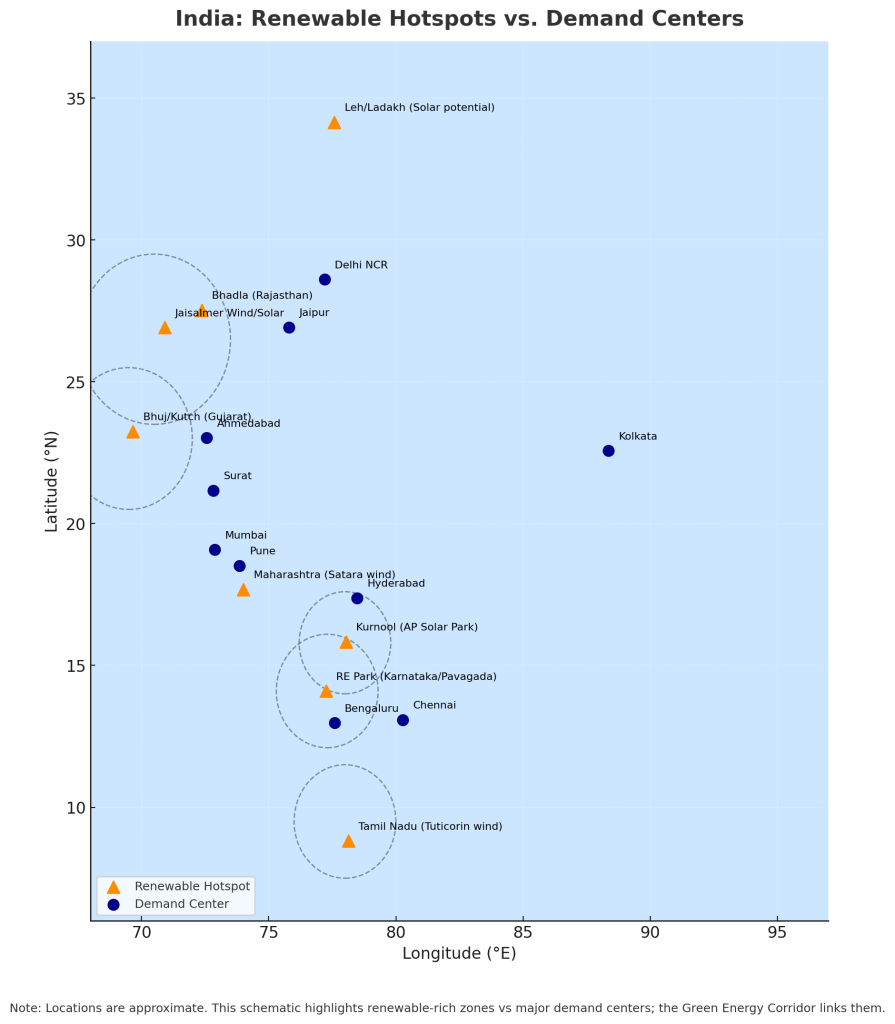
Renewable-rich regions (Rajasthan, Gujarat, Tamil Nadu, Karnataka) are far from major demand clusters. The Green Energy Corridor bridges this gap.
Current Challenges: The Barriers to Integration
Despite rapid renewable capacity growth, India faces multiple bottlenecks.
1. Variability and Grid Balancing
Solar and wind output fluctuate daily and seasonally. This makes “ramping” - quickly increasing or decreasing generation to balance the system - much harder. Renewable-rich states are already experiencing curtailment, where operators are forced to switch off solar or wind plants to stabilize the grid.
2. Financial Health of DISCOMs
Distribution companies (DISCOMs) remain the weakest link. With aggregate technical and commercial (AT&C) losses three times the global average, and a mounting debt burden, DISCOMs lack funds for grid upgrades or new investments. Their financial fragility directly affects renewable integration, as they delay payments to generators and struggle to commit to new contracts.
3. Inflexible Contracts
Many utilities are tied to long-term Power Purchase Agreements (PPAs) with coal plants. These “take-or-pay” contracts force them to buy power they don’t need, leaving little room for cheaper renewables. The rigidity of the market hampers renewable dispatch.
4. Land Acquisition and Right-of-Way
Transmission projects span thousands of kilometers. Each corridor requires land, permits, and local buy-in. Navigating fragmented land laws and community resistance often delays projects by years.
5. Coordination Across Institutions
Energy governance in India involves central ministries, state governments, regulators, utilities, and international financiers. Aligning these diverse players adds complexity to implementation timelines.
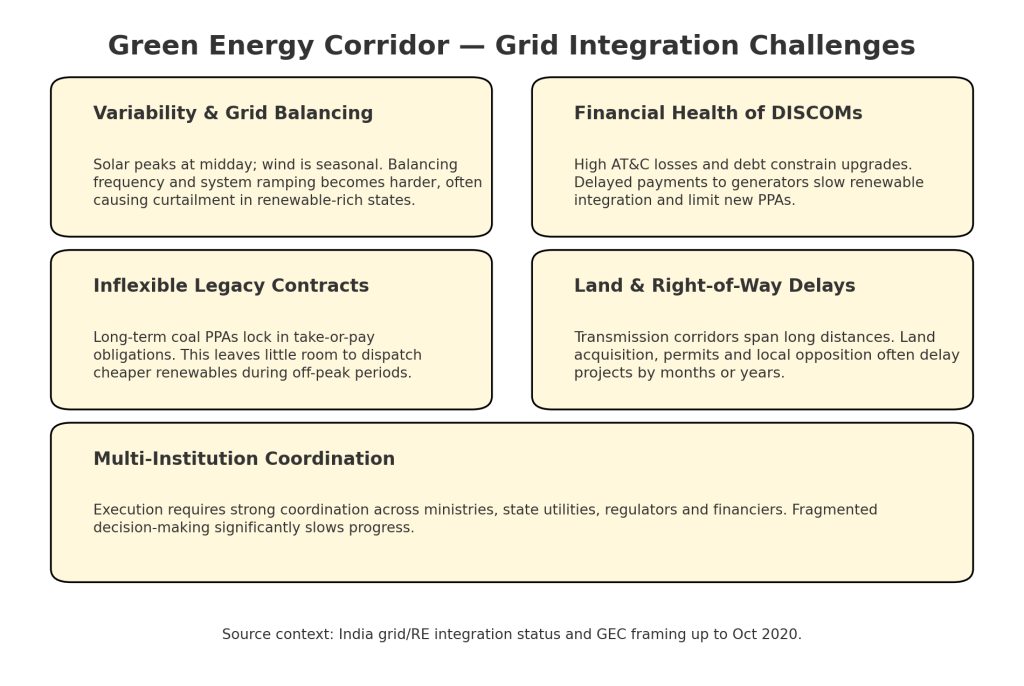
India’s renewable integration challenges span technology, finance, regulation, and logistics
The Green Energy Corridor Project: A National Solution
The Green Energy Corridor (GEC) is India’s flagship initiative to solve these bottlenecks. It aims to build a robust transmission backbone to integrate renewable energy seamlessly into the national grid.
Objectives of the GEC
- Synchronize renewable power with the grid to maintain stability
- Minimize curtailment of renewable generation
- Enable inter-regional transfer of surplus renewable power
- Strengthen both intra-state and inter-state networks
Two Dimensions of the GEC
- Intra-State Transmission Systems (InSTS):
Focused on renewable-rich states, InSTS expands local grids to absorb new solar and wind capacity. - Inter-State Transmission Systems (ISTS):
Connects renewable hubs with demand-heavy states. High-capacity links ensure that surplus renewable energy can flow nationally.
Phase I Targets (as of 2020):
- ~9,700 circuit kilometers (ckm) of transmission lines
- ~22,600 MVA of substation capacity
- Integration of ~24 GW of renewable capacity
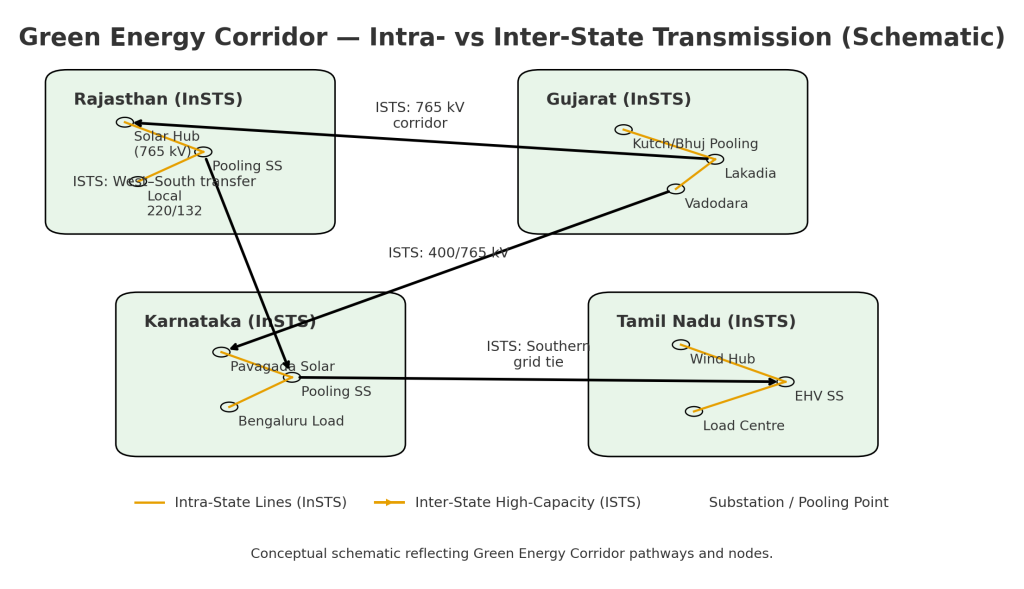
The GEC strengthens both state-level and national transmission systems, enabling renewable power to flow seamlessly across regions.
Financing the GEC
The financing model is as innovative as the engineering:
- 40% Central Financial Assistance (Ministry of New & Renewable Energy)
- 40% loan from KfW (German Development Bank)
- 20% equity from State Transmission Utilities
This tripartite model ensures risk-sharing and alignment between central, state, and international stakeholders. Additional support has come from the Asian Development Bank (ADB) and Asian Infrastructure Investment Bank (AIIB) for specific inter-state projects.
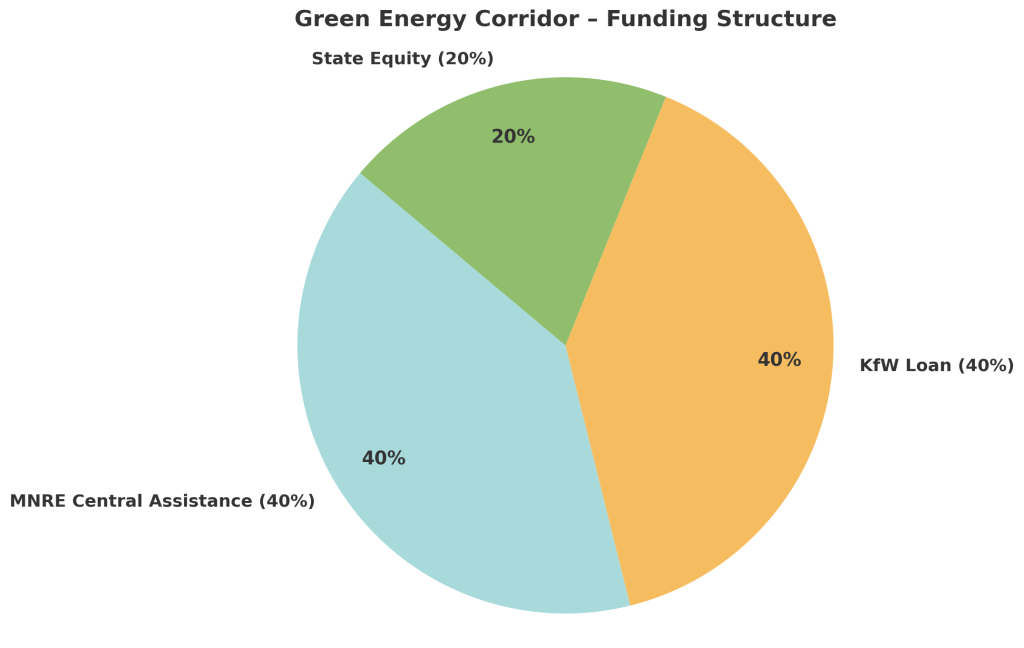
MNRE central assistance, KfW loan, and state equity contributions to GEC funding.
State-Level Examples and Early Results
Gujarat: Pioneering Large-Scale Integration
- Lakadia–Vadodara Transmission Project: Will deliver 5,000+ MW from renewable hubs in Kutch and Bhuj.
- Linked to India’s upcoming 30,000 MW hybrid renewable park, construction started in 2020 despite COVID disruptions.
Rajasthan: Solar Superpower
- Home to the 2,255 MW Bhadla Solar Park, one of the largest globally.
- Strengthened with a new 765 kV substation, allowing more solar power to feed the northern grid.
Tamil Nadu: Wind and Offshore Potential
- Already one of the top wind power producers in India.
- The GEC enhances evacuation capacity, reducing curtailment and supporting future offshore wind projects.
Karnataka and Maharashtra: Balancing Renewables and Industry
- Karnataka: Strong solar growth (Pavagada Solar Park) integrated through GEC links.
- Maharashtra: Industrial demand centers tied to new renewable corridors, reducing dependence on imported coal.
By late 2020, progress under GEC Phase I stood at:
| Component | Target | Commissioned | Progress % |
|---|---|---|---|
| Transmission Lines (ckm) | 9,700 | 7,365 | 76% |
| Substation Capacity (MVA) | 22,600 | 9,976 | 44% |
Actionable Insights: What Stakeholders Should Do
For Policymakers
- Streamline land approvals: Establish single-window clearance systems to fast-track right-of-way acquisition.
- Strengthen DISCOM finances: Introduce reforms such as time-of-use pricing, debt restructuring, and more flexible contracts.
- Encourage storage: Provide incentives for Battery Energy Storage Systems (BESS) to smooth variability.
- Coordinate institutions: Improve central-state alignment on project execution and monitoring.
For Entrepreneurs & Investors
- Distributed Renewable Energy (DRE): Rooftop and mini-grid projects offer untapped market opportunities.
- Storage Technologies: As variable renewable energy grows, storage will be essential for stability - creating a high-growth sector.
- Green Financing: Growing demand for clean bonds and international green funds creates room for innovative financing models.
For Engineers & Developers
- Smart grid tech: Integration of advanced forecasting, digital monitoring, and real-time balancing systems.
- Hybrid projects: Co-locating solar and wind, or pairing with storage, can optimize land use and reduce transmission strain.
- Regional specialization: Tailor transmission planning to each state’s renewable mix - solar-heavy Rajasthan differs from wind-heavy Tamil Nadu.
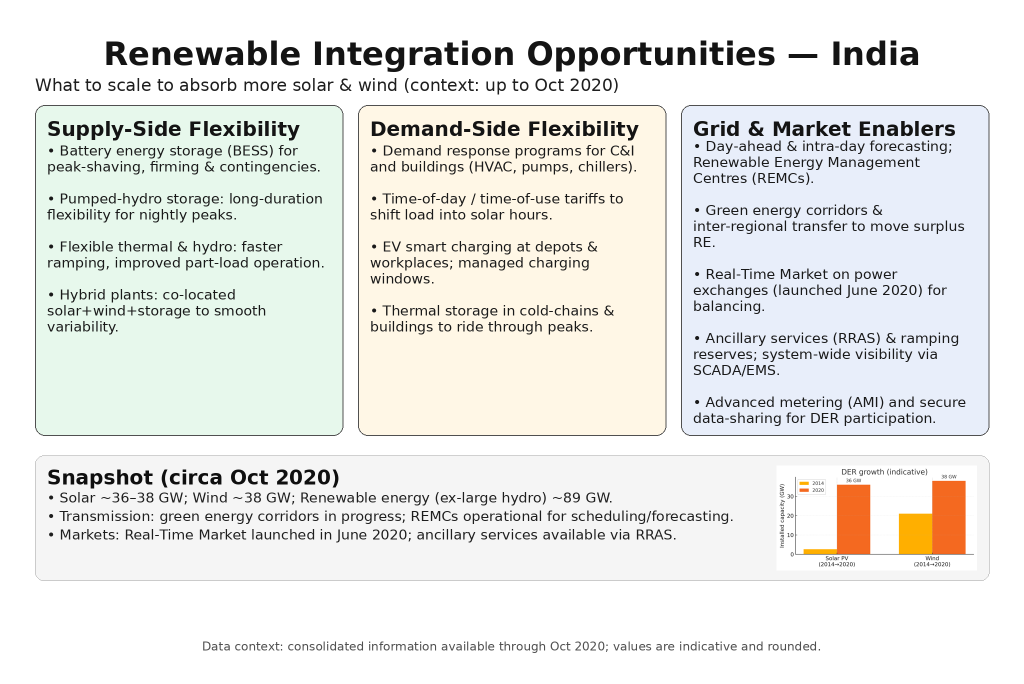
Opportunities for policymakers, entrepreneurs, and engineers in India’s renewable integration journey
Looking Ahead: The GEC as India’s Renewable Backbone
As of November 2020, India has taken decisive steps toward building a renewable-powered future. The Green Energy Corridor is not yet complete, but it is already demonstrating impact in states like Gujarat and Rajasthan.
The road is not without obstacles - financial, regulatory, and logistical - but the framework exists. If India addresses these bottlenecks with urgency, the GEC can:
- Minimize renewable curtailment
- Reduce dependence on fossil fuel imports
- Support millions of green jobs
- Lay the foundation for achieving the 2030 renewable targets
The GEC is more than a project. It is the backbone of India’s clean energy transition, connecting ambition with execution, and generation with consumption. The decisions being made today will shape the energy future of 1.4 billion people for decades.
Really useful for sustainability reporting frameworks
Really thoughtful Aditya!