

The Big Question: Can India’s Grid Handle the Renewable Rush?
Let’s be honest — India’s power sector is racing ahead faster than its grid can catch its breath.
Everyone’s talking about solar parks and wind corridors, but there’s a quieter, more critical conversation happening behind the scenes: grid stability.
Why? Because renewable energy, as beautiful and clean as it sounds, doesn’t behave like your trusty old coal plant. It’s unpredictable. Moody, even. One minute you’re basking in sunlight, the next, clouds roll in, and generation drops like a stone.
India, with its enormous and increasingly complex power system, is finding this out the hard way.
Remember - we’re a country trying to electrify every last village and decarbonize our entire generation portfolio, all at once. The ambition is breath-taking. The execution? Well… let’s just say the system’s learning as it goes.
The government’s 175 GW renewable target by 2022 (and the even loftier 450 GW by 2030) sounds heroic. But underneath that optimism is a technical question that’s been gnawing at planners and engineers alike: how do you keep the lights steady when your generators depend on the weather?
That’s where battery storage walks into the room. Quietly. Efficiently. And just in time.
The Real Trouble with a “Green” Grid
It’s easy to romanticize renewables. After all, who doesn’t like the idea of sunlight powering homes or wind turning turbines on distant hills? But here’s the catch — the grid hates surprises.
When solar floods the system at noon and vanishes by dusk, operators scramble to balance the load. It’s like running a marathon while juggling.
Here’s a term you’ll start hearing a lot more: the duck curve. It’s the chart that shows how solar power flattens mid-day demand and leaves a huge evening spike. The curve looks cute. But managing it? Not so cute.
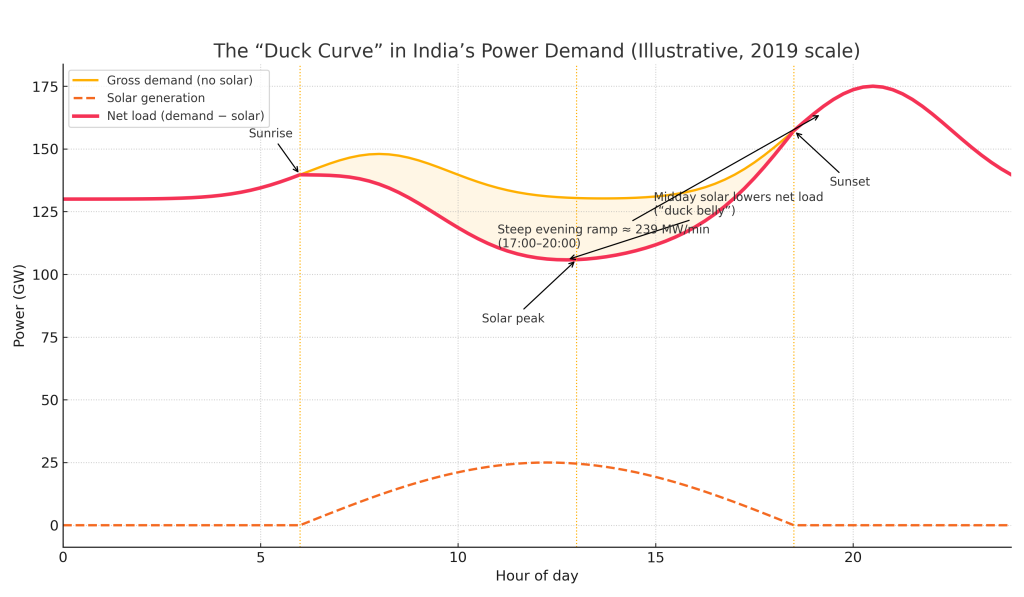
Solar’s daytime surge pushes down net demand, forcing steep ramp-ups after sunset.
And there’s more. With traditional power plants, the spinning turbines acted like a natural shock absorber — engineers call it “inertia.” When frequency fluctuated, that inertia slowed down the swings. Renewable inverters don’t do that. The grid, stripped of its flywheel effect, starts acting jittery - every small disturbance ripples further, faster.
So what happens when India’s grid, already stretched thin in rural belts and overloaded in cities, starts running on “renewable time”? Short answer: chaos, unless something balances it out.
That’s where battery storage starts to shine, not as a gadget, but as a guardian.
Batteries Aren’t Just Boxes — They’re the New Brains of the Grid
Let’s kill a misconception right here: battery storage isn’t just about storing electricity. It’s about timing. It’s the art of holding back power when nobody needs it and unleashing it the second everyone does.
Think of it as the grid’s mood regulator.
It charges when solar floods the network (when energy is cheap and abundant) and discharges when everyone switches on their fans, TVs, ACs and rice cookers after sunset.
But here’s the real kicker- modern battery systems can react in milliseconds. Milliseconds! That’s faster than a turbine can even spin up. So they’re not just “power banks.” They’re surgeons - stabilizing voltage, shaving peaks, correcting frequency, and preventing blackouts before they even begin.
Lithium-ion batteries are leading the charge (pun intended). Prices have been tumbling thanks to the EV boom worldwide. In 2020, you could get a grid-scale setup for around $200 per kWh (INR 12000-15000 approx.)-numbers that would’ve sounded laughable a decade ago.
And it’s not just about urban grids. Islands, remote villages, and industrial parks ,all stand to benefit.
Because let’s face it: India’s energy geography is uneven. Some regions drown in sunlight; others in diesel bills. Batteries are the great equalizer.
So, What’s Actually Happening on the Ground?
Talk is cheap. What matters is steel in the ground, or in this case, lithium in containers.
Take Tata Power Delhi Distribution’s project in Rohini — a modest-sounding 10 MW / 10 MWh pilot, but a milestone nonetheless. Installed right in the capital, it quietly balances loads, trims peaks, and supports a grid serving two million people.
It’s not flashy. You won’t see it trending on Twitter. But make no mistake , it’s rewriting how utilities think about flexibility.
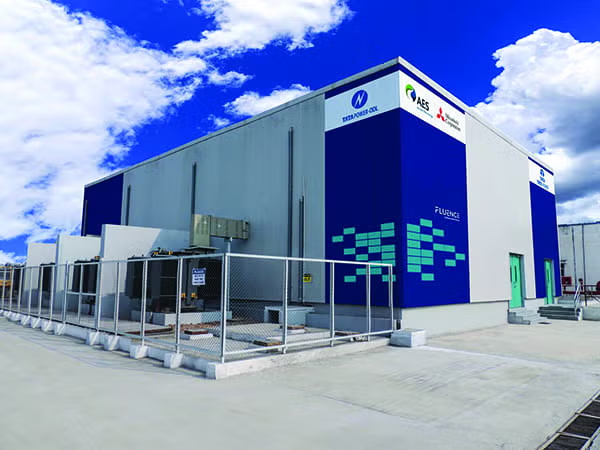
Containerized Battery Systems, Rohini, Delhi
One of India’s first large-scale BESS pilots, quietly stabilizing the grid behind the scenes
Then there’s the Andaman & Nicobar Islands, long plagued by expensive diesel imports. There, a 20 MW solar plant paired with 28 MWh of battery storage has transformed the power equation. Suddenly, clean energy isn’t just a climate statement - it’s cheaper, more reliable, and quieter.
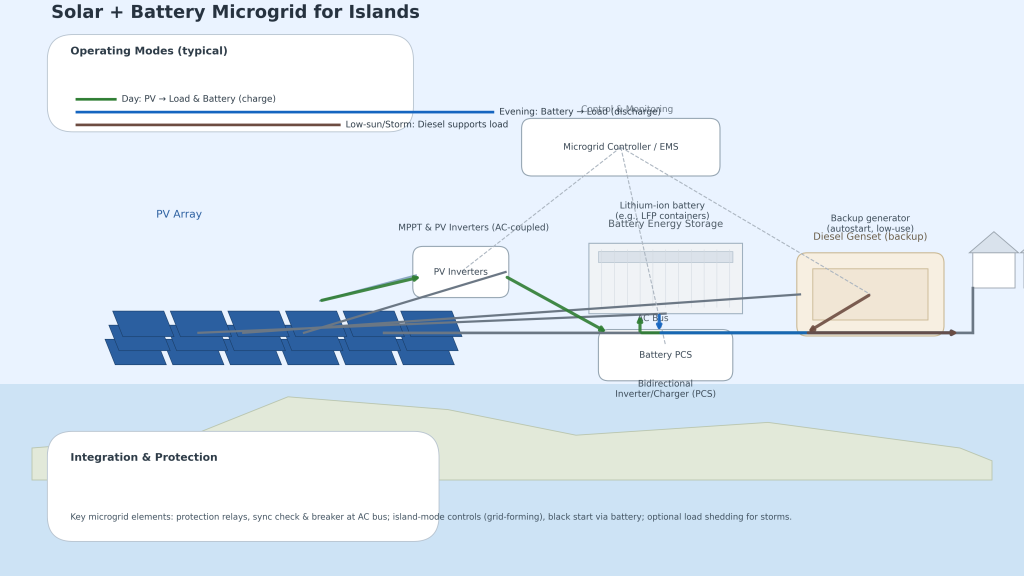
Storage keeps isolated systems running smoothly, even without mainland backup.
And let’s not forget the smaller pilots - in Puducherry, Bengaluru, and even Ladakh , where developers and DISCOMs are testing the waters, sometimes quite literally.
What These Pilots Are Teaching Us (And What They’re Not)
Here’s where the conversation gets nuanced.
Technically? The systems work. They deliver what they promise - smoothing peaks, absorbing shocks, and improving power quality. Economically? They’re inching closer to commercial viability.
But - and there’s always a “but” - the policy ecosystem isn’t keeping pace.
Right now, India doesn’t have a clear market mechanism to reward flexibility. DISCOMs can’t yet make money from providing grid-balancing services, and investors can’t easily monetize “stacked” benefits (like combining peak shaving with frequency support).
It’s a bit like owning a Swiss Army knife and getting paid for only one blade.
There’s also the procurement challenge. Who pays? Who owns the battery? Is it a utility asset, a third-party service, or part of a solar tender? The answers are murky — and regulators hate murky.
Still, early pilots have proven one thing beyond doubt: storage isn’t a futuristic idea. It’s practical. It’s here. It’s just waiting for policy to catch up.
Now, I’ll risk being blunt. We’ve spent the last few years talking about flexibility, when what we really need is to price it.
India’s entire electricity market still revolves around megawatt-hours, when it should start rewarding megawatt-seconds , the speed and agility that batteries bring.
The irony? We’re chasing “24x7 solar” slogans while still using a century-old grid playbook.
Until regulators explicitly define what “grid services” are worth — frequency response, ramping reserves, congestion management — we’ll be stuck in pilot purgatory.
Sure, MNRE’s Energy Storage Mission and NITI Aayog’s policy roadmaps are steps in the right direction. But the real breakthrough will come when batteries stop being “projects” and start being “infrastructure.”
Imagine if every solar park had an integrated 50 MWh battery — not as an experiment, but as standard equipment. That’s when we’ll have truly arrived.
Economics: The Tipping Point Is Near
The math is starting to work in our favor. Global lithium-ion costs have fallen by nearly 80% since 2010, and even conservative forecasts suggest another 30–40% drop through the mid-2020s.
Once installed costs hit the $150/kWh range, batteries won’t just complement renewables — they’ll start competing with peaking power plants outright.
And here’s a fun fact: India’s grid spends billions annually managing frequency deviations and transmission congestion. A smarter, distributed battery network could offset much of that cost.
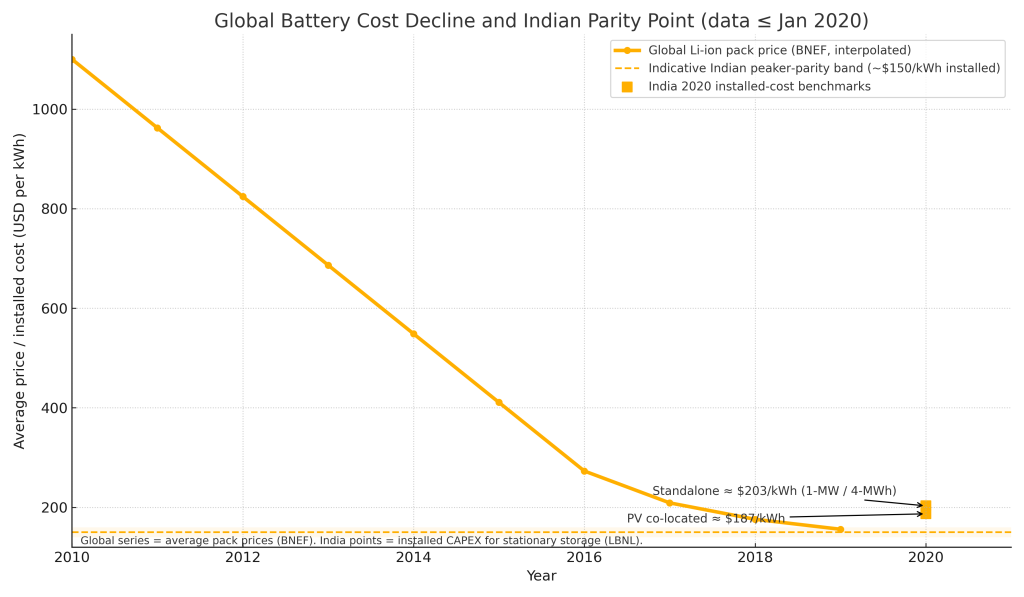
Costs are falling fast and parity with coal peakers isn’t far away
Add to that the government’s push for domestic cell manufacturing, and you’ve got the makings of an entire new industrial sector — one that could rival the solar module boom of the last decade.
So yes, batteries may start as a grid stabilizer. But they could end up as a pillar of India’s next big manufacturing play.
The Road Ahead - Between Promise and Policy
Here’s where optimism meets reality.
India has proven that battery storage can solve real-world problems but scaling it demands market evolution, not just technical perfection.
The next few years should focus on three priorities:
- Creating a Flexibility Market. Let storage compete in ancillary service markets just like generators.
- Integrating Storage with Renewables. Make co-location mandatory or incentivized for new solar parks.
- Building Domestic Capability. Encourage local manufacturing of cells and packs to reduce import dependence.
If we get those right, we won’t just be adopting global technology , we’ll be shaping how emerging markets approach energy storage.
Wrapping Up - A Silent Revolution in the Making
Let’s circle back to the big picture.
India’s renewable transition is no longer about capacity - it’s about control. It’s about whether the system can remain stable when the sun sets, the wind stalls, and the world still expects 24/7 power.
Battery storage is not the headline act yet. It’s the quiet player making sure the show goes on.
From the dusty substations of Delhi to the microgrids of the Andamans, the message is clear: this technology isn’t coming - it’s here. What’s missing is conviction.
Thanks Neeraj for highlighting the sustainability aspects
Super useful! Really valuable
This helps with our climate commitments
Thank you Rahul!
Fantastic analysis of renewable potential! Critical for our emissions tracking ⚡
Thanks Gaurav!
Great perspective on clean energy adoption Neeraj! 🔋
Thank you Karan!
This helps quantify our environmental impact.
Extremely valuable Meera!
Thanks for the clear explanation of carbon intensity
Great to hear! Really thoughtful
This helps with our decarbonization timeline! Essential for our net zero strategy ⚡