

A City That Builds and Burns Energy
Walk through any fast-growing Indian city and you will find many high rise buildings and many under construction. Behind every new building hums a bigger air-conditioner and several other energy consuming appliances. This boom in construction is an indicator of fast growth of India but also defines its large energy requirement.
Urban India already guzzles more than two-thirds of the nation’s electricity. The numbers keep climbing: power demand has been expanding roughly 7-8 percent a year. And because much of the power still comes from coal, every fresh housing block or office tower nudges emissions upward.
Yet the solution may lie in those same architectural envelopes. If buildings are consuming good amount of power then why should these not generate their own power whether partial not hundred percentage? This question is pushing architects and engineers toward Building-Integrated Photovoltaics (BIPV) as a solution. BIPV, a technology that turns a structure’s outer skin into a mini-power plant.
Solar energy is already India’s fastest-moving renewable. Massive parks in Rajasthan and Karnataka have turned deserts into grids of blue. Still, conventional deployment has limits that city planners can’t ignore.
Land. Big solar farms require large land by the square kilometre. Pavagada Solar Park alone sprawls across 13,000 acres , an area larger than many towns. Every acre fenced off for panels is an acre lost to crops or homes.
Distance. Sun-rich sites are far from cities, and moving electricity hundreds of kilometres creates losses and grid congestion. Ironically, the clean power often can’t reach the places that need it most.
Rooftops. Government targets for rooftop solar sounded bold—40 GW by 2022—but adoption has limped along. Apartment dwellers can’t agree on shared roofs, net-metering rules shift from state to state, and many households still see solar as complicated or costly.
In short, solar is thriving where people aren’t, and scarce where they are.
Let the Building Itself Go Solar
That’s where BIPV changes the equation. Instead of bolting panels onto a roof, imagine making the roof, the facade, even the windows out of solar material. No extra land, no awkward add-ons—just design that earns its keep.
A BIPV module does two jobs at once:
- it replaces a conventional building element (glass, tile, cladding), and
- it produces electricity every day for decades.
Imagine glass panels that tint the sunlight while powering your building, or roof shingles that look just like classic slate but quietly send energy to the grid. The result is a cleaner silhouette, fewer mechanical eyesores, and power generation built in from day one.
On the technology side there are mainly two types of technologies. The first is crystalline silicon cells and the other one is thin film.
Where It’s Already Working
This isn’t speculative tech. All over the world, buildings are quietly proving that solar can be beautiful.
- CIS Tower, Manchester (UK) retrofitted its entire facade with 575 kW of solar modules—turning a dated office block into an energy statement.
- Maracanã Stadium, Rio de Janeiro sports a 390 kWp BIPV roof that feeds the grid while shading spectators.
- Taiwan’s National Stadium wraps itself in 8,800 panels generating more than a gigawatt-hour each year.
And closer home? Sahibabad Railway Station near Delhi now wears India’s first BIPV roof—a 729 kW installation that replaced old asbestos sheets. The new canopy doesn’t just look cleaner; it powers lighting and fans directly on site. Small, yes, but symbolically huge.
Does It Pay?
At first glance, BIPV looks pricey. The material costs more per square metre than standard glass or tiles. But that comparison misses the point. You’re not adding a separate energy system—you’re substituting one material for another.
If a regular glass curtain wall costs ₹4,000 a square metre and a BIPV glass wall costs ₹8,000, the extra ₹4,000 buys a decades-long income stream from electricity. Over a 25-year lifespan, the avoided power bills can outweigh that premium many times over. European case studies show payback periods falling between 10 and 15 years, depending on tariff rates.
Beyond the spreadsheet, there’s branding value. For developers chasing LEED or GRIHA green ratings, an integrated solar facade is a visible commitment to sustainability—something clients now notice.
Computed Lifetime Economics (30 Years)
| Material | Lifetime Cost (₹ / m²) | Energy Value (₹ / m²) | Material Offset (₹ / m²) | Total Benefit (₹ / m²) | Net Gain (₹ / m²) |
|---|---|---|---|---|---|
| Conventional façade (glass) | 9,000 | 0 | 0 | 0 | −9,000 |
| BIPV c-Si façade | 18,000 | 22,500 | 9,000 | 31,500 | +13,500 |
| BIPV CIGS façade | 13,000 | 19,500 | 9,000 | 28,500 | +15,500 |
| BIPV solar tiles (roof) | 12,000 | 21,000 | 6,000 | 27,000 | +15,000 |
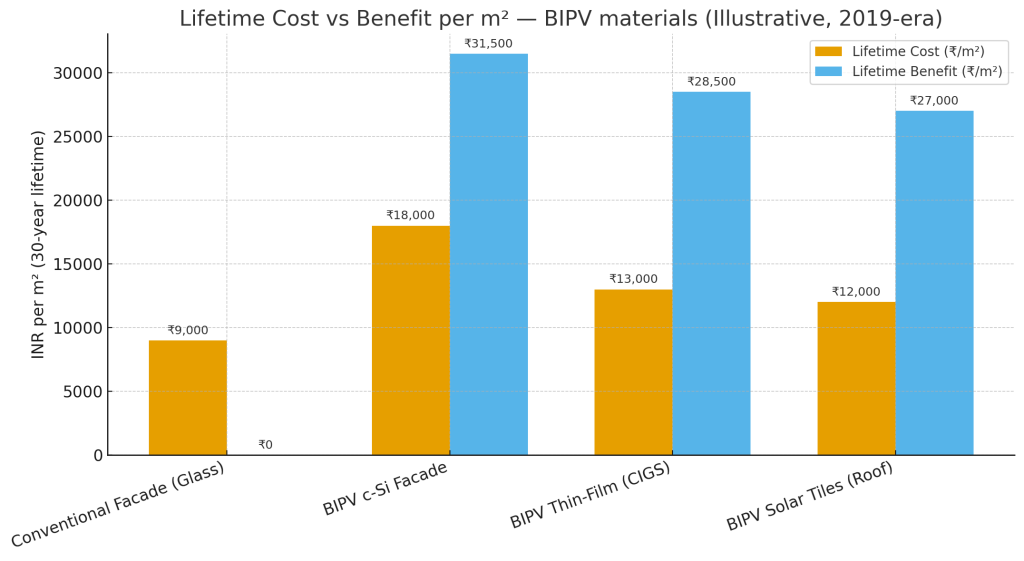
When energy savings are factored in, BIPV edges out conventional materials over time
Policy Gaps and How to Bridge Them
India’s solar policy has raced ahead, but mostly around ground-mounted and rooftop systems. BIPV slips between categories: it’s neither purely architectural nor purely electrical.
Three things could accelerate adoption:
- Targeted incentives. Treat BIPV materials like renewable-energy equipment for GST and depreciation purposes.
- Clear standards. Architects and builders need BIS or MNRE guidelines defining how to size, wire, and certify these systems.
- Model tenders. Government projects—airports, railways, secretariat buildings—should pilot BIPV through design-build contracts that others can copy.
When public projects set the precedent, private developers usually follow.
Who Should Move First?
High-rise commercial towers are have broad, sun-exposed facades and big daytime loads. Next is transport hubs like airports, metro stations and bus stations , where the architectural envelope is large and visually prominent.
Municipal and state buildings could create the early demand that helps local manufacturers scale up production. Once prices dip, residential BIPV—solar tiles on villas, semi-transparent balcony panels—will find its market.
The goal isn’t just greener buildings; it’s a more distributed city-wide energy system where each block contributes to the grid rather than burdening it.
The Obstacles in Plain Sight
No new technology rolls out without friction. BIPV faces its share:
- Higher upfront costs still deter developers focused on short-term returns.
- Few architects have hands-on design experience with solar materials.
- Electrical inspectors and building authorities lack unified approval processes.
- Domestic manufacturing capacity for specialized solar glass remains limited.
But history suggests these barriers shrink quickly once a few showcase projects prove the math. Think back to LEDs—once niche, now default. The same curve is likely here.
Looking Ahead: The Sunlit Skyline
The next wave of India’s construction boom will shape not only how cities look but how sustainably they live. Imagine a Gurgaon business district where every tower’s glass skin feeds the micro-grid, or a rebuilt railway station whose roof powers nearby street lighting.
BIPV alone won’t solve India’s energy puzzle, but it shifts the mindset from consumption to contribution. Every new facade is potential generation space; every design decision can carry an energy dividend.
As costs fall and awareness rises, the line between architecture and energy engineering will blur. The smartest buildings won’t just reduce their bills—they’ll help stabilize the grid.
And that may be the quiet revolution hiding in plain sight on tomorrow’s skyline.
Quick Takeaways
- Problem: Urban electricity demand rising 7-8 % + yearly; limited land for conventional solar.
- Solution: BIPV turns building surfaces into generation assets.
- Payback: 10–15 years in mature markets; improving as costs fall.
- Next Steps: Policy clarity, demonstration projects, local manufacturing.
Love this Neeraj the focus on environmental stewardship
Thanks for engaging! Very insightful
This helps with our renewable commitments. 🔋
Glad to help!
This helps clarify the path to net zero
Great resource for climate accountability Neeraj! 🌍
Really appreciate that Namita! 🌅
Really valuable for carbon management
Thank you Mohit!
This helps with renewable energy planning. 🔋
Great to hear! Very insightful
This is exactly what sustainability teams need Neeraj
Love this Neeraj, seeing this focus on environmental impact. 🌍
Appreciate the feedback!