


A Powerful Gust on a Straining Grid: India’s Wind Energy Moment
India’s energy story has always been about scale. With over a billion people and an economy pushing for double-digit growth, reliable electricity is both an aspiration and a necessity. While conventional thermal power has carried much of the load, the last few years have seen renewable energy move from the margins to the center of policy and investment.
The government’s target of 175 GW of renewables by 2022, including 60 GW from wind, is among the most ambitious in the world. Wind energy, in particular, has had a record-breaking run - adding more than 3,400 MW in FY 2015–16, far surpassing previous years. This success has put India in the league of top global wind nations.
But there’s a less visible story unfolding. For developers and operators, the challenge is no longer just about putting turbines on windy ridges. It’s about ensuring that the electricity they generate actually reaches consumers. Curtailment and grid adaptation have become the real bottlenecks.
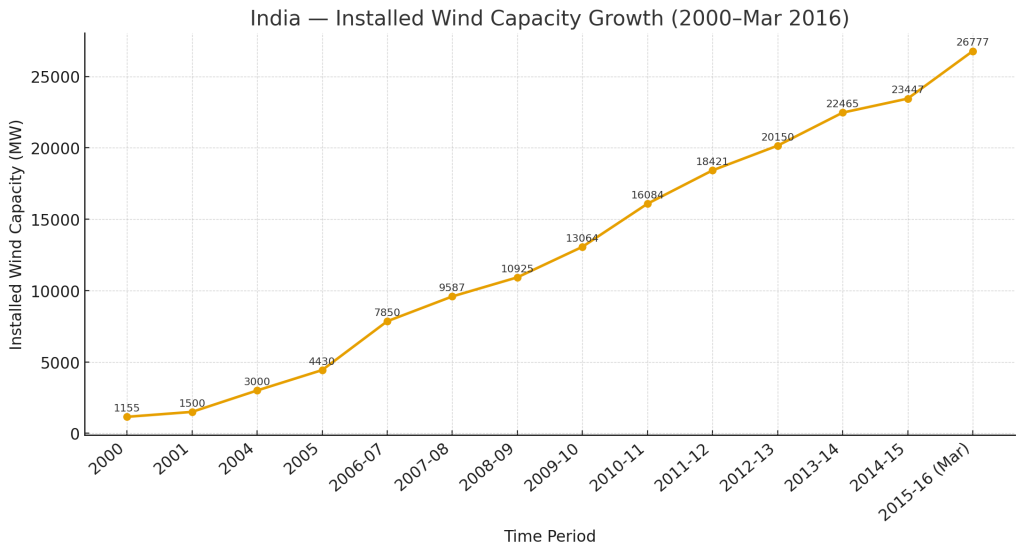
India’s wind sector has surged in capacity
Why This Matters: A Relatable Context
For policymakers, curtailment looks like wasted investment. For developers, it means revenue losses and nervous investors. For consumers, it translates into higher tariffs, since curtailed zero-marginal-cost wind has to be substituted with more expensive thermal power.
On the ground, this can feel frustrating. Imagine a farmer seeing his turbines spin, only to be told that power can’t be dispatched because the grid is “full.” Or a state discom explaining to industrial consumers why power cuts persist even though renewable capacity has grown by thousands of megawatts.
In a country still grappling with outages and rural electrification, this disconnect is not just a technical issue - it’s a human one.
The Balancing Act: Challenges of Integration
The Indian grid must operate at a delicate balance around 50 Hz. Too much fluctuation risks damaging equipment or even triggering widespread blackouts. Traditionally, large synchronous thermal and hydro plants provided inertia that kept the grid steady.
Wind energy upends this equation:
- Variability – Unlike coal, wind can’t be dispatched on command. Output depends on weather patterns.
- Curtailment – Despite “must-run” rules, many developers face forced reductions when discoms or grid operators can’t handle the load.
- Financial Constraints – Discoms locked into thermal PPAs pay fixed charges even when backing down conventional plants. This creates a reluctance to absorb variable renewables.
- Transmission Congestion – Wind-rich regions like Tamil Nadu often generate more power than local transmission lines can carry. Without stronger interstate links, power simply can’t flow.
- Forecasting Gaps – Even a 10% error in predicting renewable output at scale demands massive standby capacity - expensive and inefficient.
These issues don’t exist in isolation; they reinforce each other. The economic ripple effects are significant: developers lose revenue, investors hesitate, discoms face payment pressures, and consumers ultimately foot the bill.
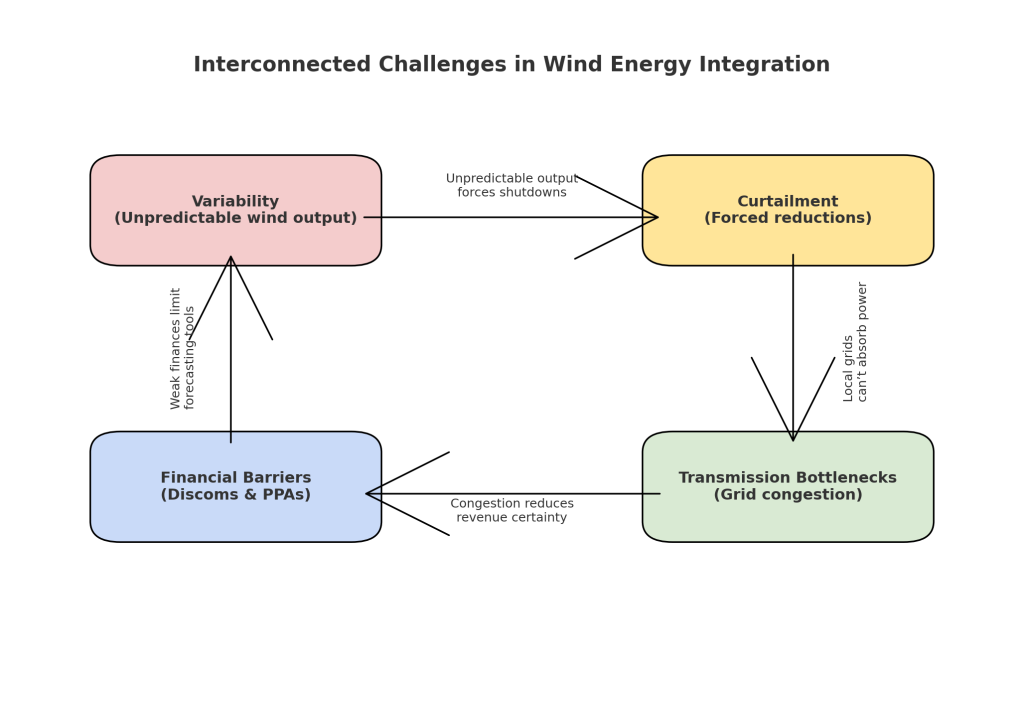
Integration challenges are interconnected, multiplying the impact on India’s power system
Decoding the Grid: A Technical Toolkit for Adaptation
Think of the grid as a vast reservoir. Coal and hydro plants are controllable taps, filling it steadily. Wind is like a monsoon-fed stream - unpredictable, sometimes flooding, sometimes barely flowing. Closing the gates when it overflows (curtailment) wastes potential. The smarter response is to redesign the system.
Key elements of the adaptation toolkit:
- Advanced Forecasting
Accurate short-term and day-ahead forecasting is essential. Better models help operators schedule backup power efficiently, reducing costly last-minute adjustments. - Flexible Generation
Conventional plants must become more agile, capable of rapid ramp-ups and ramp-downs. This shift - from baseload machines to balancing resources - is a fundamental operational change. - Energy Storage
Storage acts like a secondary reservoir, soaking up excess when winds are high and releasing it during demand peaks. Technologies range from pumped hydro to batteries, with early policy discussions already considering a National Energy Storage Mission. - Smart Grids & Real-Time Monitoring
A modern grid needs a nervous system. Remote Terminal Units (RTUs), advanced sensors, and data-driven control centers allow operators to manage power injections dynamically.
Together, these tools point to a paradigm shift: grid stability is no longer just a hardware problem solved by bigger plants. It’s a software and intelligence challenge, relying on data, communication, and real-time control.
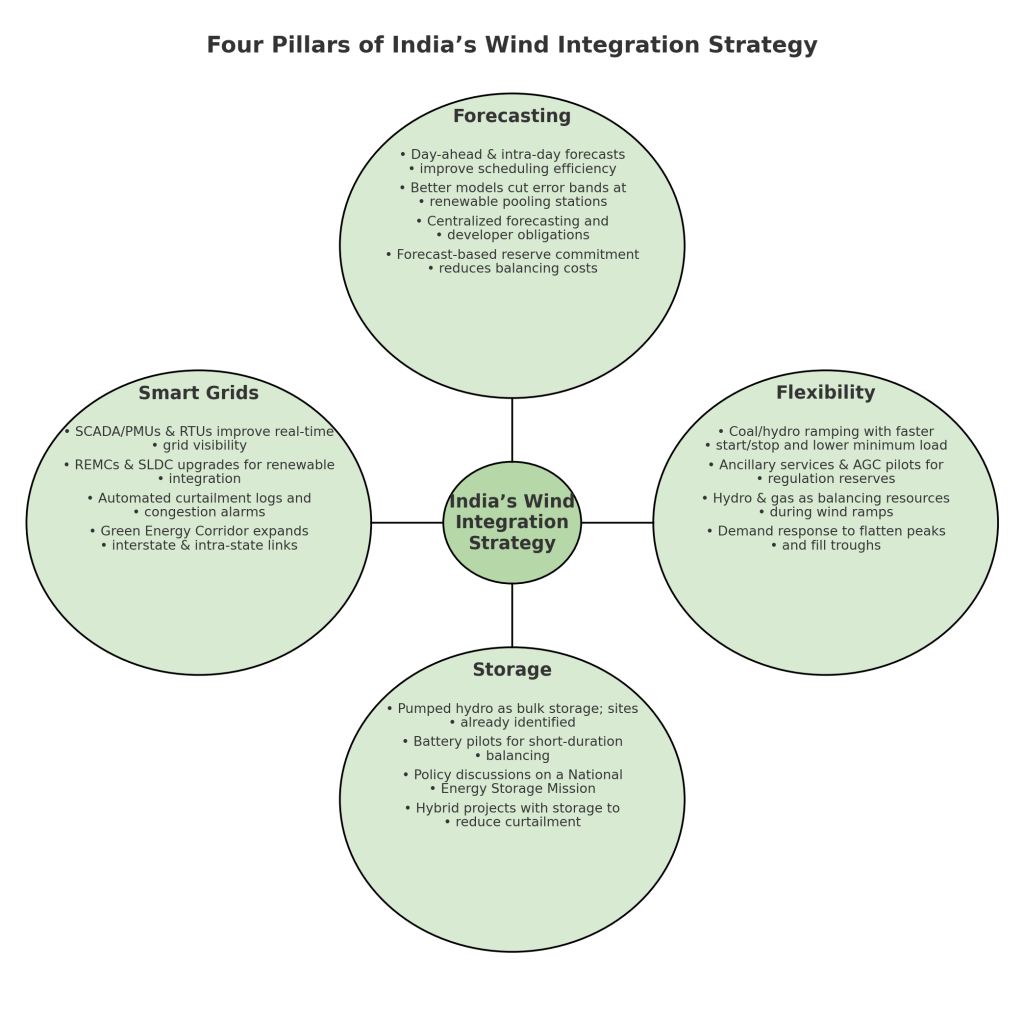
The four pillars of India’s wind integration strategy.
Lessons from the Field: Navigating the Wind Storm
Tamil Nadu: A Cautionary Tale
With over 7,600 MW installed, Tamil Nadu is India’s wind leader. But success comes with strain: frequent curtailment, payment delays, and underwhelming response to new tenders. Developers see real financial risk, slowing enthusiasm for further investment.
Gujarat: Proactive Policy
Gujarat’s Wind Power Policy 2016 directly targets integration. By mandating RTUs and encouraging captive and third-party sales, the state has tried to build confidence among investors while addressing grid realities.
International Lessons
- Denmark: With 42% wind generation in 2015, Denmark relied on high interconnection with neighboring grids. Lesson: larger balancing areas make variability manageable.
- Germany: Nearly 30% of power already comes from renewables, supported by market structures that reward flexibility and citizen participation. Lesson: market design and stakeholder diversity matter as much as infrastructure.
For India, these examples are not blueprints but principles: strong interconnections, smart policies, and inclusive markets.
The Economics of Curtailment: Beyond Wasted Energy
Curtailment isn’t just “lost electricity.” It has layered costs:
- Developers lose revenue, undermining the financial viability of projects.
- Investors see higher risk, which raises the cost of capital for new capacity.
- Consumers pay more, since curtailed wind is replaced by costlier thermal power.
- Discoms face financial strain, balancing fixed PPA obligations with variable renewable inflows.
In effect, curtailment becomes a tax on the energy transition. Unless addressed, it can slow down the very progress India has celebrated in recent years.
Charting a Course: Actionable Insights
Curtailment and integration challenges are not insurmountable. They represent the natural next phase in India’s energy transition. A few priority actions:
For Policymakers
- National Grid Code for Renewables: Standardize technical requirements like reactive power support and fault ride-through.
- Accelerate Transmission Projects: Green Energy Corridor must move faster to enable interstate flows.
- Market-Based Mechanisms: Design transparent markets for ancillary services to reward flexibility providers.
For Utilities & Grid Operators
- Real-Time Data: Invest in advanced monitoring and dispatch systems.
- Energy Storage Pilots: Deploy utility-scale batteries and expand pumped hydro facilities.
- Forecasting Improvements: Develop more sophisticated models to reduce scheduling errors.
For Developers & Investors
- Grid-Friendly Projects: Adopt advanced inverters, hybrid models with storage, and responsive designs.
- Collaborative Engagement: Work closely with regulators to shape policies that value ancillary services and grid support.
Curtailment should be reframed: not just as a technical nuisance, but as a signal to build smarter markets and smarter grids.
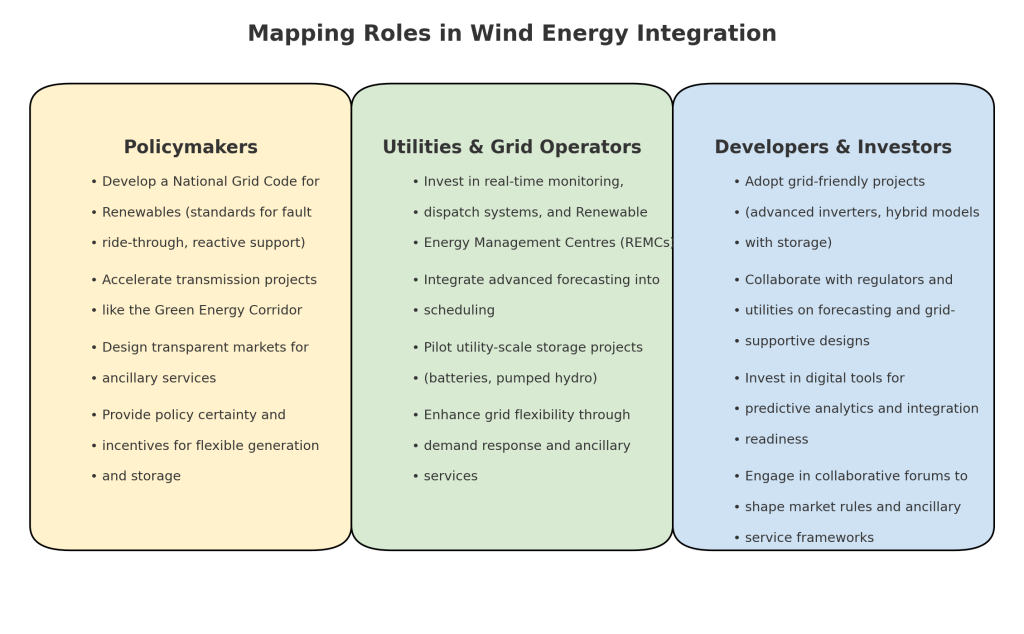
Integration is a team effort - each stakeholder has a role to play
A Human Perspective: Why This Transition Matters
It’s easy to get lost in gigawatts and grid codes. But at its core, integration is about people. Reliable electricity changes lives: powering small businesses, keeping hospitals running, enabling study after dark. Every unit of curtailed wind means a unit of clean, low-cost electricity denied to someone who needs it.
For engineers and policymakers, this is more than an abstract technical problem - it’s about delivering on the promise of energy security, economic growth, and environmental responsibility.
Conclusion: Catching the Next Gust
India has made remarkable progress in scaling up wind power. But growth has exposed the next big hurdle: moving from capacity addition to integration. Curtailment, forecasting gaps, and transmission bottlenecks are not signs of failure - they are signs of maturity.
The solutions are already on the table: smarter forecasting, flexible generation, stronger transmission, and supportive markets. What’s needed now is alignment across stakeholders.
If India can adapt its grid to catch every gust of wind, it won’t just meet targets - it will redefine what a resilient, clean, and affordable power system looks like for a developing economy at scale.
Invaluable for tracking our emission trajectory. 📉
Really enjoyed! Really appreciate it
Great breakdown of the emissions data!
Really appreciate the focus on green energy. 🌱
Really useful for ESG disclosures
Extremely insightful Divya!
This is perfect for our climate action plan. 🎯
This is exactly what we need for ESG excellence!
Extremely thoughtful Lakshmi!