

India’s Power Paradox: Why UDAY Matters Now
India today stands at an unusual crossroads. On one hand, the country has built enough generation to call itself power-surplus. On the other, the system still leans on its weakest link: state distribution companies (DISCOMs).
DISCOMs deliver more than four-fifths of India’s electricity to households, farms, and factories. Yet persistent financial distress drags on growth. When DISCOMs lose money, generators wait for dues, banks carry stressed assets, consumers endure patchy supply, and industry pays more to keep the lights on.
To break the loop, the Union Government launched the Ujwal DISCOM Assurance Yojana (UDAY) in November 2015. Unlike earlier bailouts, UDAY is pitched as a full reset—financial clean-up tied to hard operational targets and fiscal accountability for states.
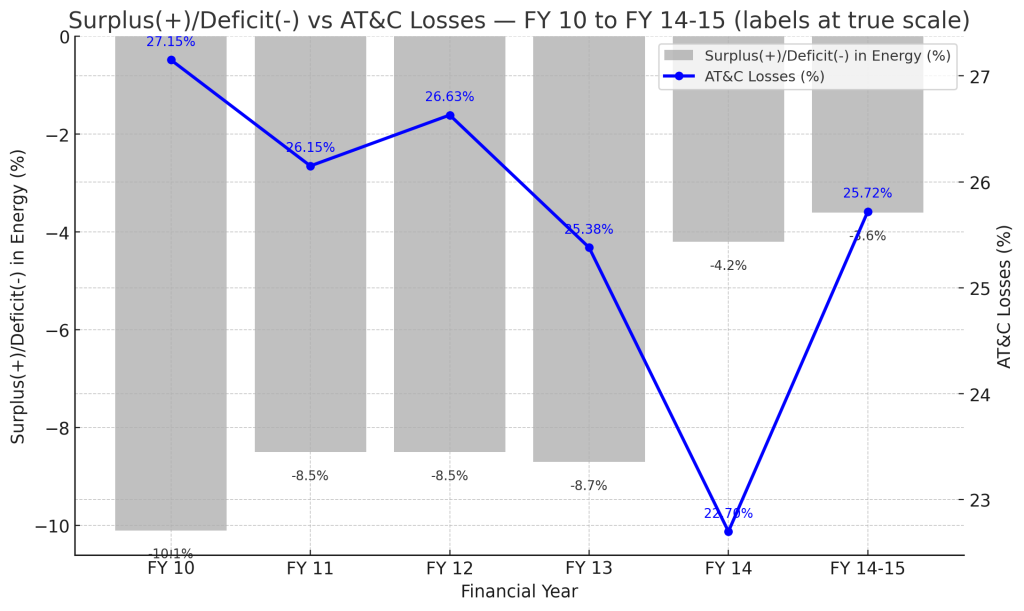
Generation is no longer the key bottleneck; distribution inefficiency remains the Achilles’ heel.
Why the Crisis Matters
The scale is sobering. By September 2015, DISCOM debt stood near ₹4.3 lakh crore—more than the annual GSDP of several states. Servicing that debt at 12–15% devours revenue that should fund better wires, meters, and transformers.
Spillovers are real. Banks roll over utility loans rather than recover them. State budgets strain to contain liabilities, squeezing social spend. Consumers feel it as outages, uneven tariffs, and slow progress to universal access. For manufacturers, unreliable supply becomes a competitiveness tax.
India has tried before. Since 2001, at least three big restructurings shifted debt between books—DISCOMs, banks, and states. The core defects remained: tariffs lagging costs, poor billing and collection, and theft that no one tackled at scale.
Relief brought relapse. Without structural change, states slid back—postponed tariff revisions, fresh borrowing, and rising losses.
UDAY attempts to change the incentives. It couples balance-sheet repair with performance milestones and links state fiscal space to utility discipline.
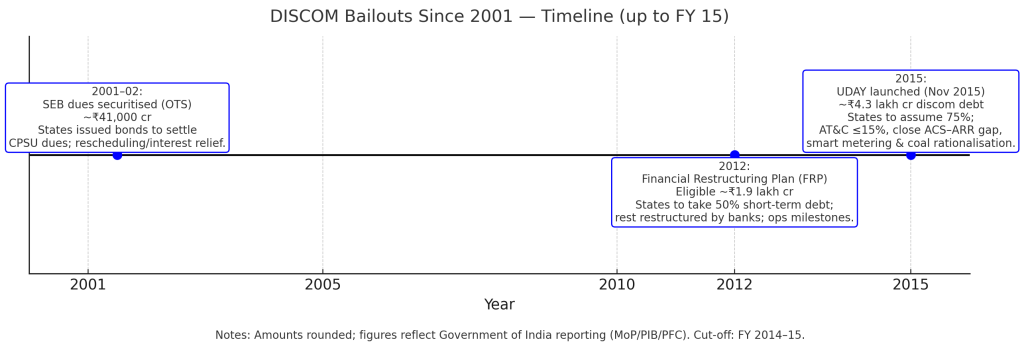
DISCOM Bailouts Since 2001
Previous efforts treated debt, not discipline. UDAY seeks to change that.
The Anatomy of the Crisis
High AT&C losses: Nationally above 22%, with some states at 35–40%. Every lost unit is foregone cash.
ACS–ARR gap: Many DISCOMs sell below cost; gaps above ₹2/kWh are not rare.
Debt spiral: Expensive borrowing keeps the system running but starves investment.
Political interference: Tariff hikes are delayed; freebies arrive without timely subsidy reimbursement.
Concentration of pain: A handful of large states—Rajasthan, Uttar Pradesh, Haryana, Tamil Nadu—drive most of the losses.
UDAY: A Strategic Blueprint for Change
UDAY rests on four connected pillars.
- Financial restructuring
States assume 75% of DISCOM debt in tranches, cutting interest costs and putting responsibility squarely on state budgets. - Operational efficiency
Targets include AT&C losses down to 15% and closing the ACS–ARR gap by FY19, enabled by:
- Smart meters for high-use consumers
- Feeder and distribution transformer metering
- GIS-based consumer indexing
- Regular energy audits and loss segregation
- Lower power costs
Coal linkage rationalisation, better domestic supply, and transparent procurement aim to shave the input bill. - Enforcing discipline
Future losses count towards state fiscal responsibility limits, hard-wiring consequences for slippage.
What Makes UDAY Different
This time the politics sit front and centre. States that reform gain fiscal room and more reliable power; states that delay pay the penalty in their own books. The approach pairs incentives with accountability—turning distribution reform from a back-office fix into a governance priority for chief ministers and finance departments.
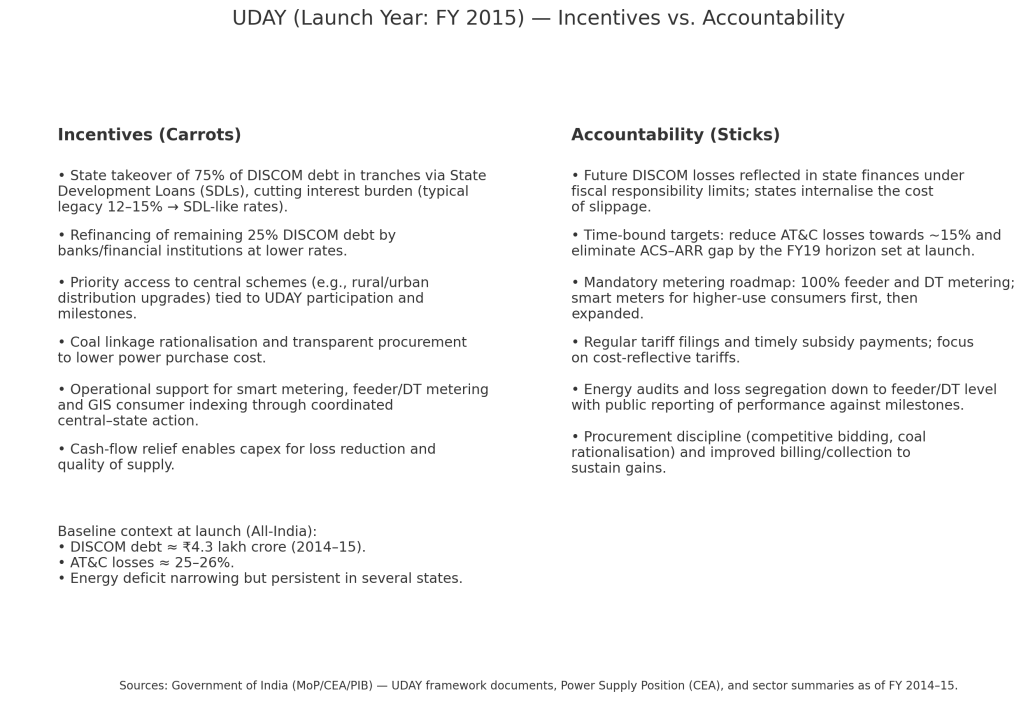
UDAY ties state development prospects to DISCOM performance.
Beyond Finance: Why UDAY Matters for the Energy Transition
UDAY lands just as climate policy surges up the global agenda—Paris COP21 was weeks away. India’s 175 GW renewable target for 2022 needs healthy off-takers.
Weak DISCOMs hesitate to sign long PPAs and struggle to integrate variable solar and wind on ageing networks. Stabilising finances and modernising operations clears the runway for renewables: bankable demand, smarter grids, and fewer stranded assets.
Global Lessons for India
Others have walked this path—Brazil, South Africa, Indonesia. The takeaway is consistent: cash infusions without reform don’t stick. Durable turnarounds blend:
- Cost-reflective tariffs
- Investment in metering and loss reduction
- A firm regulator
- Political will to resist giveaways without budgeted subsidies
On paper, UDAY mirrors these lessons by tying money to milestones.
Opportunities Ahead
Well-executed, UDAY can deliver:
- Financial relief: Lower interest outgo; more headroom for capex.
- Industrial boost: Reliable power that lowers production risk.
- Banking stability: Less rollover risk, cleaner utility exposures.
- Renewable push: Greater appetite for PPAs and grid upgrades.
- Consumer benefits: Fewer outages, clearer bills, better service.
Risks and Roadblocks
The design is only half the story. Execution is the test:
- Reluctance to revise tariffs regularly
- Patchy action on theft and billing discipline
- Capacity gaps for smart-grid roll-outs
- Reform momentum waxing and waning with elections
- A voluntary scheme that some states may slow-walk
What Sector Leaders Should Watch
- State adoption: Who signs early and meets milestones.
- Tariff discipline: Regulators allowing costs to be recovered.
- Technology uptake: Smart meters, GIS mapping, feeder audits at pace.
- Banking impact: How restructuring moves credit ratings and exposures.
- Renewable integration: Whether healthier DISCOMs speed solar and wind.
Conclusion: A Turning Point—If We Seize It
UDAY is India’s most ambitious shot at fixing distribution. It tackles debt and losses while binding state finances to results. But it isn’t a magic wand. The payoff lies in follow-through: realistic tariffs, tough action on theft, and steady grid modernisation. Do that, and India swaps stop-gap bailouts for a lasting turnaround. Fail, and the cycle repeats.
The dawn is here. What happens next depends on whether reforms outlast politics—and whether states choose discipline over drift
Really useful for sustainability reporting frameworks
Extremely appreciated Nikhil! 📖
Fantastic information on clean energy adoption! ⚡
Thanks for the clear explanation of carbon intensity
Really appreciate you taking the time! Super useful
This is perfect for our climate action plan. 🎯
Great perspective on carbon footprint reduction Neeraj! This will help with our climate goals 👣
Thank you! Glad it resonated
Thanks Neeraj for highlighting the climate urgency