

A Ray of Hope in the Fields
The late afternoon sun in the district feels warm and steady, not harsh. Near a small village on the edge of the canal belt, Shashi Bala (just for story) watches her solar pump hum quietly. Gone are the fumes, the frequent breakdowns, and the anxiety over diesel bills that ate into her meagre income.
Just two seasons ago, her life followed a predictable pattern , wait for erratic grid power, depend on costly diesel for backup, and pray the rains didn’t disappoint. Today, sunlight itself powers her irrigation. No need to chase the diesel man anymore, she laughs , “The sun comes up on time, every day.”
Shashi’s quiet smile reflects a big change happening across India’s villages , a shift toward farmers becoming more self-reliant with their energy. At the centre of this change is the Kisan Urja Suraksha evam Utthaan Mahabhiyan (KUSUM) scheme. It’s helping farmers see energy, irrigation, and income in a whole new way.
The Challenge Beneath the Soil
India’s agriculture has long depended on two unreliable fuels ,first on diesel and second on subsidised grid electricity. For decades, farmers are struggling with unreliable power , low voltage no fix hours unstable power resulting high pumping costs. In most of the regions, power for agriculture is supplied only at night; in others, it is erratic.
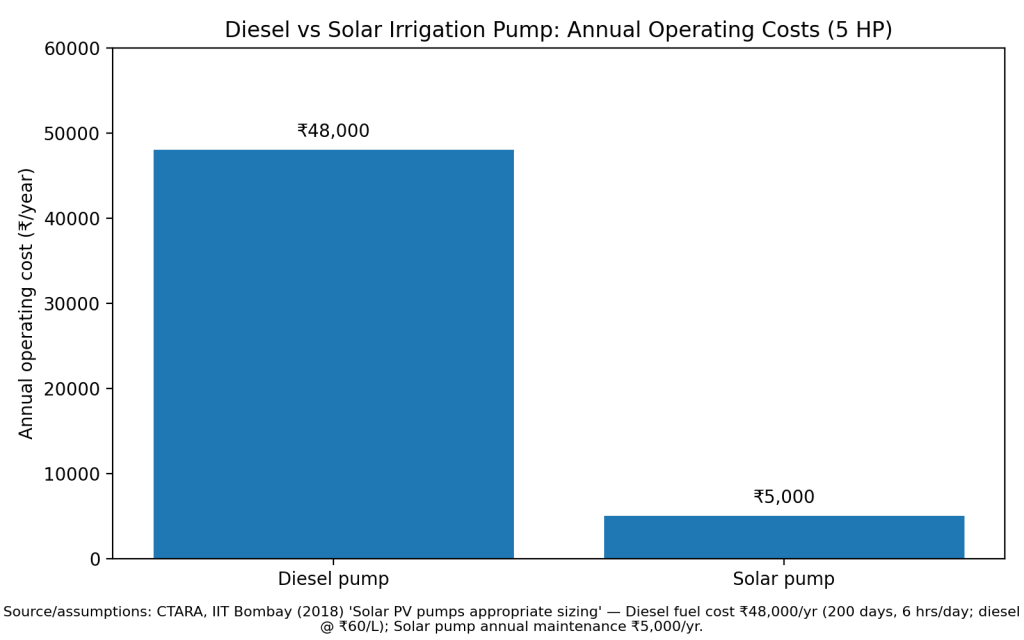
According to government data from 2021, India had over 30 million irrigation pumps, of which nearly 9 million were diesel-powered. The dependence on diesel isn’t just expensive , it’s polluting. A 5 HP diesel pump can emit close to 9 tonnes of CO₂ annually, apart from costing ₹45,000–₹50,000 each year in fuel.
For small and marginal farmers, who constitute nearly 86% of India’s agricultural workforce, this was unsustainable. They faced a cruel paradox , water available underground, sunlight overhead, but no affordable energy to draw one using the other.
Where KUSUM Took Root ?
In 2019, the government launched PM-KUSUM, a policy designed to develop farmers as energy producers to support India's clean energy transition rather than energy consumers only. At its core, KUSUM is structured into three components:
- Component A – Decentralised Solar Plants:
Allows installation of up to 2 MW solar power plants on barren or fallow lands, directly connected to the local grid. Farmers, cooperatives, or panchayats can set them up and sell power to DISCOMs at pre-fixed tariffs. - Component B – Standalone Solar Pumps:
Targets farmers in off-grid areas by providing up to 75% subsidy on solar pumps (up to 7.5 HP), replacing diesel systems altogether. - Component C – Solarisation of Grid-Connected Pumps:
Enables farmers to solarise existing grid-connected pumps, using surplus energy to earn an extra income by feeding power back into the grid.
The financial model is crafted to reduce entry barriers. Typically, 30% of the cost is borne by the central government, 30% by the state, and 40% by the farmer , of which most states allow a loan covering 30%, bringing the farmer’s effective contribution to around 10%.
The result? Access to modern solar irrigation technology without crippling debt , a rare blend of social support and clean energy innovation.
The Approach: Decentralised Energy, Empowered Farmers
The real strength of KUSUM lies in decentralisation. Instead of waiting for grid expansion or large utility-scale solar parks, it brings power generation directly to where it’s needed most , in the field and no dependence on power utility or diesel , a costly fuel.
Farmers who install small solar plants under Component A not only irrigate their own land but also sell excess power to the grid, creating a new rural revenue stream. This “feed-in” model converts idle land into productive assets, encouraging local entrepreneurship.
Under Component B, the focus is squarely on smallholders. More than two lakh standalone solar pumps had been sanctioned by mid-2022, a leap forward for off-grid regions in Rajasthan, Maharashtra, and Madhya Pradesh.
By solarising existing pumps under Component C, the scheme reduces daytime load on DISCOMs and avoids the wasteful practice of free or subsidised power, turning what was a cost burden into a generation asset. For states grappling with high agricultural subsidy bills, this shift holds deep financial implications , a quiet reform wrapped inside a solar panel.
Early Outcomes from the Field
By mid-2022, tangible outcomes were already visible. Data from the Ministry of New and Renewable Energy (MNRE) indicated:
- Over 1.25 lakh solar pumps installed under Components B and C combined.
- More than 350 MW of decentralised solar capacity commissioned under Component A.
- Approx. ₹50,000 saved per farmer per year on fuel and maintenance costs.
- Average income increase of 15–25% where solar pumps enabled multi-cropping and timely irrigation.
These are not abstract numbers. For farmers like Sumitra in Haryana or Dinesh Patel in Madhya Pradesh, they translate into concrete gains like timely irrigation, better yields, and the freedom to choose when to work.
“I used to irrigate at night because power came after 10 p.m.,” says Dinesh. “Now I plan my day around the sun, not the power cut.”
The Human and Environmental Dividend
KUSUM is doing more than just saving money , it’s quietly changing life in villages.
- Cleaner air and quieter fields: .The air feels cleaner and the fields are peaceful now. The loud, smoky diesel pumps that once filled the air with fumes are mostly gone, and villages sound calmer.
- Women’s participation: Women farmers are also finding it easier to manage their land. With reliable solar pumps, they can water their crops when they want, without depending on others or waiting for power.
- Reduced carbon footprint: Every solar pump installed eliminates roughly 9 tonnes of CO₂ per year, collectively offsetting nearly 1 million tonnes annually by 2022.
- Employment generation: Local installation and maintenance services have opened small business opportunities for rural youth trained under renewable energy programmes.
These ripple effects reinforce one of KUSUM’s underlying messages that energy access is empowerment, not just electrification.
Where the Sunlight Falters: Lessons from the Ground
Like any large scheme KUSUM is also facing many challenges . Field surveys across Rajasthan, Uttar Pradesh, and Maharashtra unveil recurring challenges:
- Administrative Delays:
Farmers often face long waits for approvals and installation of solar pumps due to lack of coordination between state nodal agencies and DISCOMs. - Financial Barriers:
Even the reduced 10% upfront cost can be difficult for marginal farmers without credit access. Timely subsidy disbursal also varies between states. - Maintenance and After-Sales Support:
Many early adopters cite difficulty in finding reliable local technicians for repair or inverter servicing. - Groundwater Concerns:
Free, unlimited daytime power can encourage over-pumping in water-stressed regions. Experts recommend coupling solarisation with micro-irrigation and groundwater monitoring. - Groundwater Level: In many regions, groundwater levels have fallen sharply, and the motor capacities provided under the KUSUM scheme are often inadequate to lift water from deeper aquifers.
- Performance Gaps:
Cloudy weather and panel soiling during peak crop season can reduce efficiency, underlining the need for farmer training and hybrid design solutions.
Yet, most practitioners agree these are transitional challenges not structural flaws. As implementation stabilises, the lessons from these early hurdles are shaping smarter state-level rollouts.
The Broader Policy Landscape
KUSUM is not an isolated effort. It is in the line of national target of 450 GW of renewable capacity by 2030, as announced in its updated NDCs.
Out of four major categories of the consumers ,agriculture consumes nearly 20% of India’s electricity, offers enormous potential for distributed solar adoption. KUSUM thus acts as both a rural livelihood scheme and a grid-balancing reform. By daytime solarisation, it helps DISCOMs reduce subsidy burdens and flatten demand curves.
States like Rajasthan, Maharashtra, and Gujarat have taken the lead, tailoring the scheme with state-specific incentives. Others, like Assam and Tripura, are exploring smaller pilot clusters to test viability before scaling up.
For India’s energy planners, KUSUM represents more than a farm subsidy , it’s a cornerstone in the architecture of energy decentralisation.
Reflections from the Field
Walking through fields fitted with gleaming solar panels, one realises the transformation isn’t just technological , it’s psychological. Farmers, long dependent on government supply lines, are now learning to generate, manage, and even trade their own energy.
Rural entrepreneurs are emerging as local system integrators and O&M providers. NGOs and FPOs are experimenting with shared-solar pump models, where multiple small farmers jointly invest and share irrigation benefits.
The real field insight? Adoption thrives when ownership and understanding meet. Where farmers see clear, direct benefits like better yields, lower costs, predictable irrigation , uptake accelerates, regardless of subsidy quantum.
Looking Ahead: From Subsidy to Long-Term Sustainability
By the latter part of the year, attention had already begun to shift to what comes next. The early momentum came largely from subsidies, but the focus is now on building rural solar systems that can stand on their own over time. The path forward includes:
- Integrating water management norms into the scheme to prevent groundwater depletion.
- Encouraging cooperative and FPO-based ownership models for shared infrastructure.
- Linking solar pumps with digital monitoring and smart inverters for real-time performance tracking.
- Streamlining approvals through online portals and one-stop state nodal agencies.
These measures can help KUSUM evolve from a subsidy programme into a rural clean-energy market, one that continues delivering value long after the subsidies taper off.
Closing Reflection: The Power of Self-Reliance
The most powerful impact of KUSUM is not measured in megawatts or tonnes of carbon saved , it’s in the mindset shift it sparks. Farmers who once queued for power supply now harvest it.
By bringing renewable energy to the grassroots, KUSUM ties together three national imperatives , energy security, farmer prosperity, and climate responsibility. It’s not just a clean energy story; it’s a rural reform story, told in sunlight and self-reliance.