

India’s power sector matures, the challenge is shifting from building supply to managing demand more intelligently. Demand Response (DR) may hold the key.
Context: Why Demand Response Matters in India
Demand Response refers to changes in electric usage by end-use customers from their normal consumption patterns in response to changes in the price of energy over time or to incentive payments designed to induce lower electricity use when prices are high or system reliability is in jeopardy.
India has attained something exceptional for the first time, now India has become an exporter of electricity and exporting to Bangladesh ,Nepal and Bhutan . Yet this success divulges an extensive challenge. The issue today is not only how much energy we produce, but how we manage it in real-time.
Urban centers are feeling the pinch most. Summer peaks now dominate, driven by cooling loads like air conditioners. Simultaneously , the growing share of solar and wind adds excitability. Firing up costly peaker plants isn’t a sustainable solution. Instead, smarter demand-side management is needed to balance the system.
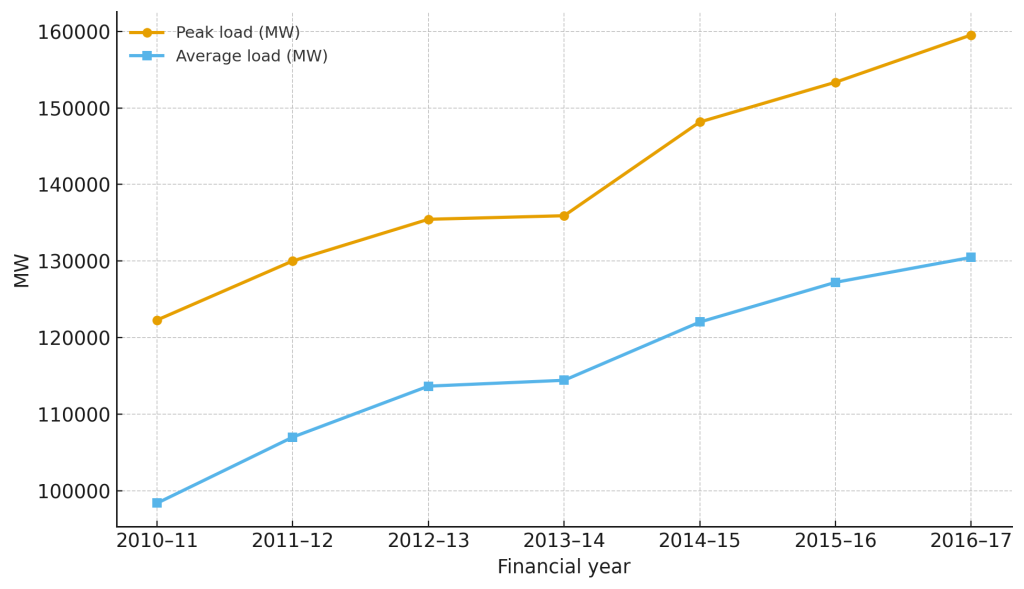
India’s peak vs. average load growth (2010–2017)
Roadblocks to Scaling Demand Response
Rolling out DR across India faces three intertwined challenges:
- Regulatory Gaps:
- State-level pilots exist, but polices are fragmented. Some states test Time of day tariffs, while others are just setting up DSM cells. A lack of national clarity makes scaling difficult.
- Financial Stress:
- India’s power distributors are caught in a financial bind. Years of mounting debt and widening revenue shortfalls have left little room for new spending. Demand Response offers a way out , cutting peak costs and improving efficiency over time but the catch is upfront. Investing in the necessary systems and paying consumer incentives can feel like an impossible ask when balance sheets are already stretched thin.
- Technology & Infrastructure:
- Smart meters form the heart of any Demand Response system. But as of early 2018, India is only just initiating to roll smart meters at large scale as earlier only pilots in few states took place. Unless these meters become communicable and can gather and share real time data in both the directions and able to download data to a data centre reliably, this will not be the true automation and will not help in applying Demand Response.
- Consumer Participation:
- Pilots show that even when the tech works, convincing businesses to adjust operations is not easy. Trust and clear value propositions are critical.
How Demand Response Works
DR is not about reducing overall energy use — it’s about shifting demand when the grid is stressed. Two main strategies stand out:
Peak Shaving : Reducing consumption during short peak periods e.g. turning down ACs in commercial building during peak hours like in offices during day peak and in market during evening peak.
Load Shifting : Shifting flexible loads from peak hours to off peak hours e.g. moving industrial process from peak hours to mid night , ironing of cloths or running of washing machine during off peak hours
The Tools Behind It
- Smart Meters (AMI): Provide real-time consumption data and enable dynamic tariffs.
- Automated Demand Response (ADR): Allows utilities to send signals directly to building or plant management systems, cutting out delays and manual intervention.
Need of DR
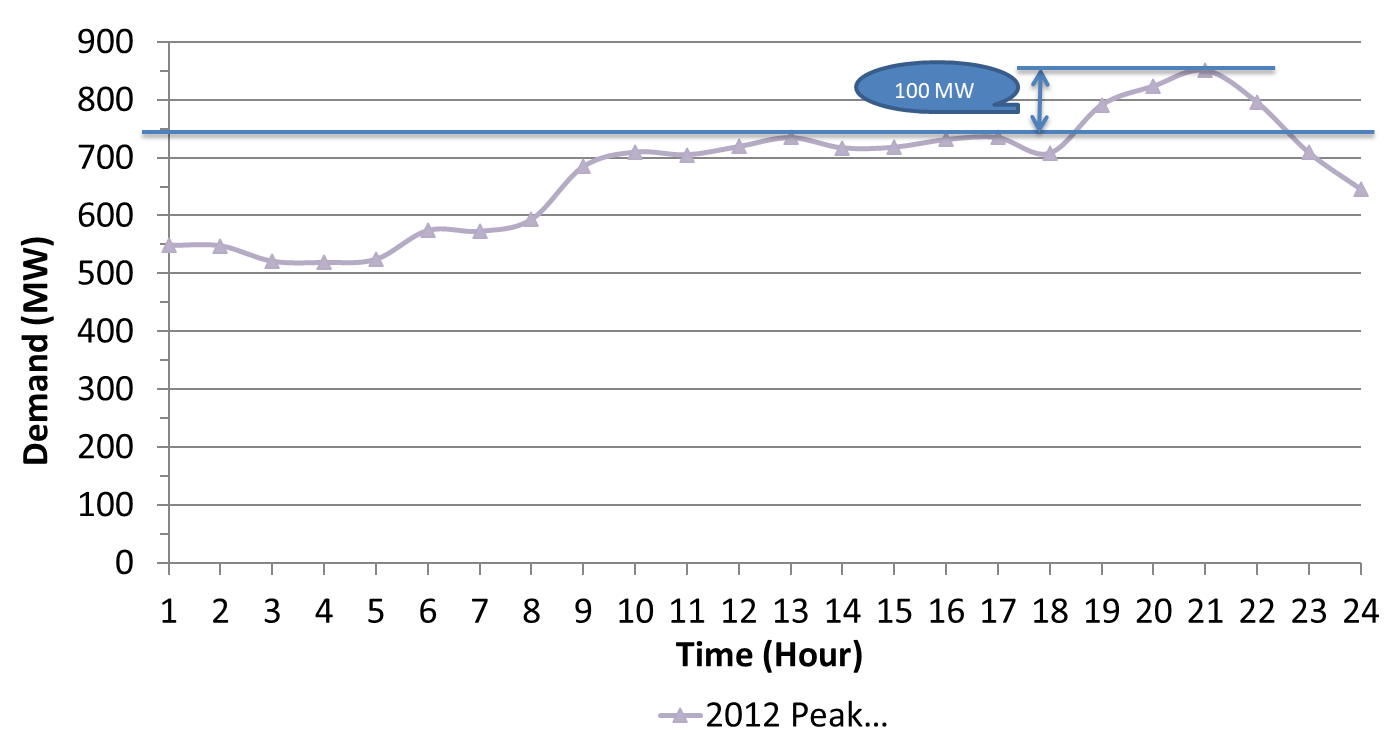
It can be seen that 100 MW demand occurs for 3 to 4 hours. The possibility of shifting or reducing it needs to be evaluated.
Impact of DR Program
DR can trim about 10% of peak load.
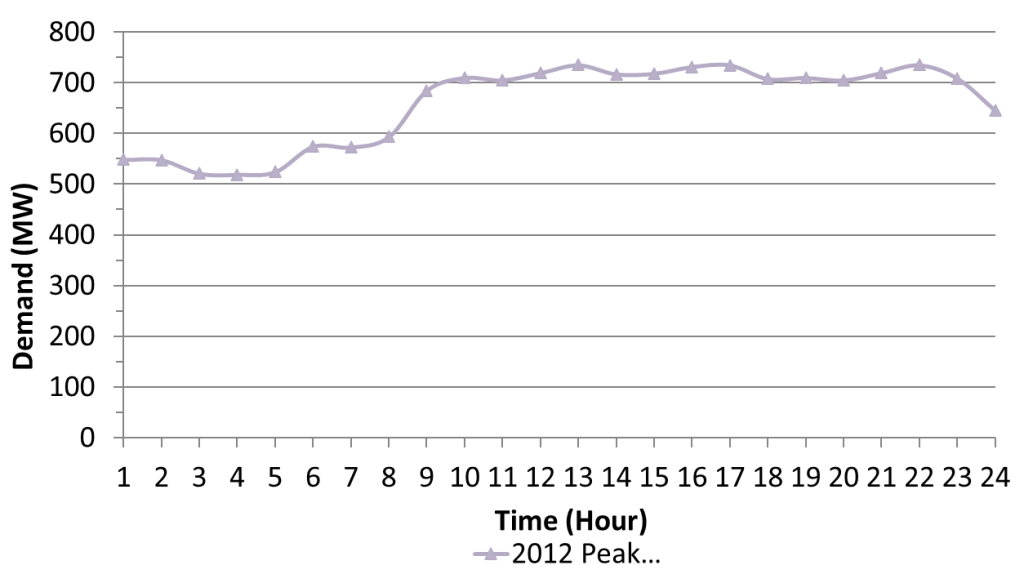
Need of DR
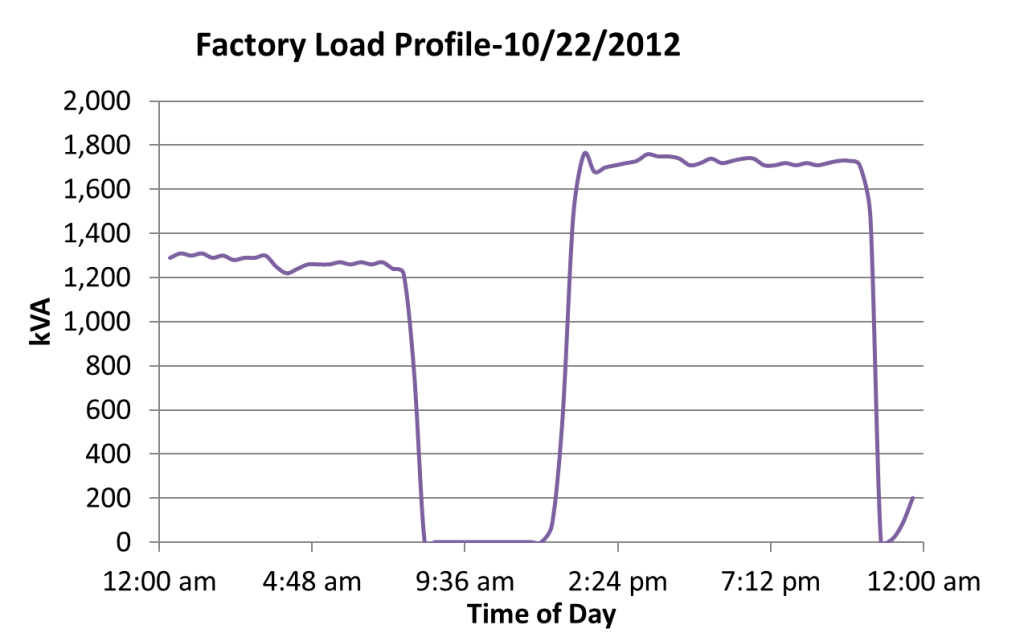
Is there a possibility of shifting or reducing load from 7 pm onwards (when the system faces peak demand) to some other time
Impact of DR Program
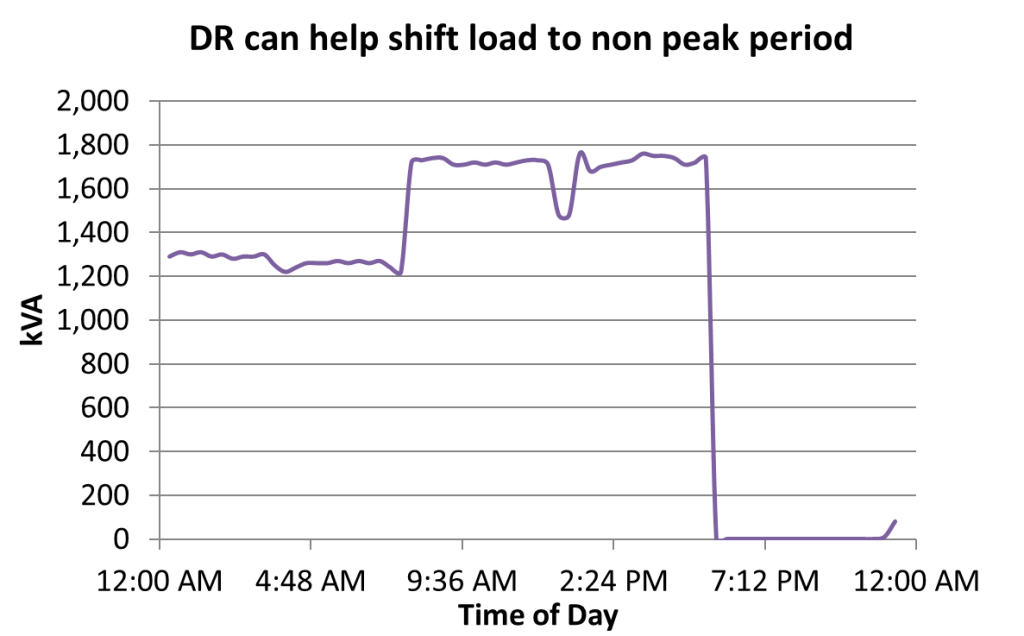
Demand Response smooths out spikes, creating a flatter, more manageable load profile
Lessons from Early Pilots in India
Though still limited in scale, early pilots show promise:
- Rajasthan DSM-Bidding Project (2017):
- 17 industrial consumers participated.
- Four DR events reduced demand by 22 MW.
- Key challenge: convincing industries to join without disrupting operations.
- Delhi ADR Pilot (TPDDL, with Honeywell & LBNL):
- 167 commercial & industrial buildings enrolled (>25 MW).
- Demand reductions ranged from 7% (commercial) to 18% (industrial).
- Lesson: different customer segments respond differently; one-size-fits-all won’t work.
- Puducherry Smart Grid Pilot:
- Installed 1,600 smart meters in first phase.
- Focused on testing AMI and storage integration.
The Value Proposition
DR creates value across three dimensions:
- Financial: Lowers peak power purchases and delays new infrastructure needs.
- Reliability: Acts as a flexible grid resource, reducing blackout risks.
- Environmental: Cuts reliance on carbon-heavy peaker plants, supporting renewable integration.
The Rajasthan pilot showed savings of nearly ₹80,000 per event, just by better aligning demand with supply.
Actionable Pathways for Stakeholders
- For Policymakers:
- Establish a national DR framework.
- Define DR as a grid resource with clear compensation.
- Incentivize smart meter rollouts and pilot-to-scale transitions.
- For DISCOMs:
- Start with industrial and commercial customers where impact is highest.
- Leverage BEE capacity-building support.
- Build internal expertise for data-driven DR programs.
- For Businesses:
- View DR as a cost-saving opportunity, not just an obligation.
- Engage with utilities to pilot ADR systems.
- Position early adoption as a competitive advantage.
Looking Ahead from 2018
Electricity demand is set to double or triple over the next decade. EV is entering into the market and fast conversion of sub urban localities to urban and metro will increase peaks. To handle these challenges growth will only sharpen peaks. If utilities keep managing demand the old way, they’ll face rising costs, more blackouts, and slower progress on renewables but a smarter demand management can address all these issues so nicely.
Yet Demand Response is in its initial phase in India. Already we have implemented pilot and know the learnings, a growing share of solar and wind and guidance & policy from Bureau of Energy Efficiency and Forum of Regulators .Now from here only need to convert pilots into national strategy that makes smarter power use .