

1. The New North Star of Climate Ambition
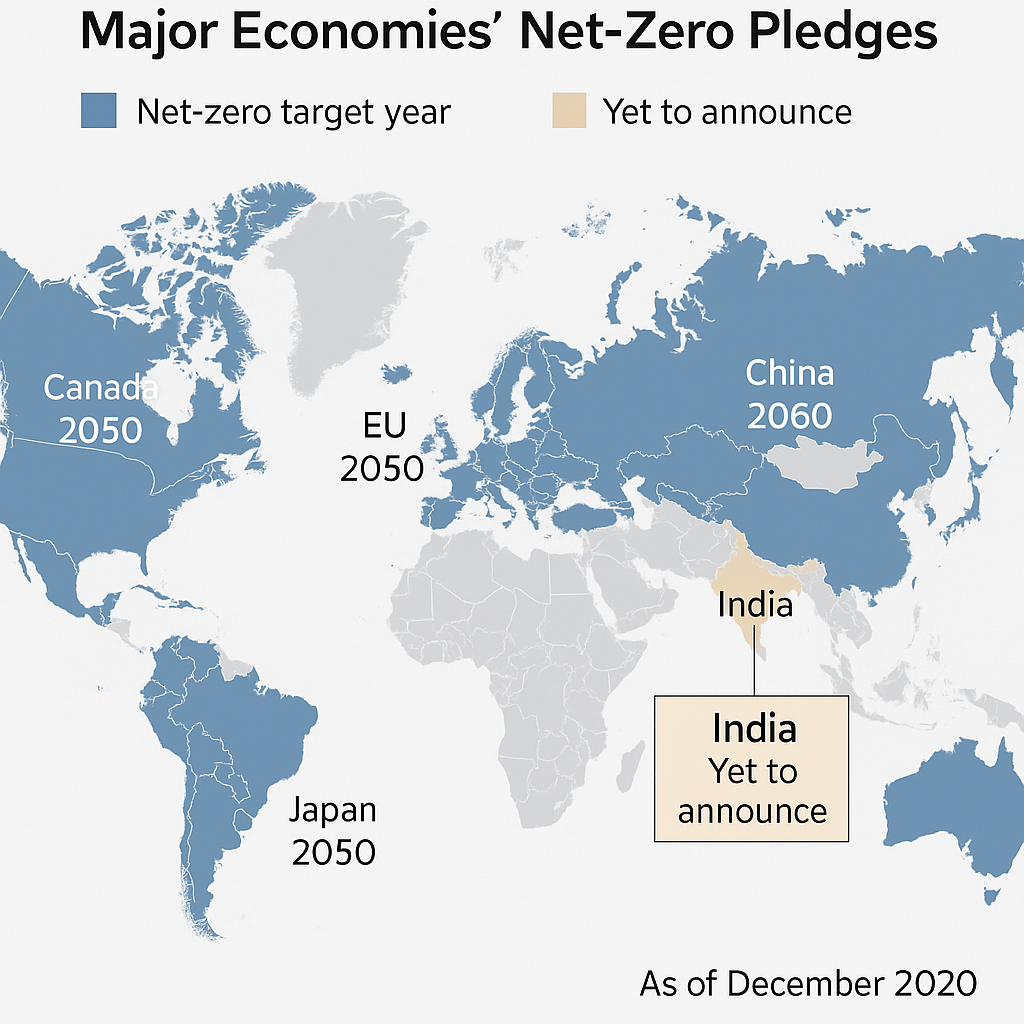
Something changed around 2020 , it wasn’t just a gleam but a complete pivot. The pandemic had forced the world to look in the mirror, and the reflection wasn’t flattering. “Resilience” became the word of the year. Suddenly, net-zero wasn’t a fringe slogan anymore. It was everywhere ,in business pitches, boardrooms, and bureaucratic briefings.
By 2021, the most of the big economies of the world ,who actually build the market and the news had stepped on it . The UK staked its claim on 2050. China stunned the world with a 2060 promise. The United States re-joined the climate conversation. And then all eyes turned to India. The question hung in the air — when will India commit?
This question was not oratorical inside the Ministry of Power and NITI Aayog. This was just like an elephant in the room. Discussions on how to make India a “Net-Zero by 2070” have started surfacing : something daring need to manifest leadership, but well founded to position in India’s reality.
And let’s be clear , it wasn’t about branding. It was a mental shift. An admission that growth and green goals weren’t opposing forces anymore. They were twins born of the same future.
2. India’s Energy Transition: Building While Decarbonising
India’s transition doesn’t look like anyone else’s. Western nations are tweaking mature grids. India is building an entirely new one , while trying to clean it up in real time.
In 2021, coal was the main fuel -to generate nearly 70% of total electricity in India. But the winds were literally shifting. Renewables were surging, with capacity past 95 GW and climbing. The government’s goal of 450 GW by 2030 sounded wild to some but not impossible to anyone watching the pace.
Here’s the rub: India’s dilemma isn’t just technical; it’s existential. Energy is the oxygen of growth. Factories, homes, farms ,all are hungry for power. Yet the world’s watching, urging India to decarbonise faster.
Unlike Europe, India doesn’t have the luxury of shutting down plants and importing energy. It has to expand and clean up simultaneously — juggle access, affordability, and ambition.
The financial world’s already tuned in. COP26 speeches, ESG scores, and green bonds are steering global capital. Investors want credible transition plans, not just good intentions.
So when talk of “Net-Zero by 2070” gained traction, it wasn’t symbolism. It was economics — India signalling that it intends to play the long game.
3. Winners, Losers, and Learners in the Net-Zero Era
A net-zero commitment isn’t a memo you file away; it’s a full rewiring of the economy. Every stakeholder like DISCOMs, industries, households have skin in the game.
a. DISCOMs: From Power Sellers to System Jugglers
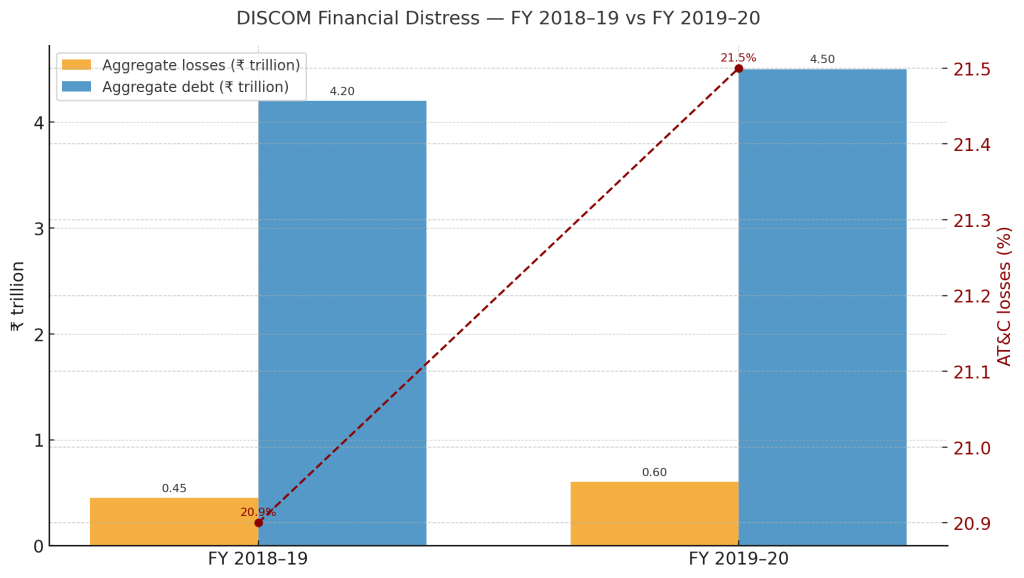
Distribution companies (DISCOMs) have long been the Achilles’ heel of India’s power ecosystem. Saddled with losses, political tariffs, and outdated gear, many operate in survival mode. A net-zero future changes the entire script.
With solar rooftops, battery storage, and microgrids spreading, energy flows will no longer be one-way. DISCOMs will need to evolve from simple suppliers into “platform managers” — balancing distributed generation, digital demand response, and grid reliability.
That’s easier written than done. Smart meters, automation, real-time data — all cost money. And for utilities already gasping under debt, reform isn’t just desirable, it’s survival. Without it, the clean-energy dream stays just that -a dream.
b. Industry: Walking the Carbon Tightrope
India’s heavy industries such as steel, cement, fertiliser, chemicals are at a crossroads. Move too slowly, and carbon tariffs will bite. Move too fast, and costs could crush competitiveness.
Decarbonisation isn’t a light switch; it’s a systems overhaul. It means green hydrogen, electrified heat, carbon capture technologies that are pricey and still in early innings. Yet ignoring them isn’t an option for long. The EU’s Carbon Border Adjustment Mechanism (CBAM) will make high-emission exports a liability.
So the equation flips. Clean becomes competitive. Quick accepters win new markets; trailers risk obsolescence.
And yet there’s optimism: India’s clean-energy surge could birth entire new ecosystems — hydrogen hubs, storage clusters, renewable manufacturing bases. Net-zero, viewed from this angle, isn’t a constraint. It’s an industrial revolution in disguise.
c. Consumers: The Quiet Transformation
For ordinary people, change will creep in slowly — and then all at once. Rooftop panels. Electric scooters. Smart appliances. Cleaner air. It’s already under way.
But here’s where things get delicate: cost and reliability. If green power feels expensive or erratic, enthusiasm will fade. The transition has to feel better than what came before , not just sound greener. Otherwise, support evaporates, and policy momentum with it.
4. The Balancing Act: Hope and Hard Truths
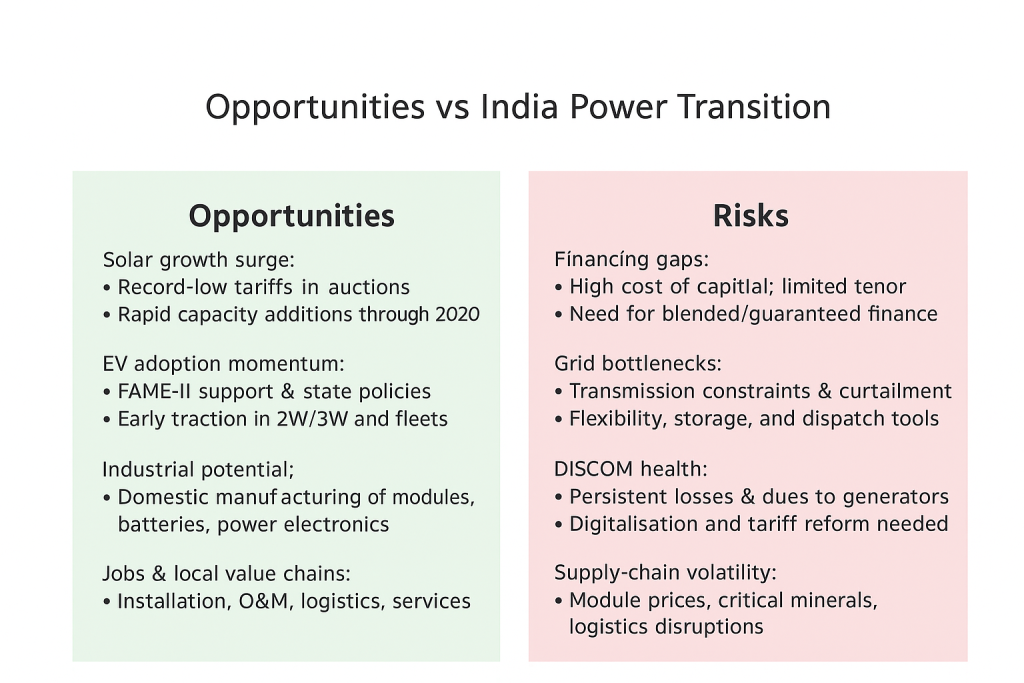
India’s net-zero roadmap comes with both fireworks and fault lines. Let’s be blunt about it.
The Upside:
– Investment magnetism. Done right, India could pull in trillions over the coming decades. Hydrogen plants, offshore wind, EV manufacturing - the opportunities are immense.
– Innovation boom. Start-ups are already tinkering with IoT grids, energy analytics, and carbon-tracking tools. Innovation loves urgency — and climate policy provides it.
– Global credibility. If India demonstrates that growth and decarbonisation can fall together, it acquires not only investors, but also moral strength across the developing world.
The Downside:
– Transition pains. Coal-heavy states could face social and fiscal shocks. Without new industries rising in tandem, the fallout could be messy.
– Financing gaps. Domestic banks remain cautious. Green finance still looks riskier than it should.
– Policy sprawl. Ministries and states sometimes pull in opposite directions — admirable announcements, unclear execution.
In short, the policy compass points north — but we’re still arguing about who’s steering. The Electricity (Amendment) Bill, Renewable Purchase Obligations, and the Hydrogen Mission all have promise. What they need now are teeth ,not tweets.
5. Leadership Focus: From Talk to Toil
If you’re in government or industry leadership, the debate’s over. India will go net-zero. The only question left is how to make it inclusive, bankable, and bulletproof.
Build the Grid of Tomorrow -Today
A renewables-led system can’t run on yesterday’s playbook. The grid needs flexibility, smarts, and serious investment in storage. Think algorithms, not analog meters. Think dynamic pricing, not flat rates.
Keep It Just, Not Jarring
Coal won’t vanish overnight, and pretending otherwise helps no one. Millions depend on it for livelihoods. So, any transition plan must cushion the blow — retraining, safety nets, regional development. A humane transition isn’t charity; it’s strategy.
Fix Finance - or Forget It
Let’s be honest . The clean energy won’t move without capital. India needs a new financing toolkit: sovereign green bonds, blended models, guarantees that crowd in private investment. Without that, policy ambition will stay stuck on paper.
Leadership, in this decade, means doing the unglamorous work — getting cables laid, contracts enforced, projects funded. Not just cutting ribbons at summits.
6. The Long View: Turning Targets into Transformation
Net-zero by 2070 might sound like a faraway goal for India , but the journey begins now. Building of infrastructure like each megawatt installation, drafting of any policy & guidelines choose to reform takes long and not an overnight task. The India we see in 2050 will be built on the energy and infrastructure decisions we make today.
Forget “peak coal” or “peak oil.” The real milestone is “peak hesitation.” Once India sets an irreversible course, the rest will follow momentum, not debate. This is the defining decade , the one that separates vision from wishful thinking
If we get this right, “Net-Zero by 2070” won’t sound like a distant dream. It’ll sound inevitable — the logical outcome of a country refusing to choose between prosperity and the planet.
Closing Reflection
The power sector has always been a bit of a wild ride — complicated, unpredictable, and impossible to ignore. This is where India’s energy story will really unfold. Every policy change, every tariff adjustment, and each new solar project isn’t just paperwork; it’s a brick in the foundation of the country’s future.
You’ve probably heard that saying about planting a tree — the best time was years ago, the second-best time is now. That couldn’t be truer for climate action. There’s no shortcut, no pause button — only a direction that leads forward.