

No other state matched Bihar’s transport growth in 2021–22: at 20.4%, it led the country. By 2022, sector emissions reached 18.4 million tonnes of CO₂, with freight doing most of the heavy lifting (83%) and passenger travel making up the remaining 17%.
1. A Turning Point for Bihar’s Clean Mobility Story
Bihar is often seen through the twin lenses of agriculture and migration. But a new story is taking shape on its roads. Low‑carbon transport is quickly becoming an engine of modernisation - linking climate goals with everyday mobility, steady livelihoods for drivers and mechanics, and the promise of cleaner city air. Patna, Gaya, Muzaffarpur, and Bhagalpur have all seen a surge in electric rickshaws, while policy efforts are now shifting toward public-transit electrification and integrated mobility planning.
By late 2023, the state began lining up its playbook with India’s big mobility reforms like FAME‑II, PLI push for advanced auto tech, and the PM‑eBus Sewa scheme. Bihar is adapting these policies to its own realities: a power grid that still needs strengthening, dense urban cores where space is scarce, and tight municipal budgets that demand smarter financing. In short, Bihar’s transport transition isn’t just about new vehicles but it’s about building a system that works for its people and fits the state’s constraints, while moving the needle on climate and air quality.
2. Policy Milestone: Linking Bihar’s Urban Growth to Clean Transit
Why Transport Matters for Bihar’s Climate Goals
Transport accounts for nearly 30% of Bihar’s urban emissions, driven largely by two- and three-wheelers and unregulated diesel public transport.
In Patna and tier-2 towns, the carbon intensity of urban mobility is increasing very fast. The State Urban Development and Housing Department (UDHD) has started planning for urban transit in line with the national climate goals.The Bihar Electric Vehicle Policy (draft 2023) prioritises:
- EV adoption for commercial and shared mobility,
- fleet electrification of city buses under PPP models, and
- charging infrastructure linked to urban power reforms under BESCOM and South Bihar Power Distribution Company (SBPDCL).
3. Bihar in India’s Policy Web: Translating National Reforms Locally
While central schemes like FAME-II and PLI-Auto set the national direction, Bihar’s challenge lies in implementation and localisation.
| Policy / Scheme | National Focus | Bihar’s Adaptation | Progress as of Dec 2023 (and immediate follow‑through) |
|---|---|---|---|
| FAME‑II | Demand incentives for EVs; emphasis on e‑2W & e‑3W, plus grants for 7,000 e‑buses nationally. | Use incentives to push shared mobility (e‑3W) and city e‑buses; keep private four‑wheelers de‑emphasized. | Bihar is among India’s top e‑rickshaw states; ~1.09 lakh e‑rickshaws registered by 2023 (Vahan‑based reporting) |
| PLI (Auto/Battery) | Localise advanced auto & EV tech manufacturing in India. | Light assembly & charger MSMEs over heavy cell manufacturing; leverage plug‑and‑play sheds in the Bihta (near Patna) cluster to attract vendors. | BIADA shows ready‑to‑use industrial space and plug‑and‑play sheds in Bihta/Patna for MSMEs; positioned for EV supply‑chain activity (no separate “EV cluster” notification) |
| PM‑eBus Sewa | Deploy 10,000 e‑buses on PPP (GCC) and fund Green Urban Mobility Initiatives (GUMI). | Patna, Bhagalpur, Darbhanga, Gaya, Muzaffarpur, Purnia are eligible under the scheme; adopt GCC with payment safeguards and depot upgrades. | Eligibility formally listed (Dec 11, 2023); first CESL tender (3,600 e‑buses) issued Nov 2023; consolidated demand shows 400 e‑buses for Bihar (200×9 m + 200×12 m) in early 2024 documents |
| GUMI (under PM‑eBus Sewa) | Support NCMC/AFCS, bus‑priority and multimodal integration alongside e‑bus ops. | Align Patna’s ITS/smart‑city stack with NCMC/AFCS; prepare proposals for priority corridors. | GUMI is explicitly part of the scheme guidelines; cities can fund AFCS, priority lanes, and integration with metro/BRT/feeder modes |
Bihar’s leadership recognises that a state-level EV roadmap must adapt to its fiscal and institutional capacity. Rather than copying richer states’ models, Bihar focuses on high-utilisation public transit and low-cost shared EV mobility.
Bihar’s EV future lies not in luxury cars, but in electric buses, rickshaws, and intermediate public transport.
4. Market Momentum: The Rise of E-Rickshaws and the Economics of Everyday Electrification
Bihar’s e-rickshaw ecosystem is one of India’s largest and most organic.
Over 1.2 lakh e-rickshaws ply across its cities and towns, largely financed by small entrepreneurs and local cooperatives.
These vehicles have proven that EVs can thrive even with minimal subsidies, provided there’s dependable financing and servicing.
The Cost Advantage
| Parameter | Diesel Auto | Electric Rickshaw |
|---|---|---|
| Purchase Price | ₹2.3–2.5 lakh | ₹1.6–2.0 lakh |
| Operating Cost/km | ₹3.8–₹4.2 | ₹0.8–₹1.2 |
| Daily Income | ₹900–₹1,100 | ₹1,200–₹1,400 |
| Payback Period | - | < 12 months |
For small drivers, the switch to electric is not ideological - it’s financially rational.
However, access to formal credit and battery-servicing ecosystems remains uneven.
Banks are often reluctant to lend to unorganised drivers, and this gap ends up being filled by informal lenders. Bihar can set the pace by introducing a credit guarantee fund for EV livelihoods, giving banks and MFIs the confidence to offer loans to low-income EV operators without taking on excessive risk.
When electric mobility meets inclusive finance, climate ambition becomes a livelihood strategy.
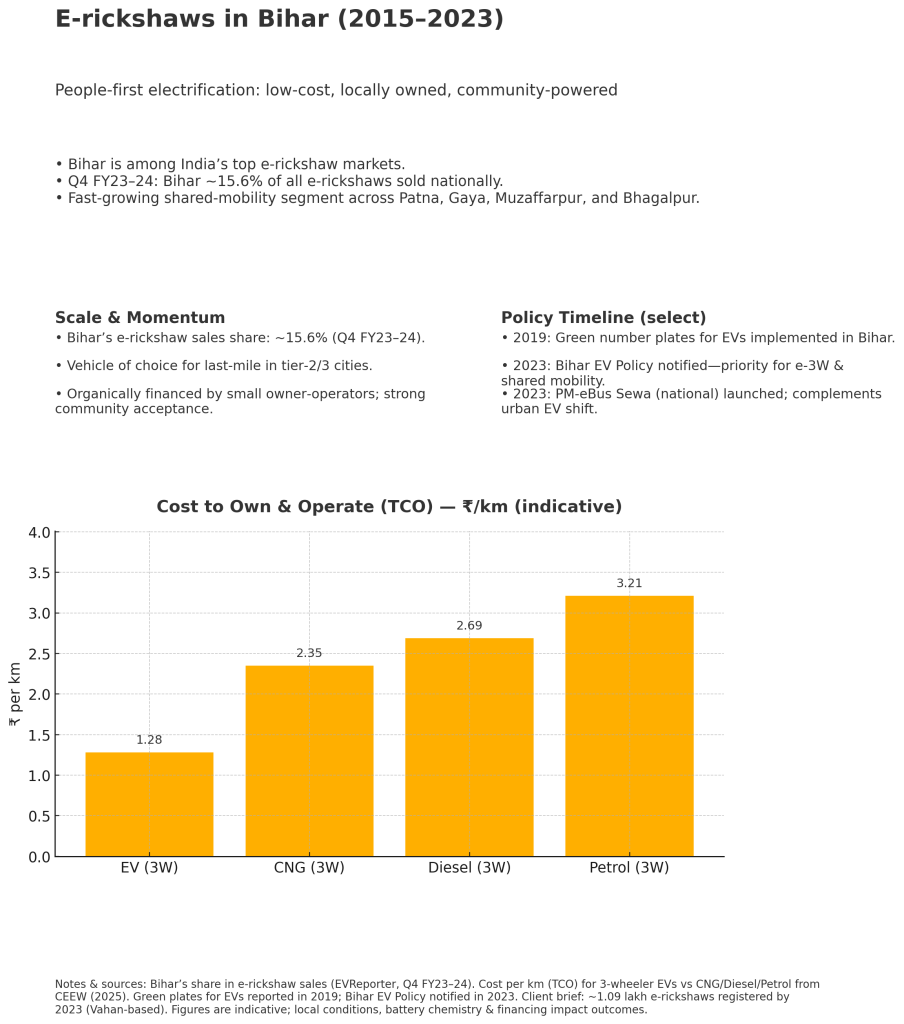
E-rickshaws have become Bihar’s largest clean-mobility segment - low-cost, locally owned, and community powered.
5. Electrifying Public Transit: The E-Bus Opportunity
Patna’s pilot under the PM-eBus Sewa scheme represents Bihar’s next mobility frontier.
The model - based on Gross Cost Contracts (GCC) - allows private operators to run e-buses while the state pays per kilometre.
This addresses the capital barrier for cash-strapped urban local bodies (ULBs).
However, execution will depend on payment security, charging infrastructure, and route rationalisation.
Key lessons from other states (like Gujarat and Telangana) are being incorporated:
- Leasing models over outright purchase.
- Depot-level solar charging integrated with SBPDCL’s ToD tariff reforms.
- Smart scheduling via Patna Smart City’s ITS platform.
Systemic Impact
Each e-bus replaces around 45–50 diesel trips daily, saving nearly 55 tonnes of CO₂ annually per bus.
A 500-bus fleet could offset 27,000 tonnes of CO₂ per year - comparable to greening 40,000 households’ annual emissions.
key operating assumptions
| Parameter | Assumption | Explanation |
|---|---|---|
| Average daily distance per e-bus | 200 km/day | A typical city e-bus operates ~200 km per day (two shifts). |
| Diesel bus fuel efficiency | 2.5 km per litre | Common for heavy-duty city buses with frequent stops. |
| Diesel emission factor | 2.68 kg CO₂ per litre | IPCC standard emission factor for diesel combustion. |
| Operational days per year | 330 days | Accounting for maintenance and holidays. |
6. Impacts on Power, Industry, and Consumers
Power Utilities
Both North and South Bihar DISCOMs face rising urban electricity demand.
EV integration offers an opportunity - not a burden - if managed through Time-of-Day tariffs and smart metering.
Trials in Patna have already shown that using solar power during the midday window can comfortably handle depot charging and avoid adding pressure to the evening peak. The new Bihar Renewable Energy Policy (2023–28) also makes it clear that EV-charging providers are encouraged to set up solar installations alongside their charging stations.
Industrial Ecosystem
Bihar is positioning itself as a light-assembly and component-supply base rather than a battery-manufacturing hub.
The Bihta Industrial Corridor near Patna offers land and connectivity for EV-component MSMEs - targeting small-scale assembly, retrofitting, and charger manufacturing.
This aligns with Bihar’s comparative advantage:
- Low input costs and labour availability.
- Strategic proximity to eastern markets (Jharkhand, West Bengal, UP).
- Existing energy-infrastructure upgrades under SBPDCL’s Revamped Distribution Scheme.
Consumers
For citizens, EV adoption is still constrained by charging access and quality assurance.
Currently, Patna has fewer than 60 public chargers, with inconsistent service quality.
To build consumer trust, Bihar needs:
- State EV Service Rules to certify CPOs.
- Single mobile app integrating charger availability, tariffs, and payments.
- Battery swap hubs at auto stands and bus depots.
7. Opportunities and Risks Ahead
Financing & Fiscal Risk
STUs and ULBs in Bihar operate under tight fiscal conditions. Without structured payment guarantees, private e-bus operators may face delayed reimbursements.
A state-level green-mobility fund, backed by pooled municipal revenues and development finance, could stabilise contracts and attract private capital.
Battery Waste & Circularity
With thousands of informal e-rickshaw operators, unregulated battery disposal is an emerging challenge.
Implementing the Battery Waste Management Rules (2022) requires establishing district-level collection points and formal recycling partnerships.
Grid Readiness
Urban substations need targeted upgrades for clustered charging.
Integrating renewable microgrids at depots and market hubs can help Bihar leapfrog toward a low-carbon power + mobility nexus.
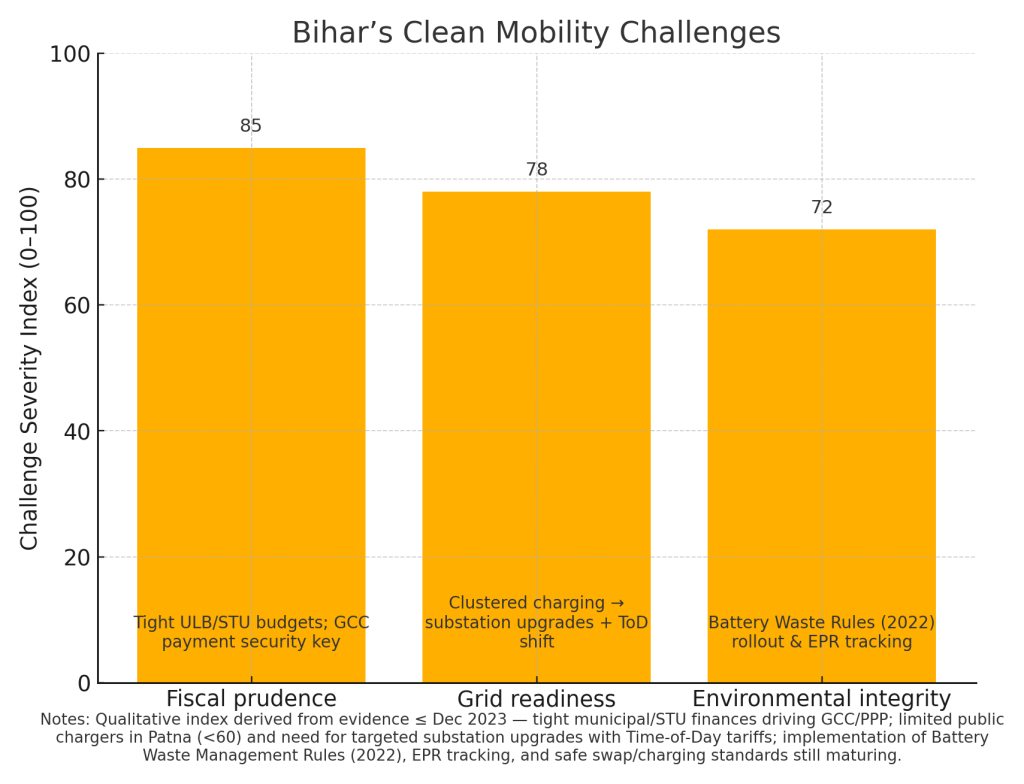
Bihar’s challenge: balancing fiscal prudence, grid readiness, and environmental integrity.
8. Strategic Perspective: What Bihar’s Leaders Should Focus On
- Prioritise Public Transport Electrification
Focus on bus and shared-vehicle fleets where emissions impact and economic multipliers are highest. - Enable Green Finance at the Local Level
Partner with SIDBI, NABARD, and state cooperative banks to create risk-sharing facilities for EV loans. - Institutionalise Circular Systems
Develop public-private recycling hubs for e-rickshaw and bus batteries. - Grid-Smart Integration
Build smart-charging infrastructure in coordination with SBPDCL, leveraging ToD tariff benefits. - Inclusive Planning
Design EV policies that enhance, rather than displace, the livelihoods of small drivers, mechanics, and fleet owners.
9. The Road Ahead: Building Bihar’s Clean Mobility Identity
As 2023 draws to a close, Bihar stands at the frontier of a transformative opportunity.
Its EV ecosystem has emerged organically, but formalising it through policy alignment, financial innovation, and institutional readiness can redefine the state’s urban identity.
The next decade could see Bihar evolve from being a late adopter to a model of inclusive decarbonisation - one where every e-rickshaw, every bus, and every depot becomes a node in a broader energy transition.
The Way Forward
- Align state EV rules with national FAME-III priorities.
- Mainstream green public transport in all smart-city and AMRUT-II projects.
- Establish renewable-powered mobility hubs that integrate solar, storage, and charging.
If Bihar follows this transition with steady effort and clear intent, the move to cleaner transport can do much more than cut emissions ,it can support inclusive growth, clean up the air, and open up long-term livelihood opportunities.