
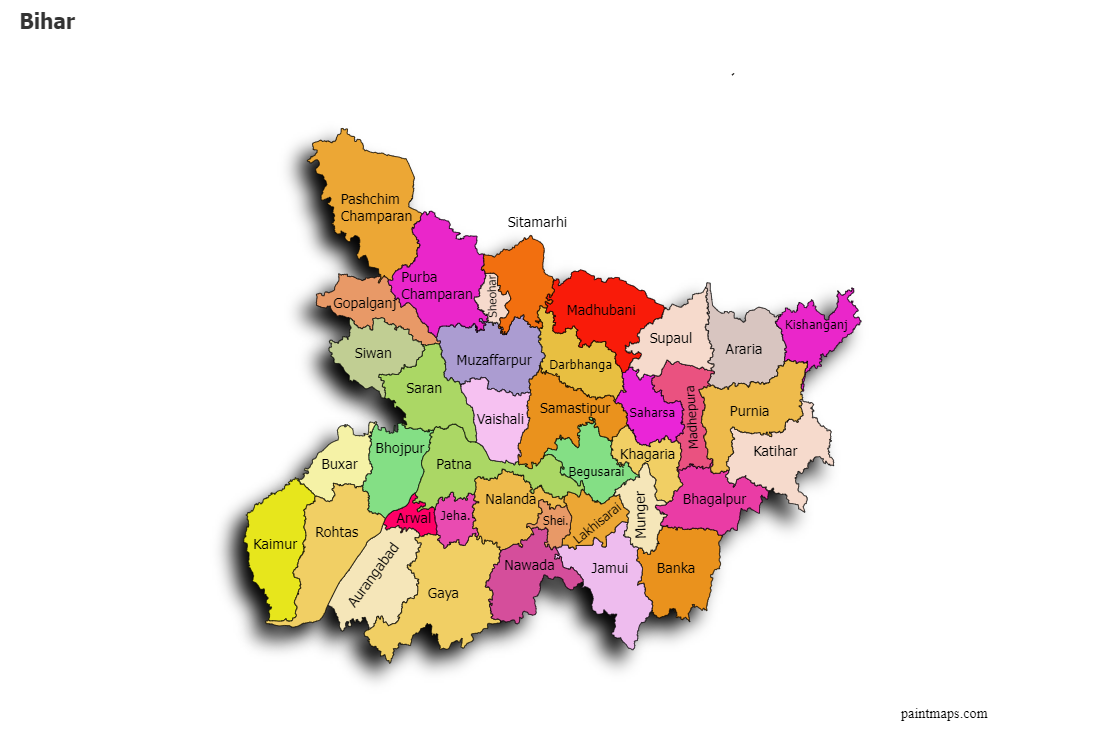

Introduction: A State at the Edge of Transformation
Bihar stands at a crucial crossroad. It has one of India’s fastest-growing state economies, but also one of its most climate-vulnerable landscapes. For millions of households that depend on rain-fed agriculture, recurring floods, droughts, and heatwaves are not abstract risks - they are everyday disruptions.
For Bihar, climate action is not a “green add-on.” It is economic insurance. A low-carbon, climate-resilient development path is the only way to ensure that growth, livelihoods, and investments aren’t washed away year after year.
For Bihar, climate action is not a “green add-on.” It is economic insurance. A low-carbon, climate-resilient development path is the only way to ensure that growth, livelihoods, and investments aren’t washed away year after year.
Energy and Emissions Profile (2018)
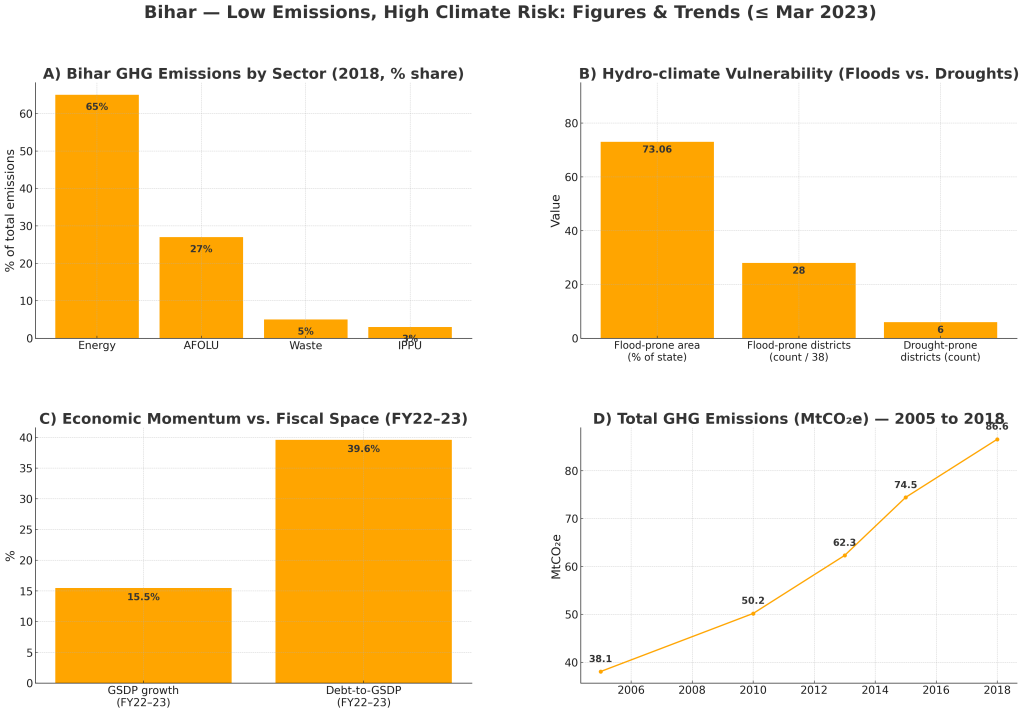
Bihar’s greenhouse gas (GHG) profile underscores a structural challenge rooted in energy access. In 2018, Bihar’s net GHG emissions totaled 86.59 Million Tonnes of Carbon Dioxide Equivalent (Mt CO2e). This figure translates to a per capita emission rate of 0.74 t CO2e/capita, which is extremely low compared to the national average. The strategic priority, therefore, is to pursue development-driven efficiency and clean energy access rather than imposing emissions restrictions that could impede economic growth.
The sectoral breakdown of emissions reveals where mitigation efforts must be concentrated :
Bihar’s Sectoral GHG Emissions (*The 2018 baseline remains the last fully audited and published detailed data for Bihar’s emissions by sector)
| Sector | Emissions (Mt CO2e) | Percentage Share |
| Energy | 56.57 | 65% |
| AFOLU (Agriculture, Forestry, Land Use) | 23.05 | 27% |
| Waste | 4.78 | 5% |
| IPPU (Industry) | 2.19 | 3% |
Bihar’s Development Crossroads: Growth Meets Fragility
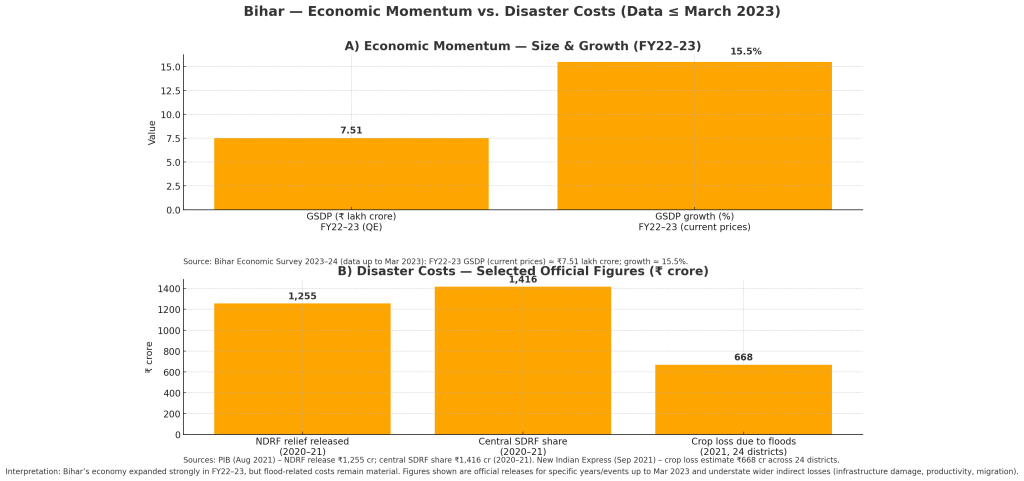
Bihar is home to over 120 million people, the vast majority in rural areas. Agriculture employs more than 80% of the population, yet contributes around 20% of the state’s GSDP. Growth in recent years has been impressive - the state clocked over 14% GSDP growth in 2022–23. But this momentum is fragile.
- High fiscal stress: The debt-to-GSDP ratio hovers close to 40%, leaving little room for shock-absorbing expenditure.
- Heavy disaster costs: Floods and droughts consistently wipe out infrastructure, homes, and harvests.
- Dependence on rain-fed systems: With limited irrigation and storage infrastructure, farmers remain highly exposed.
Bihar’s energy sector dominates emissions
The Climate Paradox: Too Much Water, Too Little Water
Few states face such a split climate reality.
- North Bihar: Chronic flooding. Over three-quarters of the northern population live under constant flood risk from Himalayan rivers like Kosi, Bagmati, and Gandak.
- South Bihar: Persistent drought. Agro-climatic Zone III is increasingly water-scarce, pushing farmers into cycles of loss and migration.
Add to this the intensifying heatwave threat. Even early 2023 saw record heat events, shutting shops and crippling outdoor labour productivity.
Bihar’s economic momentum vs. disaster costs
Why Low-Carbon Development is the Only Way Forward
Here’s why Bihar cannot afford a “business-as-usual” development path:
- Protecting agriculture: Climate-smart farming and water resilience protect over 80% of livelihoods.
- Modernizing energy: Decentralized renewables can displace biomass, clean the air, and stabilize rural grids.
- Fiscal logic: Every rupee spent on resilience saves multiple rupees otherwise spent on relief and rebuilding.
A Blueprint for Action
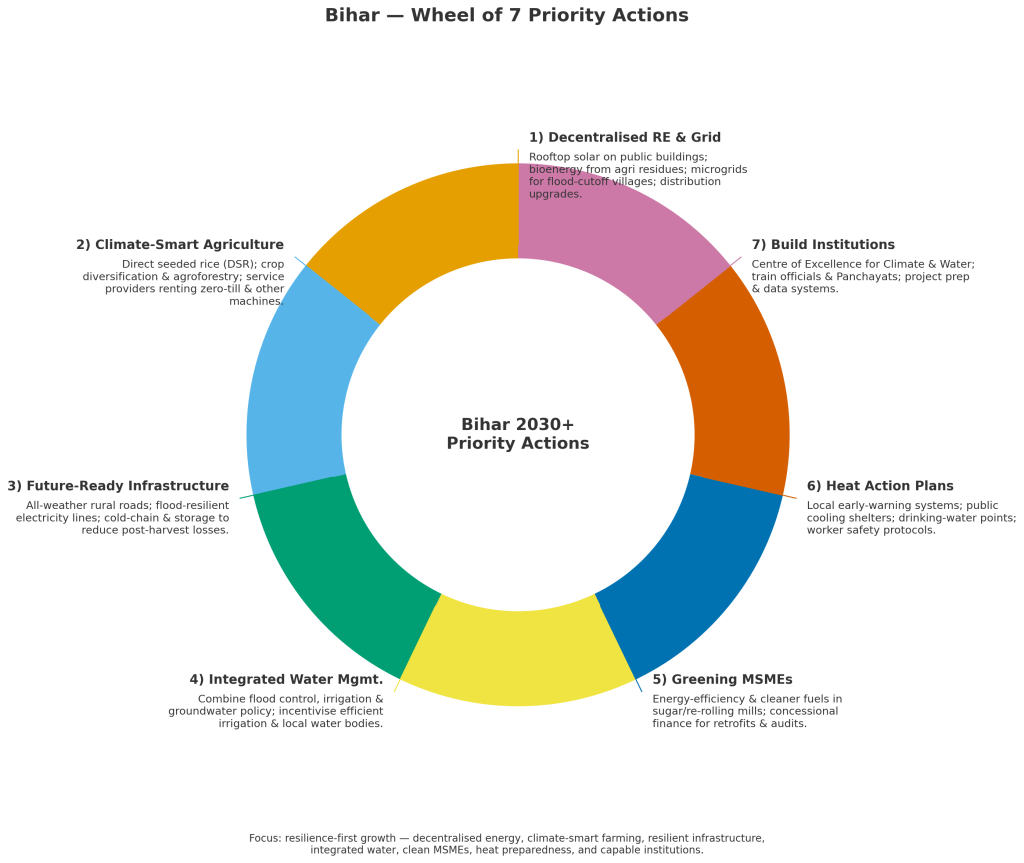
1. Decentralized Renewable Energy & Grid Modernization
Move beyond the planned 400–450 MW of solar parks. Bihar must champion:
- Rooftop solar on schools and government buildings.
- Bioenergy projects tied to agriculture residues.
- Microgrids for villages frequently cut off by floods.
2. Climate-Smart Agriculture
- Direct Seeded Rice (DSR) for water efficiency.
- Agroforestry and crop diversification to stabilize incomes.
- Farmer cooperatives to rent out machinery like zero-till drills.
3. Future-Ready Infrastructure
- Climate-proof rural roads and electricity distribution lines.
- Cold storage facilities scaled from 30 to 2,000 units to prevent post-harvest losses.
4. Integrated Water Resource Management
- Single policy combining flood control, irrigation, and groundwater management.
- Incentives for efficient irrigation systems.
5. Greening MSMEs
- Upgrade energy use in small sugar mills and re-rolling mills.
- Create low-interest financing schemes for efficiency tech.
6. Heat Action Plans
- Localized early-warning systems for heatwaves.
- Public cooling shelters during peak summer.
7. Building Institutions
- A Centre of Excellence for Climate and Water Management to train officials, Panchayat leaders, and urban planners.
Bihar’s climate strategy with 7 priority actions for Bihar
Case Studies: Bihar’s Emerging Experiments
- Direct Seeded Rice pilots: Smallholder farmers save water and labor, but adoption accelerates only when service providers rent machines instead of farmers buying them outright.
- Low-Carbon MSMEs: Targeted interventions in sugar and re-rolling mills have cut energy use and emissions, showing that small industries can lead the way.
The Roadblocks Ahead
- Finance: Bihar’s high debt limits big-ticket spending. Creative financing and external partnerships are essential.
- Institutional capacity: Fragmented responsibilities slow down cross-sector solutions like integrated water management.
- Grassroots adoption: Farmers are rationally risk-averse. Policies must reduce the cost and risk of trying new technologies.
Call to Action
If Bihar can pull this off, it won’t just safeguard its people - it will pioneer a model for other climate-vulnerable states across India.
Next steps could include:
- A Climate Investment and Resilience Cell in the state government to package bankable projects.
- A Resilience Finance Window from central agencies and development banks.
- Private sector partnerships in decentralized renewables and cold chain infrastructure.
Conclusion
For Bihar, climate resilience isn’t optional - it is the bedrock of development itself. Its low per capita emissions give it the moral authority to demand climate justice, but its acute vulnerabilities make resilience an urgent necessity.
The lesson for others is clear: embed climate resilience into growth, or risk losing both.