
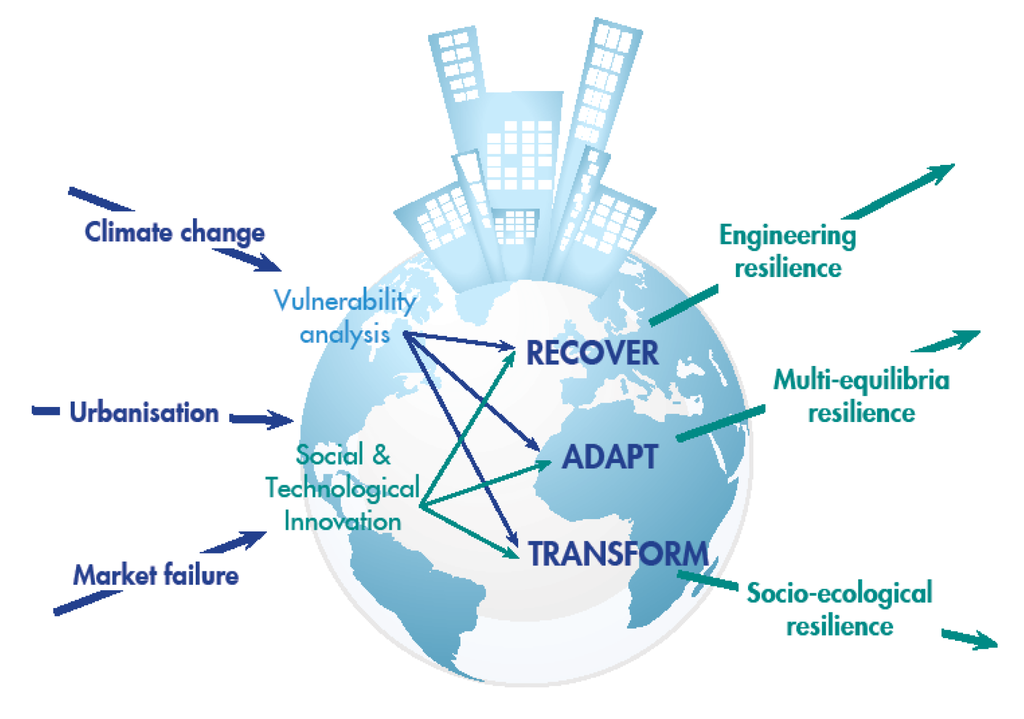

1. A Year of Milestones and Warnings
In early June 2025, India reached a landmark in its clean-energy journey.
On 9 June, the national grid met a record 241 GW peak demand with zero peak shortage - an achievement backed by an unprecedented 34 GW of new capacity in FY 2025, including 29.5 GW from renewables. Engineers across state load dispatch centres rightly celebrated a system capable of supporting the country’s economic momentum.
Yet the same week brought sobering reminders of climate volatility.
A new Council on Energy, Environment and Water (CEEW) report shows that 57 % of Indian districts - home to 76 % of the population - face high to very high heat-risk, while the 2025 Climate Risk Index ranks India sixth globally for climate-related impacts over the past three decades.
The paradox is stark: national-level sufficiency masks local fragility.
A strong national grid is only as secure as its weakest distribution link.
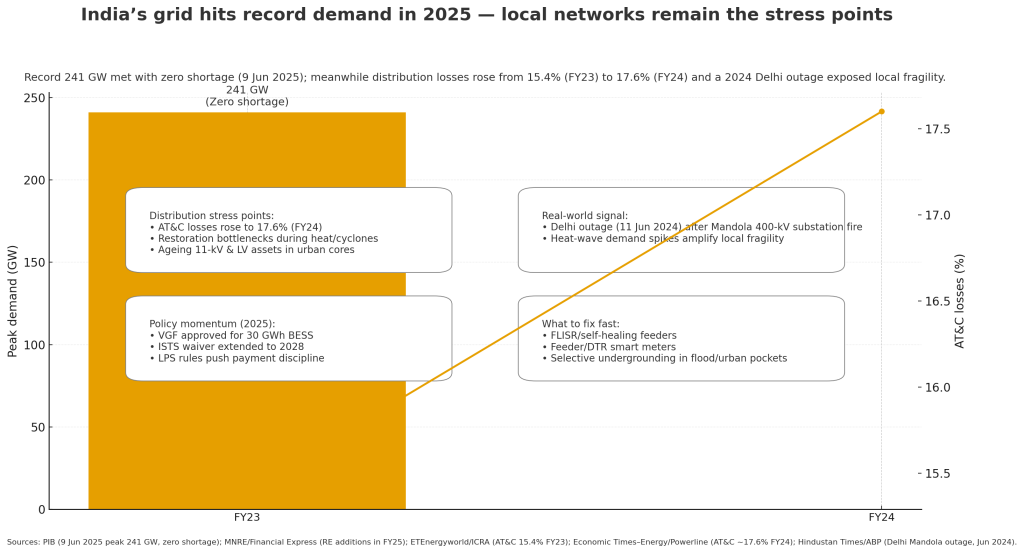
India’s grid hits record demand in 2025, but local networks remain the stress points.
2. The Distribution Weak Spot
While transmission capacity has expanded, the distribution segment - the last mile that directly serves homes and businesses - continues to struggle.
Aggregate Technical & Commercial (AT&C) losses climbed from 15.3 % to 16.3 % in the past year, reflecting both financial distress and operational inefficiencies.
When climate events strike, these weaknesses amplify.
Financially stressed DISCOMs lack capital for rapid restoration or proactive upgrades, so a single cyclone or heatwave can trigger cascading outages.
The June 2024 Delhi blackout is a cautionary case. A heatwave pushed cooling demand to record highs, a fire at the Mandola power grid in Uttar Pradesh tripped 1,500 MW of supply, and wide-area blackouts followed.
This pattern - extreme heat → demand spike → equipment failure - is becoming more frequent.
Urban demand spikes can cascade into wide outages when local grids lack resilience.
3. Cascading Costs of Climate Stress
Climate risks create a dual pressure:
Demand rises as households and businesses seek cooling, while supply falls as thermal plants and solar modules lose efficiency or as infrastructure is physically damaged.
- Supply squeeze:
- Thermal plants (still ~83 % of generation) depend on water for cooling. Heatwaves and droughts force shutdowns - between 2013–2016, 14 of the 20 largest plants experienced water-related outages costing an estimated ₹9,100 crore.
- Solar panel efficiency drops 10–25 % beyond optimal temperatures.
- Infrastructure damage:
- Cyclones and floods physically destroy feeders, substations and transformers.
- Cyclone Amphan (2020) caused $42 million in grid damage and disrupted power for 3.4 million people.
- Tata Power’s Odisha DISCOMs in late 2024 mobilised 15,000 workers for cyclone restoration.
- Economic spillover:
- Data centres - critical for India’s digital economy - rank among the world’s most climate-exposed. States such as Uttar Pradesh and Maharashtra are in the top 100 global risk hubs, where grid instability directly threatens data and financial services.
Table 1 – Climate Hazards and Grid Impacts
| Hazard | Impact on Generation | Impact on Distribution/Transmission | Estimated Financial Cost | Human Cost |
|---|---|---|---|---|
| Heatwave | Thermal shutdowns; solar derating 10-25% | Overloaded lines; fire risk; blackouts | Productivity loss up to 4.5% of GDP by 2030; ₹9,100 cr from thermal outages | Heat strokes; risk to 76% of population |
| Cyclone | Interruption of renewable output | Severe damage to feeders, substations | $42 m grid damage (Amphan) | Fatalities, displacement |
| Flood | Hydropower disruption; coal drenching | Water-logged substations, long restoration | Avg annual loss ₹25,805 cr (2011–21); urban flood losses could reach $5 b by 2030 | 1.15 lakh deaths since 1953; disease outbreaks |

Peak demand is rising faster than grid resilience measures.
4. Policy Momentum: Building the New Playbook
Despite the risks, policy signals in 2025 are promising:
- Battery Energy Storage Systems (BESS):
- Viability Gap Funding (VGF) approved for 30 GWh of storage, aiming to attract ₹33,000 crore private investment.
- ISTS waiver extended to 2028, lowering transmission costs for storage projects.
- Financial Discipline:
- Late Payment Surcharge (LPS) Rules now apply to intra-state transmission, nudging states to pay dues on time and improve DISCOM creditworthiness.
- Market Innovation:
- Draft amendments allow Battery Storage and Virtual Power Purchase Agreements (VPPAs) in OTC contracts - new instruments for hedging volatility and integrating renewables.
These moves reflect a shift from ad-hoc projects to ecosystem-wide strategy.
5. Technology on the Ground
Beyond policy, new technologies are being piloted to harden the distribution layer:
- Self-healing grids:
Automated networks use Fault Location, Isolation and Service Restoration (FLISR) to detect and isolate faults in real time, reducing outage minutes dramatically. - Vehicle-to-Grid (V2G):
Delhi’s pilot lets electric vehicles discharge power back to the grid during peak hours, turning EV fleets into distributed energy assets. - Micro-substations:
A Power Voltage Transformer (PVT)-based substation commissioned in Rohini, Delhi demonstrates how compact infrastructure can serve dense or remote areas without heavy civil works.
These innovations represent a move from top-down to modular grids, where local assets provide flexibility during shocks.
6. Financing Resilience
Technology and policy are only half the equation. Capital mobilisation is critical.
- Systemic Financing:
Instead of funding isolated projects, investors are exploring ecosystem financing - bundling grid upgrades, storage and supply-chain resilience to spread risk and improve returns. - Public–Private Partnerships (PPPs):
State utilities can offer land or concessional loans while private firms bring technical expertise, replicating successful highway PPP models for power infrastructure. - Innovative Instruments:
The RBI’s climate-risk sandbox is encouraging green credit and parametric insurance, enabling faster rollout of resilience bonds that link returns to measurable adaptation outcomes.
Call-out: Financing resilience is no longer CSR; it’s a risk-adjusted investment strategy.
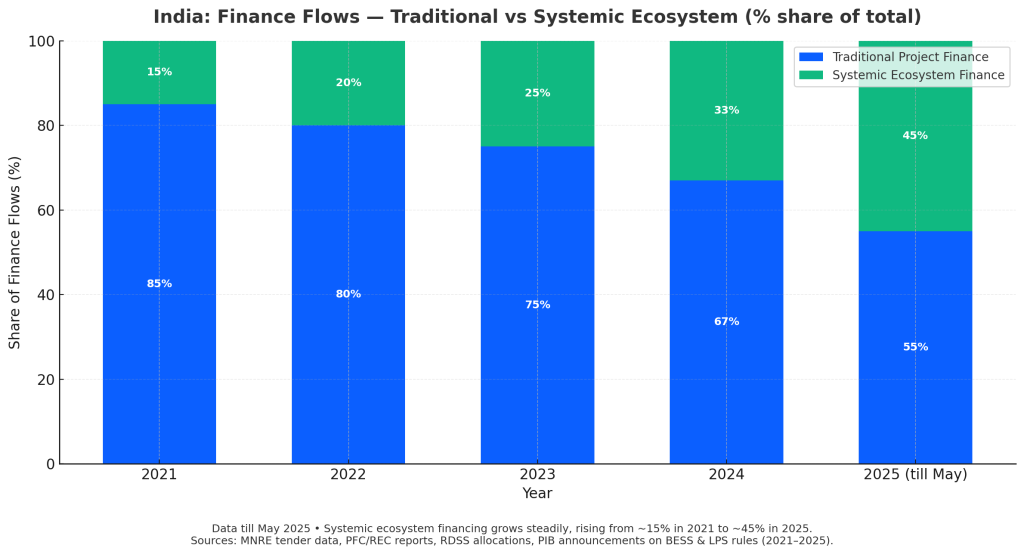
Stacked bar chart comparing traditional project finance vs systemic ecosystem finance flows.It shows how systemic ecosystem financing grew from ~15% of flows in 2021 to ~45% by May 2025, based on trends from MNRE tenders, PFC/REC reports, RDSS allocations, and PIB announcements on BESS and LPS rules.
7. Action Agenda for Stakeholders
Policymakers
- Mandate five-year resilience plans for all utilities, with standard vulnerability metrics.
- Notify heatwaves as state-specific disasters to unlock State Disaster Response Funds.
- Define a national taxonomy for “resilience investments” to guide green capital.
DISCOM Executives
- Scale smart automation and metering - pilots are no longer enough.
- Integrate storage and V2G into procurement plans to manage peak demand.
- Build a climate-ready workforce, training engineers in predictive maintenance and data analytics.
Industry & Investors
- Launch resilience bonds or adaptation-linked loans that tie interest rates to measurable grid-hardening outcomes.
- Pursue PPP structures to de-risk high-capex projects such as urban microgrids.
Global precedents - Japan’s LPG-backed decentralized systems, New York’s mandated resilience filings - offer models that can be adapted to India’s policy and market context.
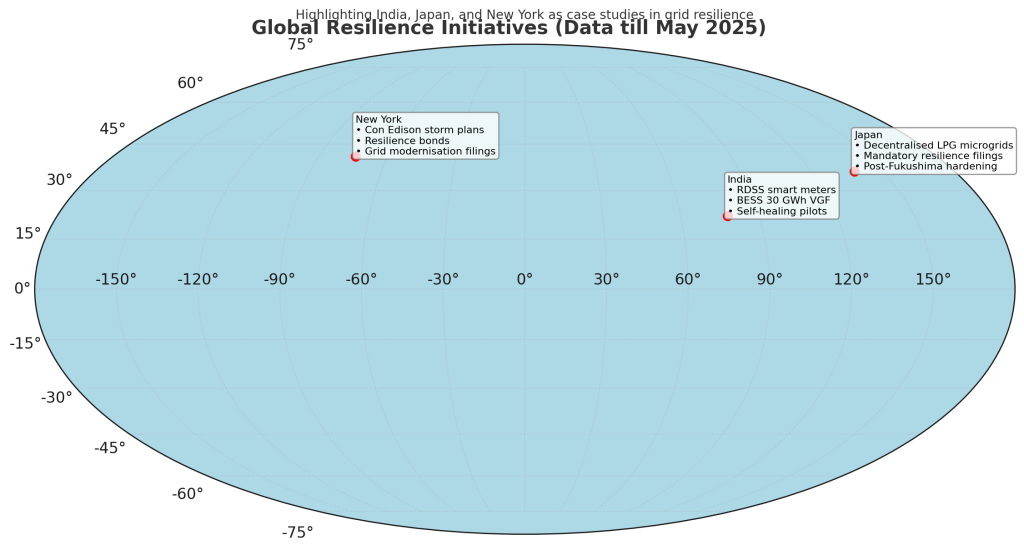
Global precedents provide blueprints for India’s next steps.
8. Outlook: From Power Sufficiency to Climate Security
India’s 2025 power milestone proves the nation can meet record demand.
But energy security in a climate-volatile world is about more than megawatts.
Distribution networks - the true last mile - must be hardened against heat, flood and cyclone impacts.
The call to action is clear:
- Move from reactive crisis management to proactive resilience planning.
- Align policy, finance and technology in one ecosystem.
- Invest today to avoid exponential costs tomorrow.
If these steps are taken, the India of the late 2020s can not only keep the lights on but set a global benchmark for how a rapidly growing economy climate-proofs its critical infrastructure.
Really valuable for sustainability governance. 🌱
Really appreciate that Namita!
Invaluable for tracking our emission trajectory. 📉
Fantastic analysis of carbon intensity
Appreciate your input! Much appreciated
This is exactly what we need for climate disclosure! This supports our renewable initiatives 📊
Really useful for climate action planning. 🌱
Appreciate you reading! Really appreciate you engaging
Appreciate the focus on sustainable practices. 🌱
Thank you Anjali! 👍
Thanks Neeraj for the clear energy transition roadmap. 🗺️
Thank you for commenting
Thanks Neeraj for highlighting the renewable transition. ⚡
Appreciate you taking the time! Really appreciate it
Love the emphasis on clean technology
Thank you for being here! Great to hear
Great resource for climate leadership!
Great to hear! 🎉
Thanks for highlighting the climate imperative. 🌍
Love this Neeraj the emphasis on renewable energy growth. 🌞
Appreciate the focus on renewable integration. 🌱
Love this Neeraj, seeing this focus on climate solutions. ✨
Much appreciated Amit!
This is perfect for our environmental goals Neeraj
Appreciate it Vishal!