

The Energy Imperative: Why Dispatchable Renewables Matter in India
A Stress Test for India’s Power Grid
In August 2023, India’s power system faced one of its harshest tests in decades. Monsoon rains - critical for irrigation, hydropower, and cooling demand relief - were among the weakest in over a century. Reservoirs dropped, hydropower generation collapsed, and just as the water failed, demand for irrigation pumps and air conditioning spiked.
The result: a record-breaking peak demand of 244 GW. Coal plants bore the brunt, providing over two-thirds of electricity. Millions of households and industries stayed lit only because of coal’s fallback role.
But this dependence comes with costs. Coal is carbon-heavy, water-intensive, and subject to volatile imported fuel prices. For a country committed to 500 GW of non-fossil capacity by 2030, defaulting to coal whenever the grid falters is not sustainable.
India urgently needs something else: clean power sources that can be dispatched on demand - not just when the sun shines or the wind blows. That is where dispatchable renewables like biomass and hydro step in.
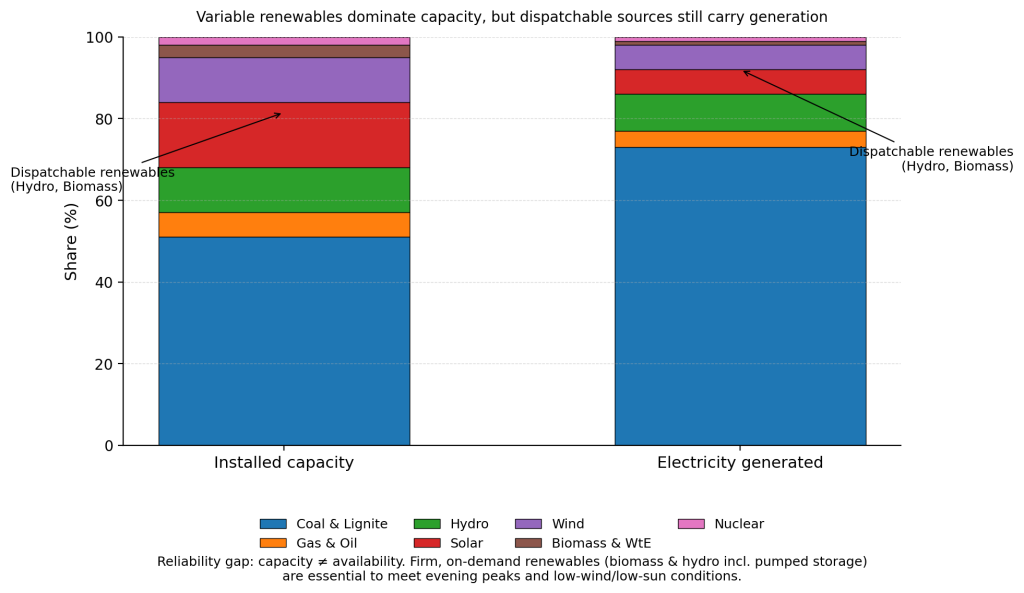
India’s energy transition is moving from capacity addition to reliability: dispatchable renewables are the missing link
The Grid’s Growing Pains
The last decade has seen extraordinary growth in solar and wind. Together, they now account for nearly half of India’s installed non-fossil capacity. Yet their strengths - low marginal cost, rapid scalability, and clean output - are also weaknesses.
- When the wind slows or the sun sets, output drops abruptly.
- Evening peaks (6–10 pm) are particularly difficult: solar vanishes just as demand surges.
- Coal and gas step in, ramping up rapidly to fill the gap.
Battery energy storage (BESS) is often touted as the solution. But while installations are scaling, most are short-duration (2–4 hours) and still expensive. Long-duration solutions like pumped storage hydropower (PSH) are promising but slow to build, with long permitting timelines.
India is therefore locked into a two-tiered system: intermittent renewables + coal backup. Breaking this cycle requires integrating dispatchable renewables that provide flexibility and sustainability.
What Do We Mean by “Dispatchable Renewables”?
“Dispatchable” means generation that can be turned on, off, or adjusted in real time to meet demand. Coal and gas fit this bill - but at high environmental cost.
Among renewables, dispatchability today comes mainly from:
- Biomass – steady baseload or co-firing with coal.
- Hydropower – large dams and pumped storage.
- Geothermal – not yet developed in India.
For India, biomass and hydro stand out as practical, domestic, and immediately scalable.
Biomass: Turning Waste into Power
India produces nearly 500 million tonnes of crop residue annually. Around one-quarter is burnt in fields - especially in Punjab, Haryana, and Uttar Pradesh - triggering toxic winter smog in Delhi and beyond.
Instead of choking cities, this residue can be feedstock for biomass power.
How Biomass Works
- Direct combustion: Residues burned in boilers to generate steam and drive turbines.
- Gasification: Biomass converted into syngas to fuel engines/turbines.
- Co-firing: Biomass pellets replace part of coal in existing power plants.
Benefits Beyond the Grid
- Steady supply: Predictable, unlike solar or wind.
- Farmer income: Additional revenue stream for crop residue.
- Cleaner air: Reduced stubble burning = lower PM2.5.
- Decentralized power: Rural plants cut transmission needs.
Hydro: The Grid’s “Mega-Battery”
Hydropower has long powered India, contributing ~12% of installed capacity. But its role is shifting from baseload to balancing resource.
Conventional Hydro
Large dams can provide round-the-clock baseload or ramp up for evening peaks. Their flexibility is unmatched.
Pumped Storage Hydropower (PSH)
Acts like a giant battery:
- Daytime: Excess solar pumps water uphill.
- Night/peaks: Water released downhill, generating instant power.
India has identified over 100 GW of PSH potential, making it the backbone of long-duration storage.
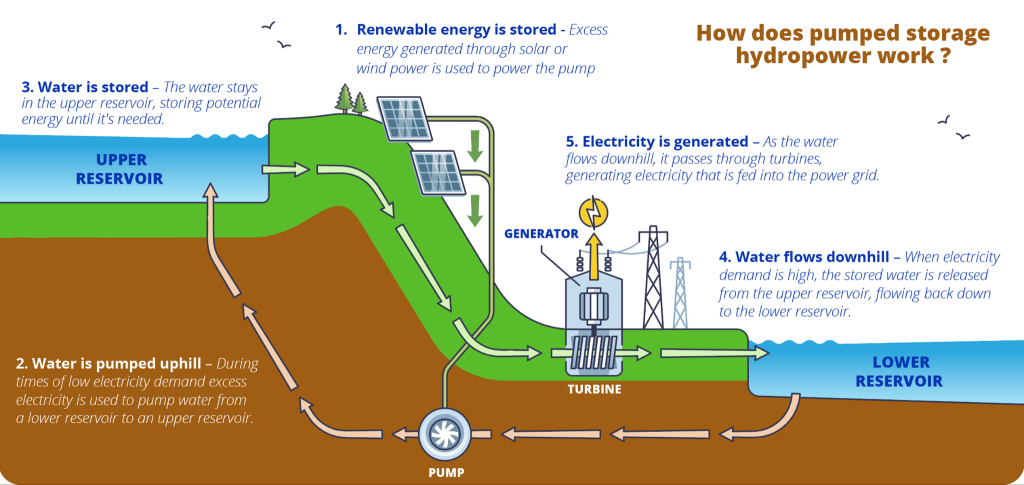
How pumped storage hydropower works: charging with solar excess, discharging on demand.
The Biomass–Hydro Synergy
The two complement each other:
- Biomass = steady baseload.
- Hydro = flexible peaker.
Together, they form a firm, dispatchable renewable portfolio, reducing coal dependence.
Real-World Blueprints
NTPC’s Biomass Co-firing Initiative
By mid-2023, ~47 coal plants across India were co-firing 5% biomass pellets. This absorbed millions of tonnes of residue, cut CO₂, and eased stubble burning.
Hosahalli Village, Karnataka
Since 1997, a 20 kW biomass gasifier has powered Hosahalli - running lighting, pumps, and small industries. Modest but symbolic, it shows rural biomass potential.
Vena Energy’s FDRE Project
In 2023, Vena Energy signed India’s first FDRE PPA with SECI, combining solar, wind, and storage to deliver demand-following renewable power.
Additional India & Global Projects (as of 2023)
- India – Biomass Power & Cogeneration: Over 800 projects installed nationwide, totalling ~10,632 MW of biomass/cogeneration.
- India – Pumped Storage Plants: ~4.75 GW of PSP capacity installed; ~3.3 GW operational in pumping mode. The Sardar Sarovar PSP (~1,200 MW) is a flagship.
- Brazil – Biopower: In 2023, ~54 TWh from 637 projects, mainly sugarcane bagasse.
- China – Biomass Electricity: ~204 TWh in 2023, nearly a quarter of global total.
- Japan – Biomass: ~49 TWh, significant share of renewable mix.
These demonstrate that dispatchable renewables are not theoretical - they are already operating at scale.
Economics and Cost–Benefit
Biomass
- Costs: Collection, pelletization, transport.
- Benefits: Monetizes waste, boosts rural incomes, cuts pollution.
- IRR: Attractive with policy supports like Viability Gap Funding and assured offtake.
Hydro
- Costs: High upfront, long timelines, resettlement issues.
- Benefits: 40–60-year life, low O&M, rapid response.
- Economics: Once built, among the cheapest and most reliable renewables.
Hybrid Portfolios
Combining biomass and hydro reduces curtailment, lowers backup costs, and strengthens grid resilience.
Policy and Actionable Insights
- Shift from MW capacity to MW-hours of reliability. Reward ability to deliver power when needed.
- Support biomass aggregation chains. Build collection hubs, incentivize pelletization, ensure farmer payments.
- Accelerate pumped storage approvals. Cut today’s 7–9 year timelines.
- Encourage hybrid tenders. Expand SECI’s FDRE models.
- Invest in digital tools. AI-driven forecasting, smart dispatch, predictive analytics.
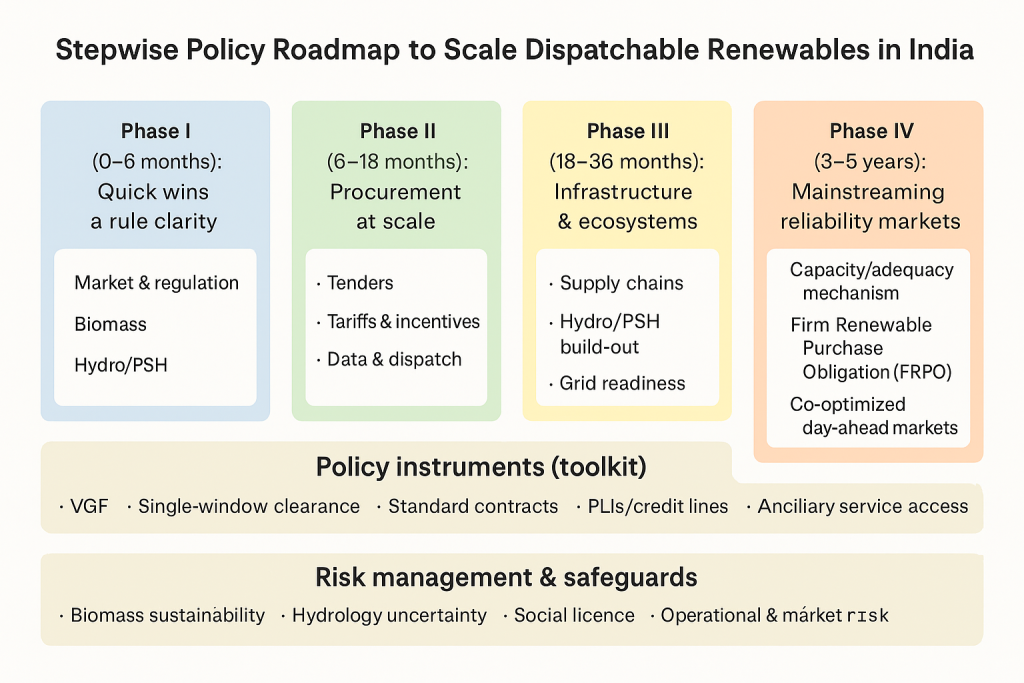
A stepwise policy roadmap for scaling dispatchable renewables.
A Vision for India’s Resilient Grid
The August 2023 supply crunch was more than a crisis - it was a wake-up call. Solar and wind alone cannot guarantee reliability. Dispatchable renewables must move centre stage.
By harnessing crop residues and rivers, India can:
- Cut coal dependence.
- Reduce emissions and improve air quality.
- Empower rural economies.
- Build a resilient, self-reliant grid.
Biomass and hydro are not stop-gaps. They are pillars of a clean energy future. Combined with storage, forecasting, and digital grids, they can anchor India’s 500 GW target.
Thanks Neeraj for highlighting the climate urgency