


A Historic Leap Towards a Green Grid
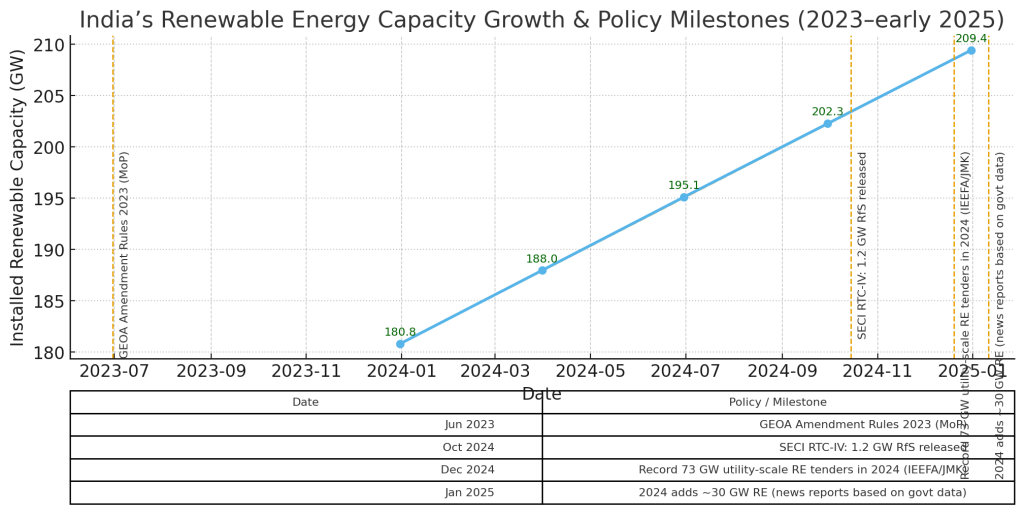
India is at a pivotal moment in its energy journey. Recent developments indicate a nation rapidly moving from building renewable assets to fully utilizing them to power industry, homes, and cities. Over the past few years, the country has consistently exceeded its renewable energy targets. In 2024, India commissioned nearly 30 GW of renewable energy, and a record 73 GW of utility-scale tenders were issued, surpassing annual targets and creating a robust pipeline of projects.
The focus now is less on “can we generate renewable energy?” and more on “how do we deliver it efficiently and reliably?” This is where green tariffs enter the scene - streamlining corporate procurement of clean energy while creating alignment between utilities, corporates, and policymakers.
Understanding Green Tariffs: Simplifying Corporate Renewable Procurement
A green tariff is a structured program offered by utilities that allows large commercial and industrial (C&I) consumers to purchase renewable electricity bundled with Renewable Energy Certificates (RECs). Unlike traditional electricity, the source of power is identifiable, the pricing predictable, and the environmental impact measurable.
Why It Matters for Corporates
Corporate adoption of renewable energy has often been complex. Traditional open access or direct PPAs involve navigating regulatory approvals, transmission logistics, and market pricing volatility. A green tariff simplifies this process, offering corporate buyers a utility-managed pathway to sustainability.
Think of it like choosing between a generic wholesale market for vegetables and signing a long-term contract with an organic farm. The produce is traceable, predictable, and supports a sustainable supply chain.
Key Models of Green Tariffs
- Sleeved PPA Model:
- Utility acts as an intermediary between a renewable generator and corporate buyer.
- Corporate buyers avoid regulatory and technical complexities.
- Billing, transmission, and compliance are managed by the utility.
- Subscriber Model:
- Aggregates multiple corporate subscribers into one renewable project.
- Ideal for sharing large-scale generation among multiple businesses.
- Market-Based Rate Model:
- Electricity rates pegged to wholesale market prices.
- Sophisticated buyers can leverage market fluctuations while committing to green power.
Green tariffs complement open access and the Green Energy Open Access (GEOA) Rules, enabling utilities to offer structured, transparent options for corporate buyers and supporting the maturing energy market in India.
Impacts Across the Energy Value Chain
For DISCOMs: Transforming the Relationship with Corporate Consumers
India’s DISCOMs have historically faced financial challenges - loss-making operations, inefficient billing, and high debts. This made them hesitant to enter new PPAs, leaving significant renewable capacity stranded.
Green tariffs create a solution: connecting profitable corporate clients with renewable projects guarantees revenue for DISCOMs while retaining large consumers who might otherwise bypass them.
By acting as intermediaries through models like the sleeved PPA, DISCOMs transform from risk-bearers to service providers, stabilizing cash flows and ensuring project viability.
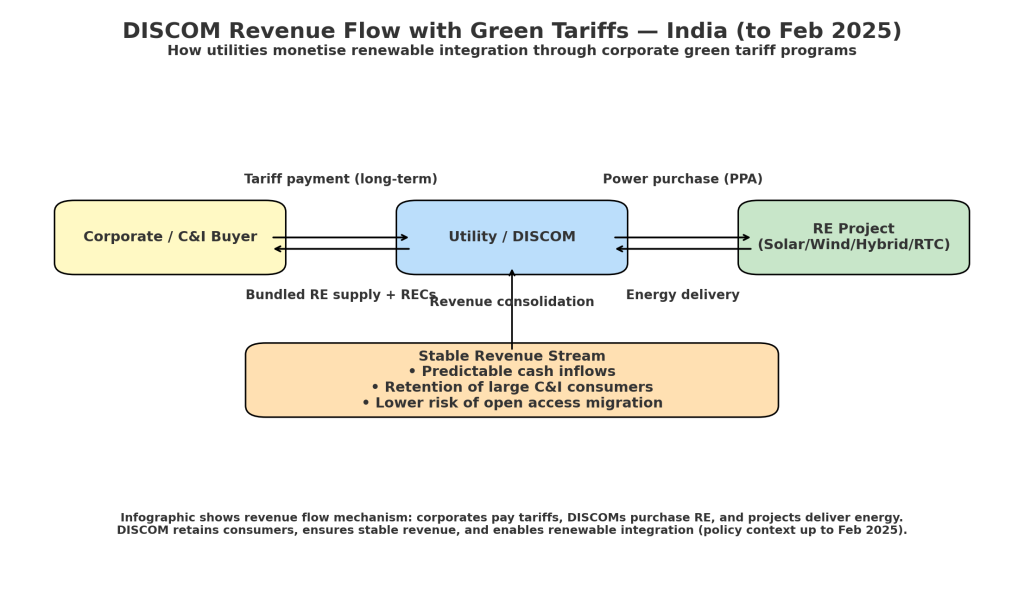
Corporate / C&I Buyer
- Large industrial or commercial consumers (e.g., textiles, cement, IT parks).
- They opt into a green tariff from their local DISCOM instead of navigating direct PPAs/open access on their own.
- Tariff payment (long-term) – Corporates pay a fixed or market-linked green tariff.
- Bundled RE supply + RECs – In return, they get renewable power supply plus Renewable Energy Certificates (RECs) or equivalent “green attributes.”
Utility / DISCOM
- DISCOM acts as the intermediary and service provider.
- It collects payments from corporates and uses them to buy renewable electricity from projects under
- Power purchase (PPA) – DISCOM signs long-term contracts with RE developers (solar, wind, hybrid, RTC).
- Energy delivery – RE projects supply electricity into the grid for onward delivery to corporates.
This dual role stabilises DISCOM revenues because:
- They retain high-value C&I consumers (who might otherwise bypass them via open access).
- They secure predictable, long-term cash flows (reducing tariff volatility and subsidy burdens).
RE Project / Generator
- Developers of solar, wind, hybrid, or RTC (renewable + storage) projects.
- They get assured demand from DISCOMs because corporates are tied to green tariffs.
- This improves bankability of projects and accelerates renewable deployment.
Stable Revenue Stream
The core benefit for DISCOMs:
- Predictable cash inflows from C&I consumers.
- Lower chance of losing profitable consumers to direct open access deals.
- Reduced financial risk, improving their creditworthiness.
- This financial stability supports further renewable integration.
For Corporate and Industrial Consumers: Predictability and Strategic Advantage
Beyond sustainability reporting, green tariffs offer tangible benefits:
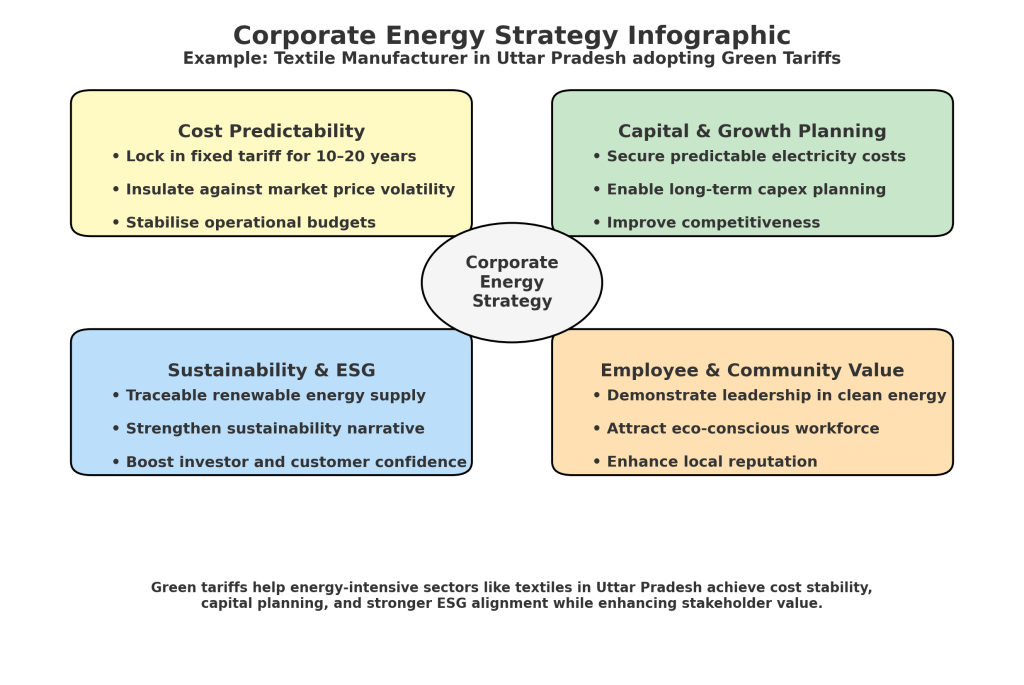
- Cost predictability: Corporates can lock in long-term rates, similar to switching from a variable to a fixed-rate loan, aiding in strategic planning.
- ESG and brand credibility: Traceable energy enables corporates to showcase their environmental commitment.
Example:
A textile manufacturer in Uttar Pradesh with volatile electricity costs can secure a fixed, competitive rate for 10–20 years. This enables predictable budgeting, capital expenditure planning, and a stronger sustainability narrative for employees, investors, and customers.
For the Power System: Building a Resilient Grid
Intermittency concerns for renewables are being addressed with Battery Energy Storage Systems (BESS). Storage costs have dropped dramatically, enabling round-the-clock (RTC) green power at competitive rates (₹4–₹5 per kWh).
A diversified energy mix - solar, wind, and hybrid projects - enhances grid stability. High solar generation aligns with peak summer loads, while wind and hybrid projects supply off-peak power. This creates a resilient, cost-efficient, and low-carbon energy system.
Strategic Opportunities and Key Risks
Opportunities
- Corporate Leaders:
- Use green tariffs as strategic tools for cost management and ESG leadership.
- Particularly useful for energy-intensive sectors like cement, steel, and textiles.
- Integrate tariffs into broader energy strategies, including efficiency measures and Time-of-Day (ToD) tariffs.
- Policymakers and Regulators:
- Standardize national frameworks to reduce regulatory friction.
- Accelerate renewable energy deployment through transparent, investor-friendly policies.
- Leverage successful GEOA rules as a model for scaling adoption.
Key Risks
- Cross-Subsidy Surcharge (CSS):
- Remains a barrier for industrial consumers.
- Reform or rationalization is essential for wider adoption.
- Policy Fragmentation:
- Mechanisms like Uniform Renewable Energy Tariff (URET) may slow agreements due to fluctuating auction prices.
- Supply Chain Vulnerabilities:
- Heavy reliance on imported critical minerals like lithium, cobalt, and nickel exposes India to global disruptions.
- Domestic manufacturing incentives, like PLI schemes, are vital for long-term security.
My Perspective: Actionable Insights
For Corporate Pioneers
- Move beyond compliance: proactively engage with DISCOMs to explore green tariff options.
- Integrate green tariffs into broader energy strategies, combining efficiency measures, smart meters, and ToD pricing.
- Treat green tariffs as a competitive advantage, reducing operational risk while meeting decarbonization goals.
For Policy Catalysts
- Reform CSS with phased, responsible approaches; consider Direct Benefit Transfers (DBT) to protect vulnerable consumers.
- Standardize procedures and costs for green tariffs nationally, ensuring regulatory clarity.
- Invest in infrastructure, including green energy transmission corridors and BESS, paying for their grid-stabilizing services.
Real-World Tariff Snapshot
| State | Industrial Tariff (₹/kWh) | Solar Tariff (₹/kWh) | Hybrid/RTC Tariff (₹/kWh) |
|---|---|---|---|
| Maharashtra | 10.88 | 2.50 | 4.00–5.00 |
| Delhi | 8.00–8.02 | 2.50 | 4.00–5.00 |
| Gujarat | 7.52 | 2.50 | 4.00–5.00 |
| Uttar Pradesh | 6.90–10.00 | 2.50 | 4.00–5.00 |
| Tamil Nadu | 6.00 | 2.50 | 4.00–5.00 |
Looking Ahead: From Policy to Progress
Green tariffs represent a market-based alignment of interests between utilities, corporates, and policymakers. They provide a transparent, predictable, and financially viable mechanism for corporate renewable adoption.
With falling costs for renewable energy and storage, and policy frameworks evolving to support them, corporate India is positioned to scale green energy adoption rapidly. The energy transition requires collective effort - government, industry, financiers, and citizens must act together.
This is India’s moment to cement a resilient, clean, and cost-efficient energy system that benefits all stakeholders. Green tariffs are a practical, actionable tool to achieve that vision.
This is exactly what sustainability professionals need Neeraj
Thanks Neeraj for highlighting the energy transition. ⚡
Thanks! 😊
This makes emission reporting clearer. ✨
Appreciate your perspective! Glad you found it helpful