

The Evening the Grid Held
It was an ordinary November evening on the surface, but inside the State Load Dispatch Centre (SLDC) of a northern Indian state, tension was high. A combination of household heating, evening cooking, festive lighting, and late-season irrigation loads had sent the demand curve spiking.
On the big screens, reserves were thinning rapidly. In the past, such conditions would have almost certainly led to feeder-level load shedding, plunging towns and villages into darkness. Yet this time, operators had more tools at their disposal.
With a few coordinated commands, utility-scale battery banks in Rajasthan began discharging into the grid. In Maharashtra, smart agricultural pumps deferred irrigation load to daylight hours. In Delhi, commercial buildings participating in pilot demand response (DR) programs reduced their air-conditioning and lighting demand.
The result was subtle but powerful: the load curve eased, the grid stabilized, and thousands of homes avoided blackouts. It was a small but telling glimpse of India’s evolving strategy - moving beyond a dependence on big power plants to a more flexible mix of batteries, demand response, and distributed energy resources (DERs).
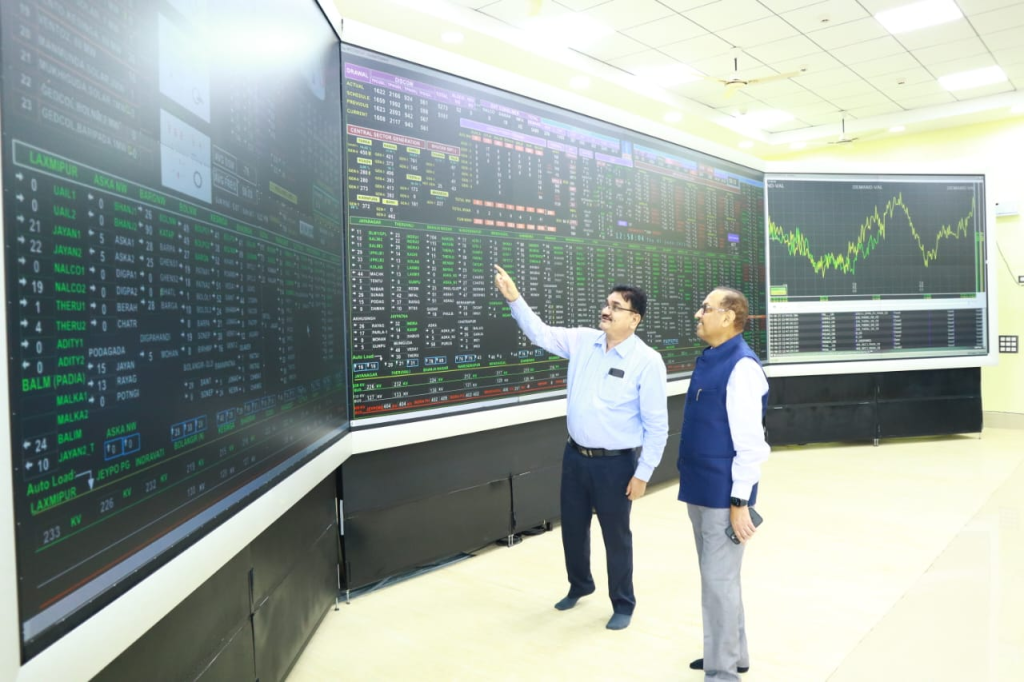
State Load Dispatch Centre coordinating load balancing during peak demand
The Problem: Demand Outpacing the System
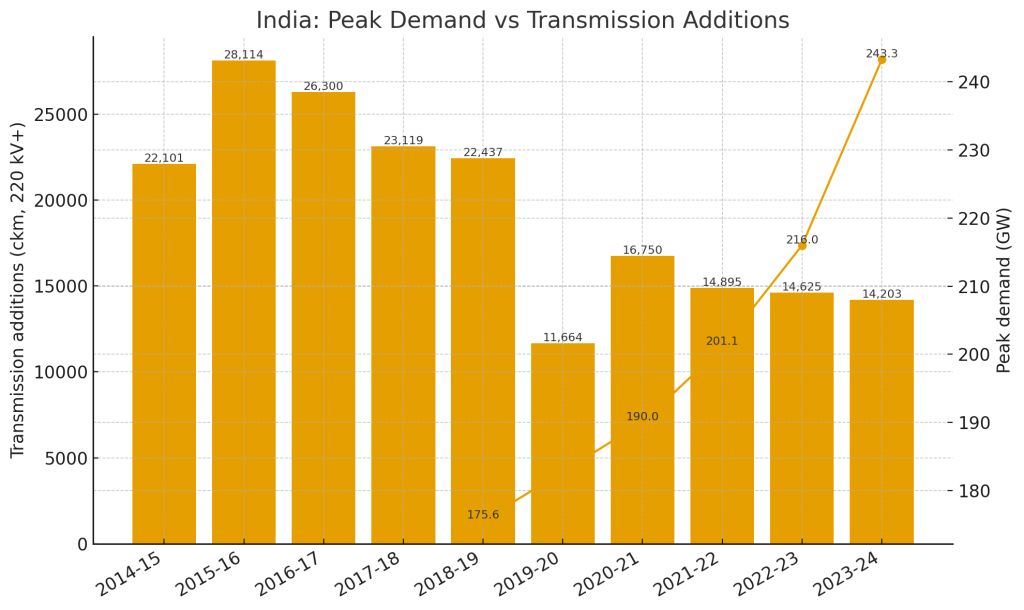
Caption: India’s peak demand in 2023 has surged faster than infrastructure additions.
India’s energy demand has been rising for decades, but 2023 set new records. The country’s peak demand touched 240 GW, reflecting rapid electrification, industrial growth, and changing consumption patterns.
Drivers of Demand Growth
- Industrial Expansion – New steel plants, data centers, and manufacturing hubs are energy-intensive and connect to the grid much faster than new supply projects can be built.
- Urbanization – Rapid construction of residential complexes, malls, and office parks is concentrating demand in urban areas.
- Electrification of Agriculture – Solar pump schemes and rural electrification are boosting load in rural belts.
- Climate Extremes – Longer summers and heatwaves are driving record demand for cooling.
The Infrastructure Lag
Unlike new industrial load, which can be connected within 12–24 months, transmission lines and substations often take 5–7 years to build, slowed by land acquisition, clearances, and technical approvals. This creates a timeline mismatch that leaves utilities scrambling.
The consequences are already visible:
- Evening peak shortages in states like Bihar, Jharkhand, and Uttar Pradesh.
- Stress on state DISCOM finances as they scramble for costly short-term power purchases.
- Regional constraints in high-growth states such as Gujarat, Maharashtra, and Karnataka.
Load shedding may no longer be the headline story every summer, but for many towns, villages, and industrial clusters, the problem is far from solved.
The Toolkit: India’s Flexible Resources
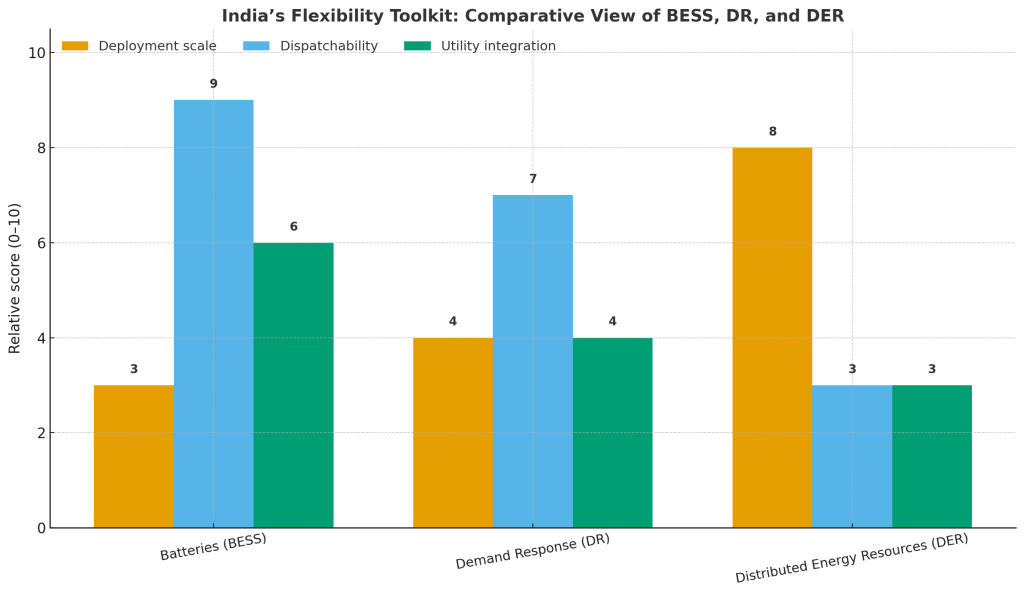
The emerging flexibility toolkit in India’s grid
Battery Energy Storage Systems (BESS)
India has set ambitious targets for 50 GW of storage by 2030, but as of November 2023, most projects remain in pilot or early deployment stages. Notable developments include:
- Rajasthan: SECI’s 500 MWh BESS tender attracted strong interest from developers.
- Andhra Pradesh & Kerala: State utilities piloted grid-scale storage for peak management.
- Delhi & Bengaluru (C&I Sector): Behind-the-meter battery deployments are growing, with tech parks and hospitals using storage to avoid outages and peak tariffs.
While still small in number, these projects are demonstrating that even a few hundred MWh of well-placed storage can provide stability during demand spikes.
Demand Response (DR)
India’s DR journey is nascent, but seeds are being planted:
- Delhi: BSES ran a pilot program using smart thermostats and voluntary curtailment incentives. Customers earned bill credits for reducing consumption during peak hours.
- Maharashtra: Agricultural load-shifting has been a quiet success. Farmers in solar feeder programs now irrigate during the day, significantly reducing evening grid stress.
- Gujarat: Industrial clusters are experimenting with automated DR, where motors and machinery ramp down briefly during system peaks.
The incentives are modest compared to global standards, but even small financial nudges are proving effective when combined with awareness campaigns.
Distributed Energy Resources (DERs)
DERs in India largely consist of:
- Rooftop solar – Over 10 GW installed, with growth driven by net-metering.
- Backup gensets – Diesel remains common in commercial and residential complexes, though hybridization with batteries and solar is increasing.
- Hybrid solar + storage systems – Pilots in Kerala and Tamil Nadu are showing resilience value for hospitals, schools, and community centers.
The challenge remains integration into DISCOM operations. While DERs reduce demand on paper, most are not yet aggregated into dispatchable resources for utilities.
Field Outcomes: Ground-Level Examples
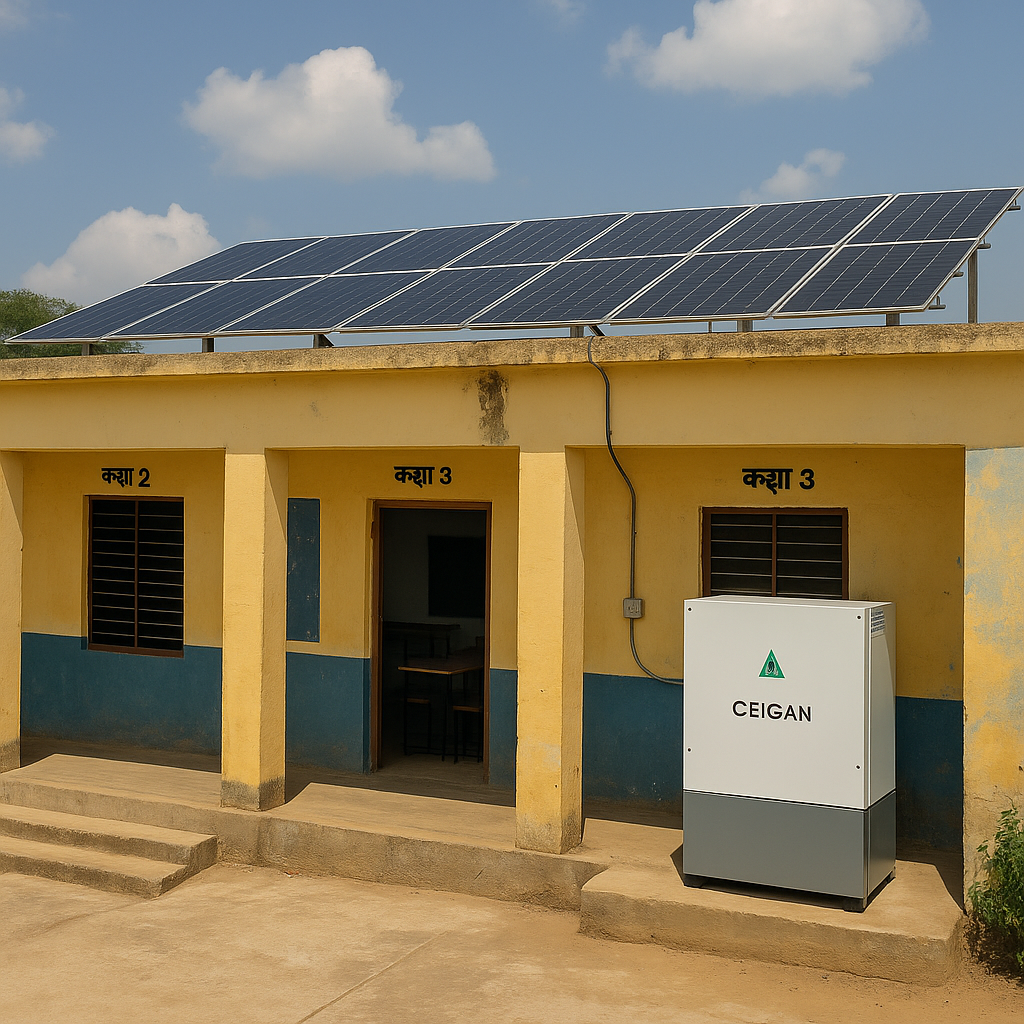
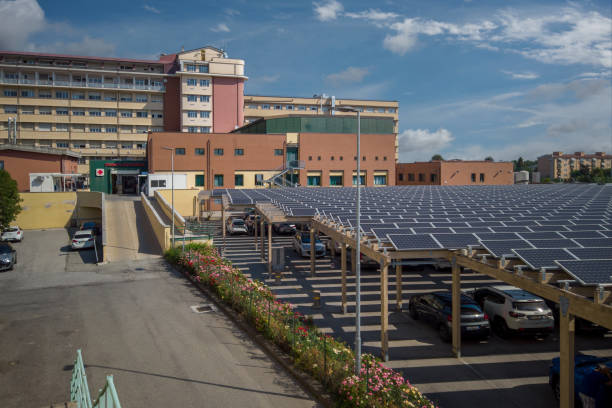
A solar + battery installation powering a school and a hospital during outages
Delhi’s Smart DR Pilot
In 2023, BSES launched a demand response pilot with a small group of residential and commercial customers. By adjusting air-conditioning, lighting, and other loads during peak hours, the pilot showed measurable reductions. Customers valued not only the bill credits but also the sense of contributing to grid stability.
Maharashtra’s Agricultural Load Shifting
Under the solar feeder program, thousands of irrigation pumps now operate in daytime hours using dedicated solar generation. This shift has two benefits:
- Farmers receive more reliable daytime power.
- Evening peak demand is reduced, easing stress on urban grids.
Kerala’s Community Storage for Healthcare
In Kochi, a hospital backed by solar + battery storage successfully rode through a monsoon outage. The project demonstrated how resilience, not just economics, is driving adoption in sensitive sectors.
Rajasthan’s BESS Pilots
Pilot battery projects supported Rajasthan’s grid during evening ramps in 2023. Even with limited capacity, the batteries helped prevent feeder-level load shedding in industrial zones.
These examples highlight a shift: flexibility measures are no longer abstract concepts. They’re delivering real relief on the ground, often in very human terms.
Challenges: Barriers to Scale
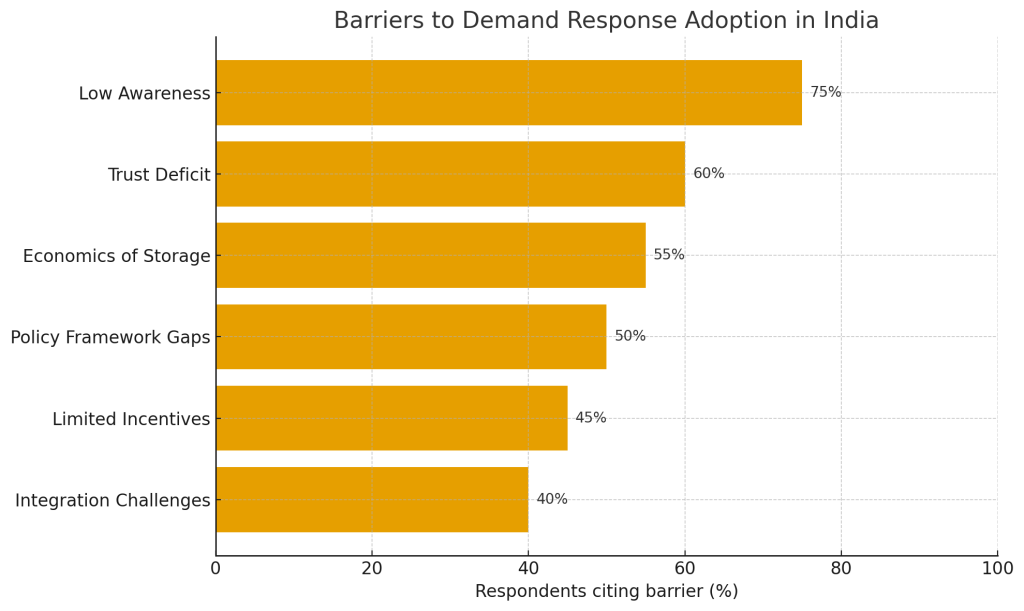
Common barriers for households and industries to join DR programs
Despite success stories, scale-up remains difficult.
- Low Awareness: Most households and even many industries are unaware of DR programs.
- Trust Deficit: Consumers hesitate to cede control to DISCOMs.
- Economics of Storage: Battery costs remain high despite falling global prices, limiting household adoption.
- Policy Frameworks: Unlike PJM in the U.S., India lacks structured markets for aggregators and DR participation.
For many Indian customers, the real value lies not in financial returns but in resilience - keeping lights on during outages, ensuring hospital operations, or maintaining production schedules. This mindset shapes adoption far more than tariff arbitrage.
Lessons Learned from the Field
1. Communication is Crucial
Pilots show that consumers are more likely to participate if they are informed early and clearly. Advance notifications, SMS alerts, and transparent billing incentives build confidence.
2. Equity Must Be Central
Load shedding disproportionately affects rural and low-income households. Programs that target these communities - like subsidized solar pumps or community batteries - deliver outsized benefits for both people and the grid.
3. Smarter Targeting Works
Instead of broad appeals, utilities are finding success by targeting specific feeders, industries, or clusters where flexible load can provide maximum benefit. This “precision DR” avoids unnecessary customer fatigue while delivering reliable results.
Regional Snapshots
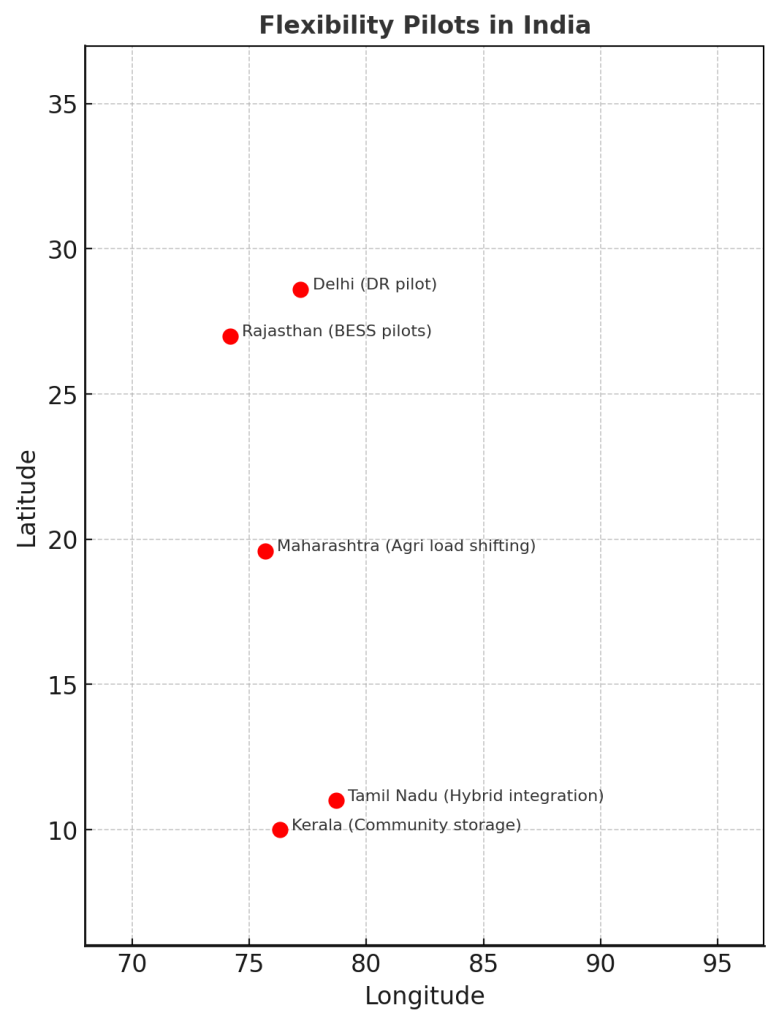
States leading flexibility pilots in India
- Delhi: DR pilots with smart thermostats.
- Maharashtra: Solar feeder agricultural load-shifting.
- Rajasthan: BESS pilots for evening peak shaving.
- Kerala: Community solar + battery for healthcare resilience.
- Tamil Nadu: Hybrid solar-wind-storage integration with industrial customers.
Each state is experimenting with different models, reflecting diverse demand profiles and policy priorities.
Closing Reflection: India’s Way Forward
India’s electricity sector is at a crossroads. Demand is rising at a pace unseen in decades, while traditional solutions like adding coal or building transmission take years. Load shedding, once thought of as a relic of the past, is resurfacing in pockets across the country.
But the experience of 2023 shows that India now has new levers:
- Batteries to shave peaks.
- Demand response to flatten curves.
- Distributed resources to provide resilience where it matters most.
These solutions aren’t silver bullets, and they require investment, design, and above all, consumer trust. But together, they offer breathing room - giving India’s power sector time to catch up with its infrastructure build-out.
Appreciate post! Really easy to follow 💭
Thank you Ashwin! 👍
Thanks Neeraj for sharing your expertise!
Thank you! Glad it resonated
Really enjoyed analysis
Really appreciate your thoughts
Super informative analysis Neeraj! Can’t wait to try this out
Extremely appreciated Divya! 📖
Great work on this Neeraj! 🎯
Fantastic work! Great insights shared 💚
Appreciate it Suresh!
Clear and concise
Thanks for sharing! Super useful
Neeraj, exactly what i was searching for!
Love the approach! Saving this for future use ✅
Thanks Arjun!
Thank you Neeraj for this approach! Really deep dive
Really appreciate that Abhishek!
Love the way you explained this, Neeraj
Great post
Love perspective! Can’t wait to try this out
Appreciate it Sanjay!
Really deep dive 🌟
Appreciate it Amit! 🔄
Neeraj, very readable! 👀
Thank you for your perspective! Really appreciate your kind words 🔍