

1. A Race Against Darkness
This year the main story ,that is in the centre of India's development, is the rural electrification drive under the Deendayal Upadhyaya Gram Jyoti Yojana (DDUGJY) .The target is very big : electrification of 18452 villages have to be completed within a short time period of 1000 days and the rollout has been brisk. Still, the real point isn’t in the dashboards. It’s about fairness, opportunity, and what steady light changes in everyday life. A bulb that stays on in a small home. A streetlight that makes a late walk safer in a remote hamlet. These small fixes add up for families and for the country. As the 2018 deadline nears, the focus is moving from simply hooking up lines to keeping them live: not just connections but continuity, not just counting poles but counting what people can do when the lights stay on.
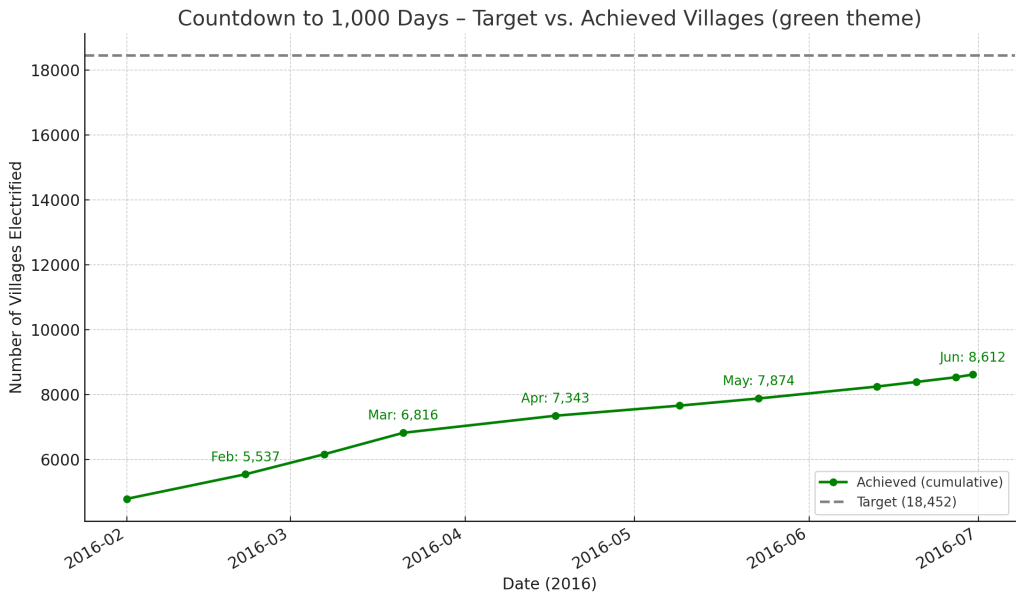
India’s ambitious rural electrification journey
2. The Foundation: Understanding DDUGJY
The Deendayal Upadhyaya Gram Jyoti Yojana (DDUGJY) was launched in 2014 ,as an extension of Rajiv Gandhi Grameen Vidyutikaran Yojana (RGGVY).The purpose of this scheme is to provide 24x7 , reliable and quality supply to each rural household.
The Three Pillars of DDUGJY
- Feeder Separation: Separation of agricultural feeders from domestic feeders so that households, schools and dispensaries could get round the clock supply and agricultural feeders as per the schedule.
- Village Electrification: Every remaining unelectrified village is to be connected, with free connections for Below Poverty Line (BPL) households.
- Infrastructure Strengthening: Erection of new lines, substations and metering systems to ensure round the clock reliable & quality supply and to reduce losses.
3. Progress So Far: The November 2016 Snapshot
As of November 2016, India’s mission-mode execution is showing results that would have seemed impossible a few years ago.
- 116,680 villages have been electrified — roughly 96% of the target.
- Over 246 lakh BPL households now have electricity connections — around 62% of the goal.
- Projects worth ₹42,000 crore have been sanctioned across 32 states and union territories.
These gains come from hard work and on‑the‑spot fixes. In Assam’s floodplains, crews load equipment onto boats to cross the rivers. In Jharkhand, poles go up steep hills with the help of tractors and bullock carts. What began as an infrastructure plan has become a countrywide push.
Transparency has been a standout feature. The GARV mobile app allows anyone to track electrification in real-time .GARV is the first in India’s energy governance.
4. The Financial Web: Why UDAY Matters
You can’t talk about rural electrification without UDAY (Ujwal DISCOM Assurance Yojana). Introduced in 2015, it was meant to help state‑run power distributors steady their finances and break the long cycle of debt
The two schemes are deeply intertwined. DDUGJY builds the grid; UDAY keeps it alive. A financially weak DISCOM can’t maintain infrastructure or ensure reliable supply.
By late 2016, over 86% of UDAY bonds had been issued, signaling that the financial turnaround is well underway. Yet, operational efficiency remains the next frontier.
5. Field Perspectives: Voices from the Ground
The best measure of progress isn’t in reports ,it’s in people’s stories.
In Udmari, Assam, for the first time in living memory, residents can charge their phones and run ceiling fans through the summer. “Our children can now study after sunset without a kerosene lamp,” says a local teacher.
In Kalahandi, Odisha, small shops stay open later, and students gather under public streetlights to read together , a small but profound shift in daily rhythm.
And in Bihar’s Damdama village, the local tailoring cooperative saw productivity rise by nearly 40% after switching from pedal machines to electric ones. Electrification isn’t just about convenience but it’s enabling micro-enterprises and small rural economies to flourish.
But the ground reality also carries a note of caution. Many newly electrified villages report intermittent supply and voltage drops. The wires have arrived, but the current sometimes hasn’t - is a reminder that the next phase must focus on quality, not just quantity.
Studies from the field indicate that households with electricity access see a 30–35% increase in non-farm business income. That’s not just a statistic but it’s a signal that power access is directly translating into local opportunity.
6. Igniting the Rural Economy
Electricity turns dormant potential into real productivity. All over India, small entrepreneurs are putting it to work.
- Flour mills that once ran on diesel now operate more cheaply on the grid.
- Irrigation pumps powered by electricity irrigation pumps are replacing diesel sets trimming farmer's cost.
- Welding, tailoring, and food-processing units are springing up near newly electrified zones.
7. The Reality Check: DISCOMs and Financial Sustainability
While the infrastructure is expanding, the business case for distributing rural power remains fragile. For most DISCOMs, rural supply is financially loss-making — a service driven by social commitment rather than profit.
The key challenge lies in AT&C (Aggregate Technical and Commercial) losses, which still hover between 20% and 60% across several states. In contrast, efficient states like Gujarat, Telangana and Andhra have less losses . This discrepancy shows the unevenness within ecosystem of Indian power sector.
Subsidy in tariffs and the delay in subsidy reimbursements compress the cash flow results deterioration in maintenance and reliability hit.
The DDUGJY’s long-term success depends on breaking this cycle through metering reforms, loss-reduction incentives, and better accountability in operations.
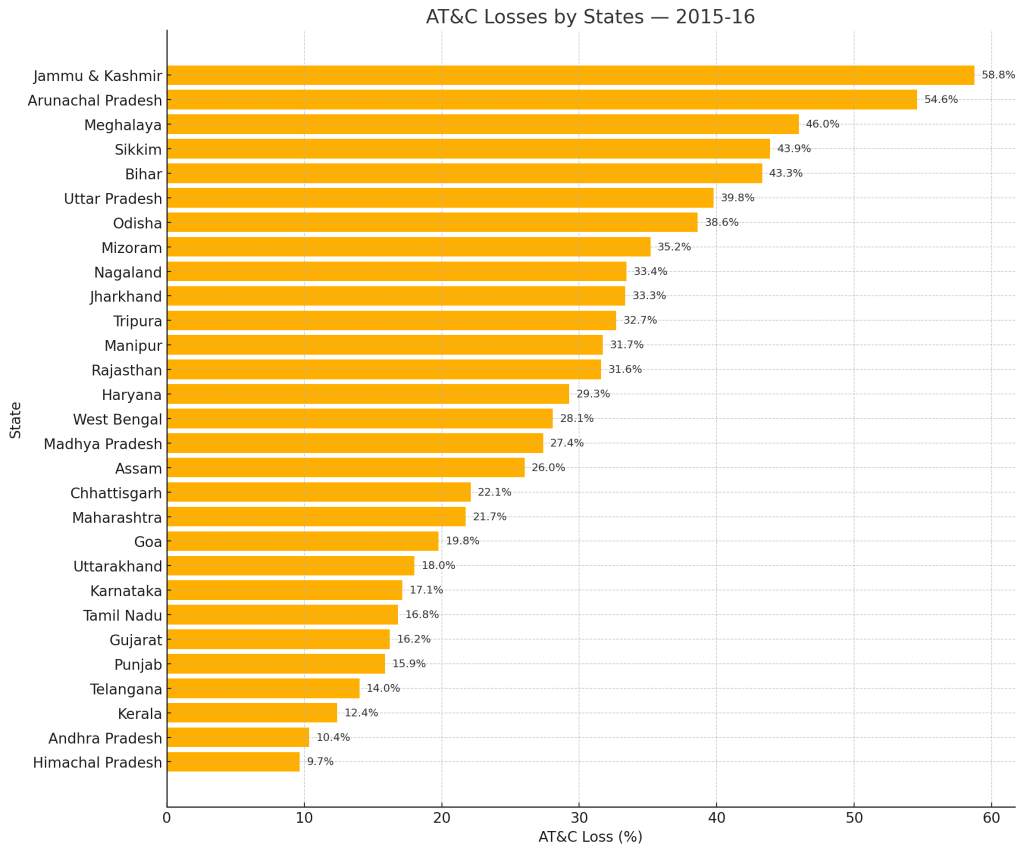
The uneven financial health of India’s power distributors.
8. Innovation Corner: Experimenting Beyond the Grid
When the grid is away ,a quieter shift takes place by flourishing and taking hold of off-grid renewable power and mini grid systems.
Across Uttar Pradesh, Bihar and Madhya Pradesh the entire hamlets are being powered through solar microgrids by the local businessmen. In many tribal's regions, they are also trying out biomass units and solar- diesel hybrids for practical tasks like pumping water and milling rice.
Yet, the private sector’s participation remains limited due to regulatory uncertainty. Investors hesitate when rules about future grid integration are unclear. A clear policy framework for off-grid operators , including buy-back guarantees and asset integration mechanisms could unlock private capital and innovation.
9. The Quality Question: Quantity Isn’t Enough
As the 1,000-day mission nears its halfway mark, the difference between being connected and being powered has become stark.
A village may be declared “electrified” once basic infrastructure exists, but the lived experience depends on hours of supply, voltage stability, and affordability.
Surveys across several states show that nearly 9 out of 10 dissatisfied consumers cite “unavailability” as their biggest issue. Connectivity without reliability, risks undermining the very goals of rural development like education, health, and enterprise all rely on steady power.
The next chapter must focus on service quality metrics, not just connection counts.
10. Opportunities on the Horizon
The rural electrification journey holds enormous opportunities ,both developmental and commercial.
- Smart metering and remote monitoring can support DISCOMs in loss reduction by increasing billing and can detect fault easier and faster.
- Rural energy entrepreneurship, from solar developing pivots to micro grids micro-grids can create many jobs and can help in managing load of utility.
- Decentralized renewables can create a hybrid model for resilience and scalability .it can support the main grid by complementing the load and balancing the grid.
By 2016, policy had already started heading this way. The Rural Electrification Corporation (REC) was funding new technologies, and several states were testing energy-service models designed around the realities of rural life.
11. Strategic Takeaways
- DDUGJY and UDAY are interdependent. The physical and financial reforms must move in sync for the results to endure.
- Quality of supply matters more than connections. Reliability and productive consumption drive true socio-economic gains.
- Private participation needs clear regulation. Hybrid and off-grid models can be powerful allies if policy confidence is built.
- Innovation should be mainstreamed. From smart meters to solar rooftops, decentralized tech should be part of the reform DNA.
- Measurement must evolve. Shift from “villages electrified” to “hours powered per consumer” as the benchmark.
12. Closing: Lighting the Road Ahead
The Deendayal Upadhyaya Gram Jyoti Yojana is one of India’s most ambitious energy missions and also one of its most human. The progress achieved in just two years demonstrates what coordinated action between central, state, and local agencies can achieve when aligned with purpose.
But the real measure of success won’t be the number of villages marked “electrified” on a dashboard. It will be whether that light stays on, whether it fuels livelihoods, education, and dignity for millions.
If the focus now shifts to reliability, financial stability, and hybrid innovation, rural electrification could well become India’s defining story of inclusive growth.
Comments are closed!