

Visit into the control room of a substation of any a state utility and you will find the same picture: a single-line diagrams pasted on the wall, a few blips of alarm, a landline phone ringing frequently, and a handful of SSO or engineers juggling more variables than a person reasonably should. On paper, India has edged towards surplus generation. In people’s homes, the story is not so neat. A transformer wheezes through the evening peak, a feeder trips, the bill that turns up at month-end looks nothing like actual use, and somewhere in the middle the distribution company (DISCOM) tries to make the books add up. This is the gap smart meters are meant to narrow—not with a miracle, but with routine, usable information.
Think of the last decade as the generation decade: add capacity, clean up old plants, get the big numbers right. The next stretch belongs to distribution: loss reduction, honest billing, faster fault response, and the slow, careful stitch-work that turns a network into a service. Smart meters are not the whole solution, but they are the front door to it. They change the conversation from “how much did we supply?” to “where did power actually go, when, and why?”
Why the old model frays
The old grid was built for predictability: centralised stations push, consumers quietly pull, and the lines in between behave themselves. That tidy sketch no longer holds. Industrial loads swing with production schedules; residential demand spikes on hot evenings; rural feeders run long and low. Add the early signs of distributed generation—rooftop solar here, a diesel-PV hybrid there—and yesterday’s control room is suddenly guessing more than it should.
Policy noticed. The Ujwal DISCOM Assurance Yojana (UDAY), launched in late 2015, set down a blunt truth: if you cannot see what is happening at the consumer end, you cannot run a modern distribution business. Hence the push for smart metering among higher-consumption users—those above roughly 200 units a month. This is where revenue sits, where losses hurt, and where accuracy has the most immediate payoff. No more estimated bills based on hunches, fewer fights at the cash counter, and a clearer trail from substation to street to front door.
But the meter itself is only the visible bit. The cleverness lives behind it: the network that brings readings back, the software that cleans and validates them, and the habit—because it is a habit—of acting on what the data says.
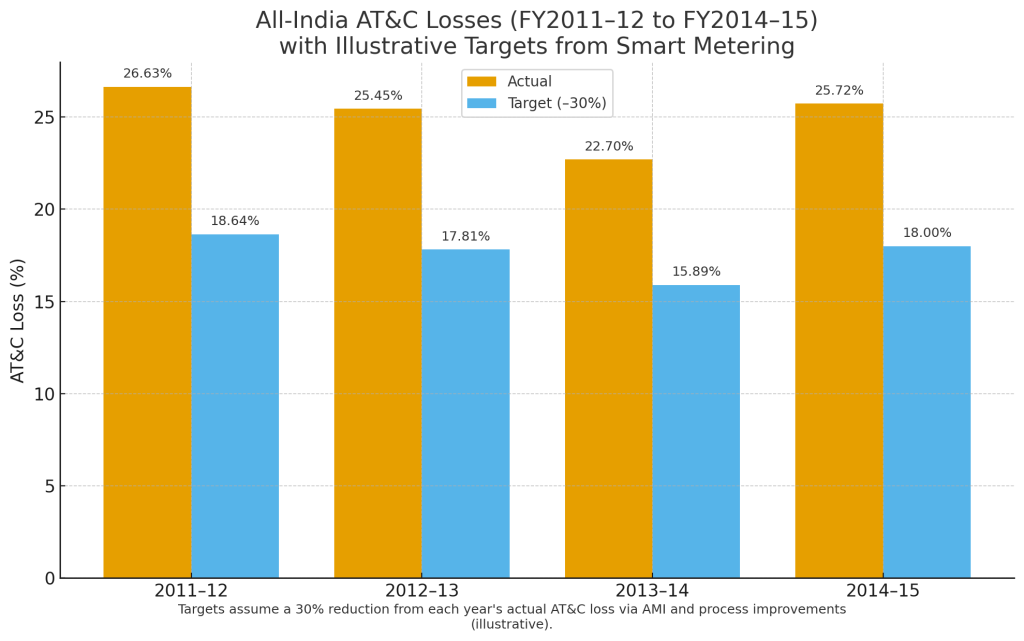
AT&C losses 2012–2015 on the left; adjacent bars showing target cuts with smart metering
What sits under the hood (and why it matters)
An Advanced Metering Infrastructure (AMI) has four moving parts:
- Smart meters that measures and records energy in real time at regular intervals, spot tamper events, and in many cases enable remote services.
- A communication layer—RF mesh, PLC, cellular, or a blend—that moves data reliably from home to head-end.
- A Head-End System (HES) that speaks “meter”, polls devices, handles firmware, and queues jobs.
- A Meter Data Management System (MDMS) that sanity-checks the numbers, reconciles gaps, and hands clean data to billing and analytics.
Put those together and mysteries become logs. A string of meters go dark on one side of town—likely a local fault, not a city-wide event. An odd set of spikes appears after midnight—worth a site visit. A transformer shows a peak shape that keeps nudging past its rating—time to reconductor or split the load. Losses stop being an amorphous 25% and break into addressable pieces.
There is a grown-up side to this newfound intelligence. Once you hold interval data on millions of consumers, you must guard it. Encryption cannot be an afterthought, nor can the mundane things—access controls, audit trails, separation of duties. For many utilities, these are new muscles. They will ache at first. Better now than later.
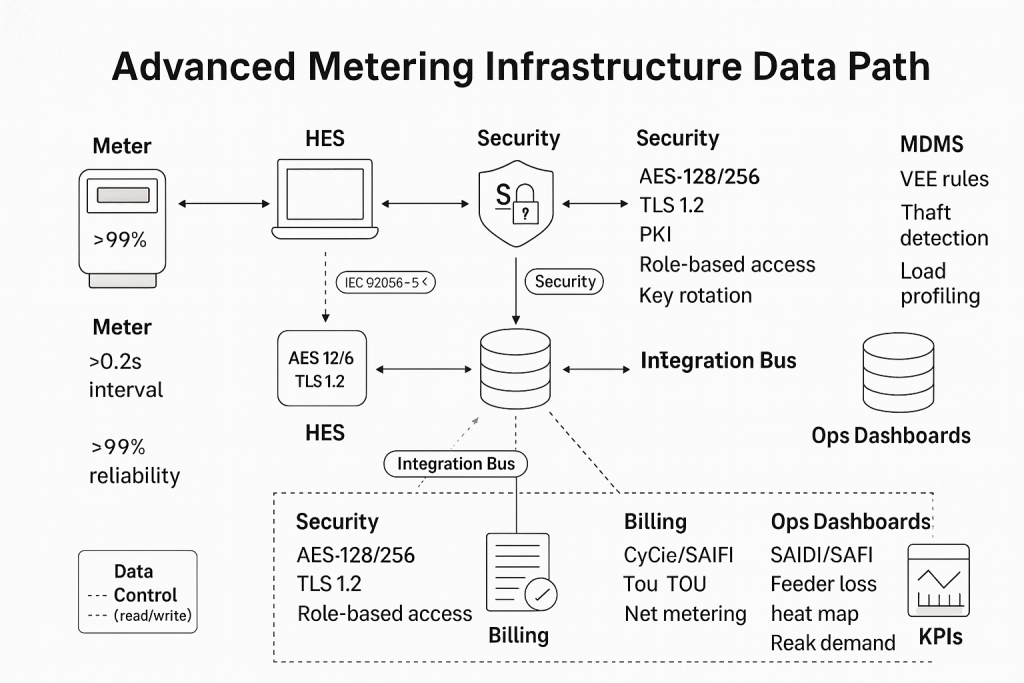
The “nervous system” of a modern distribution utility
Pilots: small labs, big lessons
India’s pilots do not speak with one voice—and that is the point. Different terrains, vendors, and communication choices reveal strengths and flaws quickly.
- HPSEB, Kala Amb (Himachal Pradesh) ~1,500 consumers
Focus: AMI and outage management.
Status: Devices are in and sending data. Peak-load control is not a slogan; it is now a chart on someone’s screen. - CESC, Mysore (Karnataka) ~24,500 consumers
Focus: AMI, outage management, peak-load management.
Status: Among the most advanced. Communications uptime became a religion; only after that did the team expand dashboards. - UGVCL, Naroda (Gujarat) ~22,000 consumers
Focus: AMI with power-quality features.
Status: Re-tendering slowed the train. The cost was not just time; it was the loss of team momentum. - PED, Puducherry ~34,000 consumers
Focus: AMI with a nod to storage integration.
Status: Tender awarded; early rollout underway; promising ground to explore how interval data and storage talk to each other.
A theme runs through all four: where the DISCOM has a technically confident team and a stable specification, progress quickens. Where procurement turns into a maze—unclear requirements, shifting goalposts—everything drags. Interoperability sits quietly in the corner like an uninvited referee. Without common, published protocols and data models, an excellent pilot becomes an island.
People, not just kit
You can import good meters by the truckload. You cannot import good habits. Three areas decide whether a smart metering programme feels like progress or just new boxes on shelves.
Project discipline. Rollout touches metering, IT, billing, operations, and stores. If one of those drifts, the whole chain wobbles. A meter swapped in the field but not commissioned in the HES is a data ghost. A billing cycle changed before MDMS rules settle will create avoidable chaos. Someone has to own the timeline and say “not yet” as often as “go”.
Data hygiene and cybersecurity. Validation, estimation, and editing rules must be written down, not whispered in hallways. Who can change a master record? Who can push firmware? Who signs off on key rotations? Boring questions, until the day they are not.
Analytics literacy. Flood a room with ten dashboards and nobody will use any of them. Start with two or three: read-success rate by feeder, top tamper alarms by subdivision, and a simple loss heat-map. Put them into the weekly routine. Once those stick, add the next layer.
The National Smart Grid Mission (NSGM), set up in 2015, has a chance to bring order to tendering and standards. If it can publish reference specs, promote shared services where scale helps (a state-level MDMS, for example), and nudge everyone towards a small set of interoperable choices, it will save the sector years.
What success actually looks like
A successful AMI programme does not look glamorous. It looks… orderly.
- Interval reads land when they should.
- Exceptions are flagged and someone owns them.
- Field teams act on alarms within a defined window.
- Estimated bills shrink to rare, justified cases.
- Disputes are settled with usage traces, not raised voices.
- Peak shapes inform investment: capacitor banks here, reconductoring there, a split transformer where a feeder keeps sweating.
Failure, oddly, looks busy: a big launch, a ribbon cut, a dashboard demo, and six months later the loss figure has barely budged. The difference is not the brand of meter. It is whether the organisation treats data as something to use, not just something to collect.
The money question (asked plainly)
Do smart meters “pay back”? It depends where you start. If your AT&C losses are north of a quarter, you do not need heroics. A modest cut—helped by better tamper detection, fewer manual reads, quicker restorations, and more accurate billing—adds up. The savings rarely arrive on Day 1. Communications must stabilise, the HES and MDMS need to stop choking on bad records, and teams have to shift from routine to exception-based work. That bedding-in period is not a flaw; it is the price of moving from guesswork to discipline.
Policy that helps (without smothering)
Set the direction; hold back from micromanaging the route. Targets for high-consumption segments? Yes. Baseline security requirements and core data models? Yes. Mandating a single communication medium for every terrain in the country? No. Encourage modular contracts that avoid vendor lock-in; support capacity-building; align financial restructuring with operational milestones. UDAY pointed the way on structure; NSGM can help on standards and knowledge-sharing.
A sane rollout recipe
- Fix the ledger first. Clean the customer database, link meters to transformers and feeders, reconcile with GIS. A dirty ledger will quietly sabotage everything else.
- Start where it hurts and pays. Prioritise high-use consumers on the worst-performing feeders. These are the places where visibility changes behaviour fastest.
- Make communications boring. Test in the field—dense city lanes, peri-urban sprawl, rural runs—and mix media if needed. Reliability beats elegance every day.
- Stabilise the data chain. HES → MDMS → billing needs a quiet period to bed down. Freeze unnecessary changes. Let validation rules mature before you add bells and whistles.
- Institutionalise response. Who picks up which alarm, within how long, and how is that tracked? Write it down. Measure it. Publish it internally.
- Copy the method, not just the kit. When one cluster shows real gains—losses down, disputes down, restoration times down—replicate the playbook.
The consumer’s eye view
Most people do not care what “MDMS” stands for. They care that the bill makes sense and that faults are fixed quickly. Smart meters, done properly, clean up both. A simple message on the bill (“your heaviest use is 6–9 pm on weekdays”) is not a gimmick; it is a small nudge that helps households shift a little demand and understand their pattern. If the DISCOM starts solving problems before the complaint is lodged—because the meter told them first—trust follows. Once that trust takes root, resistance to change (including remote connect/disconnect in clear cases) softens.
Why meters unlock the next chapter
Smart metering is a gate, not a destination. Once interval data is reliable, several doors open:
- Time-of-day tariffs can reflect system costs without swapping hardware each time the tariff order changes.
- Demand response stops being a theory: a factory shifts a process by an hour and gets paid to do it; a commercial building pre-cools before the peak.
- Distributed generation—small solar exports in particular—can be measured and settled without drama.
None of this happens overnight. Without smart metering, though, it does not happen at all.
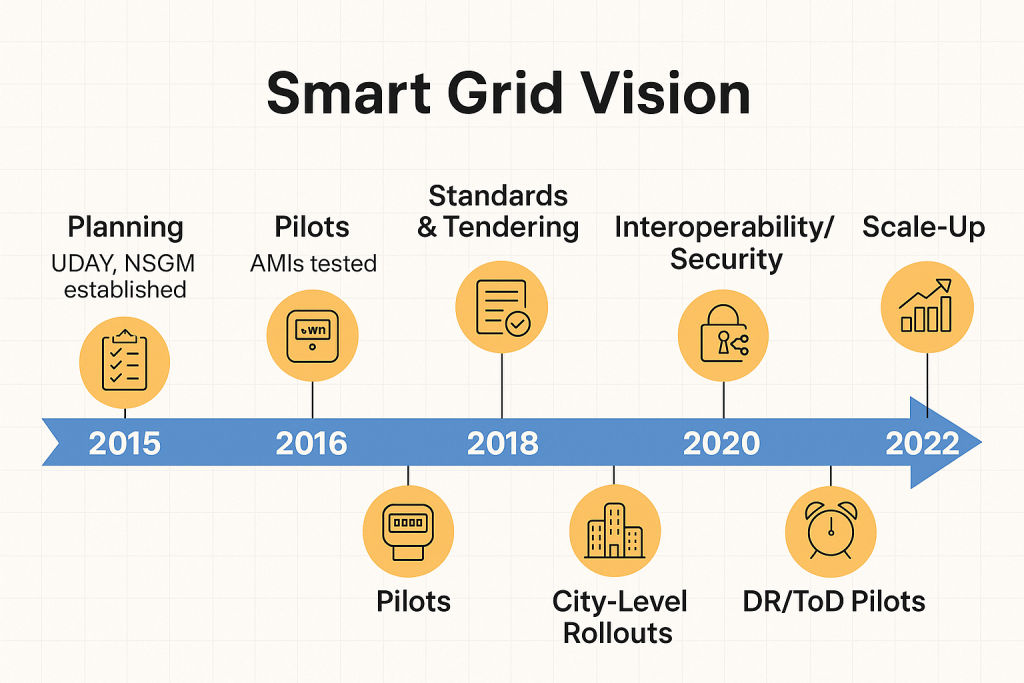
Conceptual roadmap showing progression (planning → pilots → standards/interoperability → scale-up).
Four field notes to carry forward
- Mysore: uptime first, dashboards later.
- Kala Amb: small pilots teach fast; peak management is real once the data shape is stable.
- Naroda: re-tendering costs momentum; stable specs are a gift to your future self.
- Puducherry: even early storage linkages sharpen thinking about peaks and economics.
These are not showcase trophies. They are learning spaces. Treat them that way and the second wave of rollouts will waste less time and money.
The quiet conclusion
There is no romance in a well-run AMI programme. It does not make headlines after the launch party. It just keeps showing up: reads arrive, alarms are handled, bills match usage, investments follow evidence. The glamour is in the outcome—losses turning into planned upgrades, complaints giving way to routine, engineers who sleep a little better because the system tells them the truth.
India does not need a grand gesture to fix distribution. It needs a thousand small, sound decisions, made with better information. Smart meters supply that information—patiently, relentlessly, day after day. That is their promise. It is also their challenge: the hardware will come; whether the habits follow is up to us.
Neeraj, well structured! 🔥
Extremely helpful! Much appreciated 🔨
This makes everything clearer
Incredibly useful Simran!